I came to the UFO topic a skeptic. Like most people, I assumed it was mostly prosaic explanations with a bit of disinformation mixed in, and I didn't expect to find anything real underneath. I was wrong. Whatever the ultimate origin turns out to be, I've found the UFO topic is a Trojan Horse for very real terrestrial issues. Releasing the UFO files is not enough. The flaws that allowed this to happen have to be fixed. This is Part 1 of a multipart series on those flaws, starting with whistleblowers and the retaliation they faced for coming forward.
- Part 1: Whistleblowers
- Part 2: Overclassification
- Part 3: Oversight
Transparency Note: After this book's content was finished, I began working pro bono with whistleblowers, whistleblower groups, and nonprofits in the UAP space. As a cybersecurity researcher, my interest was purely technical. I hoped to come across advanced malware worth writing about. My involvement should not be read as endorsing or dismissing anyone's claims.
The UFO Conspiracy Isn't a Theory
The UFO topic is often dismissed as a conspiracy theory. I used to call it one myself. But a conspiracy and a conspiracy theory are not the same thing.
- Conspiracy. A secret plan or agreement between two or more people to do something unlawful or harmful.
- Conspiracy theory. The belief that an event is the work of a secret plot by powerful groups, held even when other explanations are more probable.
After years of investigation, one of the few things in this topic that I can definitively say isn't a theory is the conspiracy itself. I've seen the retaliation firsthand. An op-ed never finished after a break-in. Cords cut. And account-takeover attempts conveniently timed just before they came forward for email addresses that are not public.
Scientific studies with predetermined conclusions meant to mislead the public and shape policy. Misappropriation of funds. Psychological operations aimed at the American public. All of it in writing, by the programs that carried it out and the directors who ran them.
Members of both parties on the secrets task force say they cannot get straight answers. Congressman Eric Burlison has said the Intelligence Community Inspector General found some of Grusch's allegations consistent with his account, that the programs weren't following the law, weren't reporting to Congress, and were overly compartmentalized. What it couldn't establish was what the programs were actually doing, because it "had a hard time getting these programs to even respond."
Damned If You Do
Whistleblowers should be supported, protected, and even actively encouraged, because history keeps proving they are sometimes the only warning a country gets. In 1934, Major General Smedley Butler, at his death the most decorated Marine in the country's history, testified under oath to Congress that a group of wealthy businessmen had tried to recruit him to lead a private army of veterans and overthrow President Roosevelt. He was mocked. The New York Times called the story a "gigantic hoax." Then the House committee that looked into it concluded otherwise, finding "there is no question that these attempts were discussed, were planned, and might have been placed in execution when and if the financial backers deemed it expedient." No one was ever prosecuted. A coup against an elected president was planned, the only reason we know is that one general refused to go along, and the country's first instinct was to doubt him and charge no one. If even he could be waved off, consider the calculation facing an ordinary employee deciding whether to come forward.
In December 2007, former CIA officer John Kiriakou became the first U.S. official to confirm on the record that the agency had waterboarded its prisoners, and to call it torture. He was right, as the Senate's own investigation would later document in detail. It did not protect him. Four years later the Justice Department charged him, and in 2012 he pleaded guilty to disclosing the identity of a covert officer. He served nearly two years in federal prison, and he remains the only person connected to the CIA's torture program to spend a day behind bars, punished not for the torture but for talking about it. Gina Haspel, who had run one of the black sites, was named CIA director in 2018. As Kiriakou wrote that year:
"While I went to prison for disclosing the torture program, Haspel is about to get a promotion despite her connection to it."
In a June 2024 complaint to the Equal Employment Opportunity Commission, a woman using the pseudonym Daniella Sparks alleged that the CIA's own Threat Management Unit and Office of General Counsel:
"repeatedly instructed myself and the other victims to make false statements to law enforcement and informed us that if we associated ourselves with CIA in any manner, we would be guilty of mishandling classified information."
The agency's own lawyers, in other words, allegedly warned assault victims that telling the police the truth would make them criminals.
Well before that complaint was filed, a CIA trainee named Rachel Cuda had already lived it. She did what a victim is supposed to do. She set out to report her assault. The FBI is federal and holds clearances. The CIA's own security office is even supposed to keep an FBI agent embedded for cases exactly like hers. By her account, the Agency would not give her that contact, and handed her the FBI's open, public phone number instead. Her lawsuit says she was told she could not reveal her affiliation with the CIA, or her attacker's, to any law enforcement without the Agency's advance permission. She says she was ordered not to discuss the assault with anyone, and warned that doing so "may violate federal law." When the CIA finally agreed she could give her attacker's name to local police, in December 2022 she took it to the FBI and the Fairfax County police, and three days later, by her account, its Office of General Counsel told her that she had mishandled classified information. She was not the only one. By the account of a 2025 study in the Yale Law & Policy Review, the Agency accused multiple victims of mishandling classified information for making the very reports it had authorized.
A new law was supposed to end the confusion, and it did not. Nine months after it passed, at an internal CIA town hall reported by CNN, the agency's chief operating officer, Maura Burns, admitted officers were still unsure how to report a crime without breaking the rules on classified information. "There's still some hesitation and reservation about that," she said. Overclassification is its own problem, and one I'll cover in Part 2.
"Dead Men Tell No Tales"
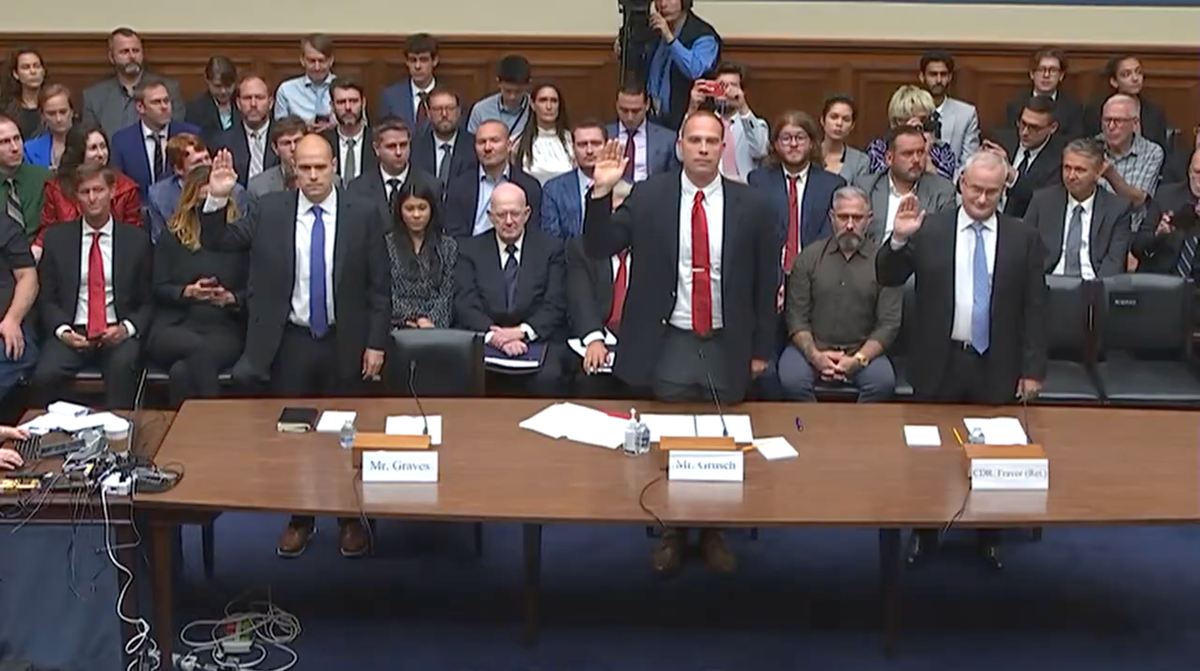
For as long as this subject has been around, so have rumors of intimidation, violence, and even murder. At the July 2023 House Oversight hearing, Representative Tim Burchett asked David Grusch point-blank whether he knew of anyone who had been murdered to protect the secret. Grusch said he had to be careful how he answered, that he had directed people with that knowledge to the appropriate authorities.
Lue Elizondo is best known publicly for AATIP, but his more consequential work was elsewhere, as Director of the National Programs Special Management Staff inside the Office of the Under Secretary of Defense for Intelligence. In the documentary The Age of Disclosure, he went past rumor. He argued the government has killed U.S. citizens without due process before. "It's not done very often," he said, "but we can."
That phrase, without due process, is worth pausing on, because it is the whole difference between a lawful killing and a murder. The Fifth Amendment says the government cannot deprive any person of life, liberty, or property without due process of law. Due process is what the state owes you before it can take those things, a charge, a hearing, a judge, a chance to defend yourself. Take it away and the killing has no legal justification, and a deliberate killing with no justification is typically considered murder. Nothing about a badge or a clearance changes that. An official who kills a citizen outside the law can be charged with murder like anyone else, even if that reckoning almost never comes.
The fear turns up even in accounts from people who were never public figures. Kirk McConnell spent thirty-seven years as a congressional staffer on the Senate Armed Services Committee and both intelligence committees, about as sober an institutionalist as this subject attracts. Asked what convinced him the claims were real, he pointed to no single revelation, only "multiple moments," among them "listening to a particular witness or source who was himself visibly shaking at the prospect of revealing" what he had been exposed to. "You go home," he said, "and you don't know what to do with yourself."
The government's own skeptic saw the same fear. Sean Kirkpatrick, the first director of AARO, noted his own investigators found a former Air Force officer visibly terrified, recounting how he had been read into a secret program called "Yankee Blue" and warned that if he ever spoke of it he could be "jailed or executed."
Part of why I did this investigation and wrote Lies Above is this. On podcasts, whistleblowers and former officials describing this retaliation can in some cases sound paranoid from the outside, or like they are embellishing to seem more credible. After meeting some of them firsthand, seeing results of break-ins, surveillance, and hearing other private accounts I no longer doubt that it is happening.
Everyone Agrees. Nothing Changes.
Protecting whistleblowers is a rare thing both parties actually agree on. And it still never gets done. I will not pretend to know the perfect fix, but looking at whistleblower advocacy groups, there seem to be some straightforward and common-sense suggestions.
The Project on Government Oversight, a nonpartisan watchdog that testified before the House task force now handling declassification and UAP, has laid out six steps for Congress:
- Give intelligence and military whistleblowers an independent place to report, with independent judges who can actually order relief when someone is punished for coming forward.
- Overturn Navy v. Egan, the 1988 decision that lets an agency strip a security clearance, and end a career, with almost no outside review.
- Hold the Pentagon to the same burden of proof as every civilian agency.
- Let a whistleblower take a retaliation claim to court, in front of a jury.
- Close the loophole that strips these protections from intelligence contractors.
- Give the watchdog offices meant to police all of this real independence, and leaders who cannot be fired for doing their job.
Here's one I would add myself. The one piece of this system that actually rewards a whistleblower is the False Claims Act, which gives a person who exposes fraud against the government a share of whatever gets recovered, somewhere between 15 and 30 percent. It works, but only if the money comes back. The government can decline the case, or move to dismiss it over the whistleblower's objection even when the fraud is real, and after the Supreme Court's 2023 ruling in Polansky that power is close to unreviewable.
If the government decides not to prosecute the case, it becomes the whistleblower's to carry, often after they have already lost their job for coming forward. The share actually rises, to between 25 and 30 percent, but the whistleblower now funds and runs the case alone. The costs involved for legal cases can run into six figures, especially if they have to actually go to court. The cost and stress alone are enough to dissuade most whistleblowers.
Topping it off, the facts you would have to put in a complaint are the same ones whistleblowers are frequently threatened with prosecution for disclosing. That is the box John Kiriakou was in. He went to prison for blowing the whistle. A decision that ends a fraud case, and someone's one shot at relief, should at least come with a stated reason they are allowed to appeal.
In the one national poll to put the question directly, 86 percent of Americans backed stronger legal protections for federal whistleblowers, including 78 percent of Republicans and 94 percent of Democrats. Despite this, it still does not get done. One of the six fixes, closing the contractor loophole, passed the Senate unanimously and then stalled in the House.
A Call for Change
The people in this piece are not abstractions to me. I have sat across from some of them, and the reforms that would have protected them are not stalled because anyone is against them. They are stalled because Congress does not feel enough pressure to move.
You can be that pressure. Find your representative and your two senators, and tell them to pass these protections, starting with the contractor fix already through the Senate and waiting in the House. It takes five minutes, and enough of them is the only thing that has ever moved a bill everyone claims to support.