
"If you are only skeptical, then no new ideas make it through to you. You never learn anything new. You become a crotchety old person convinced that nonsense is ruling the world. (There is, of course, much data to support you.) But every now and then, maybe once in a hundred cases, a new idea turns out to be on the mark, valid and wonderful. If you are too much in the habit of being skeptical about everything, you are going to miss or resent it, and either way you will be standing in the way of understanding and progress."
—Carl Sagan, "The Burden of Skepticism," Skeptical Inquirer, Vol. 12, Fall 1987.[1]
No one can be skeptical of everything all of the time. It takes far more work to disprove a conspiracy theory than it takes to invent one and set it loose. Add a subject you don't much care about, plus the plain fact that nobody has the time, and even a committed skeptic can end up believing whatever flatters their own worldview without ever checking the evidence.
It's Always Sunny in Philadelphia built an entire episode on exactly this. In the 2012 episode "Reynolds vs. Reynolds: The Cereal Defense," Mac defends creationism in a mock trial. He tells Dennis that "science is a liar sometimes," then springs the trap:[2]
Mac: Have you seen these fossil records? Have you pored through the data yourself? The numbers? The figures?
Dennis: Well, no. I'm... no.
Mac: So let me get this straight, Mr. Reynolds. You get your information from a book written by men you've never met, and you take their words as truth, based on a willingness to believe, a desire to accept, a leap of, dare I say it? Faith?
Dennis is right about evolution, and he still walks into it, because he has never pored through the records himself. For years, with no real interest and no real thought behind it, that is exactly what I had done with UAP. I am not alone in it.
The topic never runs short of confident debunks to borrow. Despite being a SETI Institute astronomer, Dr. Seth Shostak appears to have accepted one of the more public skeptical debunks. The Navy videos, he says, have explanations no more exotic than commercial aircraft or balloons.[3]
On one popular skeptic podcast, Serious Inquiries Only,[4] the host opened by admitting he had skipped the hearing entirely.
"I just haven't watched the congressional hearings," he said. "I haven't looked at really any of them. You know why? Because it's just not [expletive] aliens."
His guest, the astrophysicist Dr. Bryan Gillis, said the same. "I also haven't watched those congressional hearings because I'm with you," he said. "It's not aliens. So I can't comment on the specific reasons there." They then spent the episode confidently dismissing testimony they had just admitted they had not examined.
Even Sam Harris, someone whose work I have read and one of the self-described "Four Horsemen" of New Atheism, admitted he did roughly the same thing:
[...] what's his name, isn't it Mick West? [...] I have since seen some of those videos. I mean, now this is going back still at least a year, but some of those videos seem like fairly credible debunkings of some of the optical evidence. And I'm surprised we haven't seen more of that. Like there was a fairly credulous "60 Minutes" piece that came out around that time looking at some of that video and it was the very video that he was debunking on YouTube [...]. But again, it seemed like a fairly credible debunking. I haven't seen debunkings of his debunkings.
—Sam Harris, interviewed on the Lex Fridman Podcast #365, March 14, 2023.[5]
That same "60 Minutes" segment[6] Harris mentions, from May 2021, was the thing that finally made me take the topic seriously. So I did what he had not. I went and looked at the debunk everyone treated as the definitive one, expecting it to hold. It did not, and that disappointment is ultimately why I wrote Lies Above.
Take Mick West's analysis of the Nimitz "FLIR1" video, the one Harris found credible. West analyzed a weapons system he had never operated, working from the video alone, and confidently misstated how it tracks.[7] The "99.9" in the range field is not a distance the infrared pod measured. The forward-looking infrared pod receives its range from the jet's fire-control radar, and "99.9" is what the system shows when the target is past that range or the radar is being jammed.[8] The pilot who shot the video, Lt. Chad Underwood, has said the object was "offensively jamming" his radar, with the vertical-line indications aircrews are trained to read as electronic warfare.[9] West left all of that out, along with the corroborating sensors.[10] The Princeton's SPY-1 radar tracked the objects for days, an E-2 Hawkeye detected them, and the aviators watched them in broad daylight.
None of that makes the answer "aliens." The honest answer is "I don't know," and that is exactly why the underlying data should be released. In this case it may be gone. AARO's former deputy director says the recordings were shipped to the lab at Dahlgren, Virginia, and that two physical searches could not find them.[11]
It made me realize the skeptic community has a specific problem with this topic. On nearly everything else, we tell people to listen to the scientists and the experts in the field, because a non-expert loses the context that changes the meaning. Then on this one, we do the opposite. I liken it in my book to the antivaxxer movement. A non-expert shows you something that sounds frightening and is technically true, that formaldehyde is present in some vaccines, notes that formaldehyde is toxic at high doses, and lets you draw the scary conclusion on your own.[12] Left out is the context that your body makes formaldehyde as part of normal metabolism, and that an infant carries far more of it in their bloodstream at any given moment than a single shot delivers, on the order of ten to two hundred times more.[13]
Somehow the burden has landed on the whistleblowers to produce evidence of some of the most classified systems in the world, in public. Many of them have taken it to Congress. David Grusch personally brought many of the roughly forty firsthand witnesses he interviewed to the Intelligence Community Inspector General,[14] which found his reprisal complaint credible and urgent.[15] By that same reporting, those witnesses came with photographs and official documents, not testimony alone. It should not be on them. It is up to the public, and specifically the academic and skeptic communities, to pressure our politicians to make that data public, or at least available to the people charged with oversight.
That every public UFO program has downplayed and distorted the topic is its own book. You can read it in their own words. In 1953 the Robertson Panel[16] recommended that the government "debunk" flying saucers to cut public interest, and the program heads and science advisors who came after mostly carried that posture forward. All of it while decades of declassified files, and the government's own 2022 assessment,[17] place these objects in "restricted or sensitive airspace," over the sites we guard most closely. A demand they hand over evidence that sits in government vaults, often in buildings designed specifically to prevent you from sneaking anything out of it. To frame data as non-existent because it is classified, and leave it out because it hurts your argument is not skepticism, but dogma.
A large part of why I fell out of the skeptic movement is that YouTube, social media, and podcasts quietly swapped skepticism for debate. Winning replaced finding out. And on this topic the move I keep seeing is the strangest one of all, denying that evidence exists because the person making the claim cannot personally hand it to you. That distinction, between no evidence and classified evidence, is the whole ballgame, and it is why the strongest data here, the incidents caught by more than one sensor at once, and by our most advanced ones, matters so much. Before we get there, though, we need to be honest about what the word evidence even means.
What Is Evidence, Anyway?
Evidence is data in the context of a hypothesis. Ask someone to "show me the evidence" without naming the hypothesis it is supposed to bear on, and you will talk past each other forever, because you are being asked to prove a claim no one has stated out loud.
In my experience, "show me the data" almost always means "prove it was alien." That goalpost moves from person to person, and I will admit mine moved on me more than once, and continues to move. The Nimitz aviators never said alien. They said they had no idea what they saw,[18] and raised the non-human possibility only because of the sheer performance they described.
When I argue the data exists, or that the event probably happened close to how they reported it, most skeptics I talk to assume I am selling little green men. I think that reveals their own hidden premise, that the performance is impossible, so anything should it be real would have to be non-human in their mind.
For what it is worth, I do not much care whose Tic Tac it is. The oversight and overclassification failures are the real story. I joke that the only acceptable answer left is non-human intelligence, because the alternative is worse. If a terrestrial adversary has been doing this for decades, against the largest defense budget on earth, and we still cannot say whose it is or how it works, that is not a mystery. It is an admission of total failure.
Here is what surprised me most getting into this. There is not only evidence, there is a mountain of evidence that the data exists, spread across decades of declassified memos[19] and system specifications, including a Chris Mellon article in which he discusses some of our unclassified sensor systems.[20] The very thing that is repeated as "missing".
Which brings us back to Shermer, who reached for the base rate, a genuinely useful tool, and aimed it at the wrong question, misstating both what it measures and where it applies. So let us start with a quick 101 on what the base rate actually is, and why it matters that the DNI's own assessment found most of these objects "probably do represent physical objects," registered "across multiple sensors, to include radar, infrared, electro-optical, weapon seekers, and visual observation," some of them "detected near military facilities or by aircraft carrying the USG's most advanced sensor systems."[21]
Two Numbers, Two Questions
If you have heard me talk about cybersecurity, or read almost anything I have written, you know I cannot get far without reaching for the base rate. As someone who has managed multiple cybersecurity operations centers (SOCs), understanding the base rate is the difference between a huge backlog of security alerts that are primarily false positives, which my analysts naturally start to assume are benign and ignore, and a SOC that has the time to properly investigate the events it receives, where a majority of the alerts they face are likely to be a real intrusion.
Picture two in the morning in a security operations center. One tool flags one file on one laptop, somewhere in a company running tens of thousands of machines. Before I know a single technical detail, I already know the thing that matters most. On any given night, almost none of those machines are actually compromised. Real intrusions are rare. That rarity has a name. It is the base rate, the share of cases where the thing you are hunting is genuinely present, before you look at any specific piece of evidence.
Here is the example I like to use when teaching the subject.[22] Take a small environment that generates a million events in a day. Two real intrusions slip in, and each one produces about ten events a good rule should catch. That is twenty malicious events hiding in a million. Put another way, the odds that any single event in front of you belongs to a real attack are about one in fifty thousand. Your rule is not sorting a balanced pile. It is looking at a million events to find twenty.
Now add a new rule to that event stream. It has two different numbers, and they are easy to run together. The first is how often it catches a real attack. The second is how often it false-alarms on a benign event, its false-positive rate. Those are not the same number, and they act on two different piles.
Say this rule is perfect on the first count and catches all twenty real attacks, and its false-positive rate is one in a hundred thousand events, which sounds almost flawless.
But that rate hits the benign pile, and the benign pile is nearly a million events. One in a hundred thousand of a million, 1,000,000 × 1/100,000, is ten. So the queue fills from both piles at once, twenty real attacks caught from our 100% effective rule, plus ten benign events wrongly flagged, thirty in all, and twenty of the thirty are real, two in three. An analyst can work that.
Now loosen the false-positive rate in an attempt to reduce false negatives, to one in a thousand, a number that still sounds clean on a slide. All twenty real attacks are still caught. But the false alarms climb to 1,000,000 × 1/1,000, a thousand of them. Now the analyst is hunting twenty real attacks in a queue of 1,020, and only twenty of those 1,020 are real, about two percent. The rule never got worse at catching an attack, we just adjusted the rule to be more accepting of false positives in an effort to reduce false negatives. In the real world, no rule is ever 100% effective, which is why a SOC manager may do that, but 100% simplifies things for explanation.
Swap the intrusion for any rare thing and the detector for any test, and the shape does not change. A lone alert, sitting by itself, is weak. Not because the tool is bad, but because the thing it hunts is rare. This is what my whole field runs on. So how do you ever climb out of that hole?
You weigh the evidence. And there is a precise tool for doing exactly that, called the likelihood ratio.
The likelihood ratio asks one clean question about any piece of evidence. How much more likely am I to see this if the thing is real than if it is not? You take the chance of seeing this evidence when the thing is present and divide it by the chance of seeing it when the thing is absent. For a test or a detection rule, those two chances have plain names. The top is the detection rate, how often it fires on real cases. The bottom is the false-positive rate, how often it fires on benign ones. Divide the first by the second and you have the likelihood ratio, the weight of the evidence. A clue ten times more likely to show up when the threat is real than when it is not has a likelihood ratio of ten. When signal detection theory was first formalized in the early 1950s, its founders proved something strong[23] about this number. The theoretically perfect observer, the one no real system can beat, is simply the one that ranks evidence by the likelihood ratio.
Now lets connect it back to the base rate. You start with the prior odds, which is how you would bet before you look at any specific evidence. It is nothing more than the base rate written as odds. Odds are the gambler's way of stating a chance, X to Y, how often something is real versus how often it is not. One real event for every fifty thousand benign ones is odds of one to fifty thousand. Then you multiply by the likelihood ratio of what you observed. What comes out is the posterior odds, how you would bet after the evidence is in, the same situation updated for what you just saw.
posterior odds = prior odds × likelihood ratio
or
odds after viewing evidence = odds prior to viewing evidence x likelihood ratio
That two percent I counted a moment ago was not arbitrary. It falls straight out of this. The base rate was twenty real events in a million, odds of about one to fifty thousand, the fraction 1/50,000. The rule catches all twenty, so its detection rate is one, and it false-alarms on one benign event in a thousand, a false-positive rate of 0.001. Its likelihood ratio is one over 0.001, which is 1,000. Multiply the two.
posterior odds = 1/50,000 × 1,000 = 1/50
Odds of 1 to 50, one real alert in every 51, or about 2 percent. The base rate is stuck at 1/50,000. The only thing you can actually move is the likelihood ratio, the quality of the rule. Sharpen it so it false-alarms on just one benign event in a hundred thousand, a likelihood ratio of 100,000, and the very same formula pays out differently. From a fraction of a number, all the way to two.
posterior odds = 1/50,000 × 100,000 = 2
Odds of 2 to 1, two real in every three, about 67 percent. Same base rate both times. The base rate simply sets the floor.
And likelihood ratios stack. Get a second piece of evidence that is genuinely independent of the first and you multiply the two ratios together. Two independent pieces of evidence worth ten each are worth a hundred together, three are worth a thousand.
Remember that lone alert? On its own it was weak. The same alert sitting next to a firewall alert and an email security gateway alert, all on the same host, is a different animal, because those three sensors watch different layers, and would have to false-alarm at the very same moment by chance. Independent false alarms almost never line up. Real signals do, and the likelihood ratios multiply, so the odds climb fast. Nothing about that logic is particular to software. It runs the same through radar returns, an infrared camera, a human eye, or any sensors that fail independently.
Which brings us back to what this article is ultimately about. The base rate and the likelihood ratio are two different quantities answering two different questions.
How rare is this kind of thing? That is the base rate, and it sets only where you start.
How much weight should I give to this particular evidence? That is the likelihood ratio, and a low base rate does not touch it. This is not a matter of taste. The signal detection theory literature is explicit[24] that a test's capability to tell a real signal from noise does not change when the base rate changes. Just like in the cybersecurity domain, increasing the amount of false alarms does not increase the amount of true alarms.
Now you have both numbers, the base rate and the likelihood ratio, and a feel for when each one applies. So let us look at where Shermer applies them correctly, and where he does not.
The Right Tool
I typically avoid watching "debates," and I'm not sure what made me put the debate between Jesse Michels and Michael Shermer on in the background. Shermer founded Skeptic magazine and has spent decades as the person in the room who asks the deflating question. Usually he is right to ask it. Sitting down with Michels not long ago, he reached for the exact tool I just laid out.
Michels walks him through a stack of cases. Guards on nuclear sites, radar returns that physicists had reviewed, a launch crew reporting their missiles going offline. Shermer listens, and responds:
So you're picking the unusual anomalies that happened. This is what's called base rate neglect in Bayesian reasoning. What's the base rate of weird anomalies that happen at all nuclear sites everywhere in the world for the last fifty years? Does anybody keep track of this? Most nights, nothing happens. Nobody sees anything. 365 nights a year, maybe one night a year, somebody sees something weird. We write books about the weird stuff.[25]
He has a phrase he comes back to all afternoon. "You're picking the winners." Which is often true, and a lot of believers brush past. On its own terms, that objection is frequently correct.
Start with where you look. The New Jersey drone flap in the fall of 2024 unfolded over some of the most crowded airspace in the country, thick with airports and commercial drones, right as the news told everyone to go outside and look up. More watchers, more sky, more sightings. It is the Bermuda Triangle, more wrecks because more ships pass through, not because the water is cursed. That is the base rate doing honest, useful work. (Note: I do not agree with Shermer's characterization of the drone flap.)
Then there is his four-cells point. When someone says the "missing scientists" are being silenced, Shermer asks the right question. What is the base rate? How many people in that line of work die or vanish in a normal year, and how many outside it? To claim two things travel together, that working in that field raises your odds of a suspicious death, you do need the whole table, all four cells, not just the frightening one. He is right that without it, a pattern is just a pattern somebody liked.
None of this is bad faith. It is the base rate used precisely as designed. Ask how often the thing actually happens, set your prior, then update. So did Shermer apply it properly?
The Wrong Job
He did, at least in the two places I just gave him. The drone flap and the four cells are honest uses of the base rate. The same tool that priced those two claims correctly then gets pointed at every case in the stack, including the ones built from far more than a crowd and a scary anecdote.
This is where he misunderstands how to apply it, because the base rate answers a different question than the one he is asking. Go back to the two quantities from the security operations center, the base rate and the likelihood ratio.
The base rate sets the prior (remember, in gambling terms this means your estimation prior to seeing the evidence), where you start before you look, and it was the one stuck at one in fifty thousand. The likelihood ratio sets the weight of what you actually saw, and sharpening it was the only thing that took the chance the alert was real from 2% to 67%.
They answer different questions, and moving one does not move the other. Make the target ten times rarer and the prior drops tenfold. The sensors do not get worse at their job. Their power to tell a real object from a false alarm is a property of the instruments, not of how often real objects show up, and it does not change when the base rate changes.[26]
So here is what a low base rate actually does. It simply raises the standard of evidence. It does not lower the evidence. A rare target means you need stronger evidence to reach the same confidence, not that the evidence in front of you is suddenly worth less. That most nights nothing happens and once a year somebody sees something strange is a true and useful claim about the prior. It sets the bar high. It says nothing at all about whether one particular strange night is a false alarm, because that is the other quantity, and rarity never reached it.
When the evidence really is just one weak report, that high bar is the end of it. One grainy object, or one tired witness at the end of a shift, with nothing else to back it up. A single report like that, against a prior that low, is far more likely to be a false alarm than the real thing, and Shermer is right to set it aside. It is the same low base rate I walked through at the start, the one that left twenty real alerts adrift in a thousand false ones. If that were the whole case, "you're picking the winners" would be the whole answer.
It is not the whole case. The incidents that actually carry the argument are not one detector having a bad night. They are several at once that would need to fail in unrelated ways. A radar, an infrared camera, and a handful of trained people looking at the same object, in the same place, at the same time, in daylight. Those do not add. They multiply, the way I showed earlier, because independent false alarms almost never line up by chance. The low prior that sinks a lone witness sighting does not sink a stack of independent sensors all agreeing, because the weight on the other side of the scale is no longer one likelihood ratio. It is the product of each independent detection mechanism's likelihood ratio, and that climbs fast.
The base rate is the right tool, but is not being properly understood or applied. It is the prior odds before taking the evidence into account and nothing more, and the sharpest call you can make on the evidence is set by its likelihood ratio,[27] read off what the sensors can and cannot separate. Shermer spent a prior-setting tool against the sensitivity, the one number it has no grip on. Asking how rare something is sets your starting line. It does not measure whether these particular instruments can tell a real object from a glitch. That is a different question. It has a different answer.
There is a second mistake folded underneath the first, easier to miss. To ask what the base rate is and then answer it from the cases that survived every filter, the ones famous enough to argue about, is to read a rate off the winners. You cannot do that. And the surprising part is that you never needed to.
The Missing Bombers
Start with why you cannot. The famous cases are famous because they survived. Somebody saw something, thought it strange enough to report, the report was specific enough to log, the log was interesting enough to investigate, and the investigation failed to explain it away. Every case Michels put on the table cleared all of those filters, and as Blue Book's Special Report No. 14 identified, it was consistently the cases with more evidence that went unidentified, not less.[28] That is what put it on the table. So the pile is not a random draw from everything that crosses the sky. It is drawn from the far end, selected by the very outcome you are trying to measure. Count the rate of anything in a pile assembled that way and you have measured the pile, not the sky.
There is a cleaner version of the mistake from the Second World War. A statistician named Abraham Wald was asked where to add armor to bombers. The data was the damage on the aircraft coming home from raids, and it clustered on the fuselage and the wings, with almost none on the engines. The obvious move is to armor where the bullet holes are. Wald said the opposite. Armor the engines, the place with no holes. The bombers in front of him were the ones that made it back. The ones shot through the engines were missing from the data, because they went down. The damage he could see marked what a bomber could survive. The clean spots marked what it could not. His numbers were a record of survivors, and survivors lie about the population they came from.
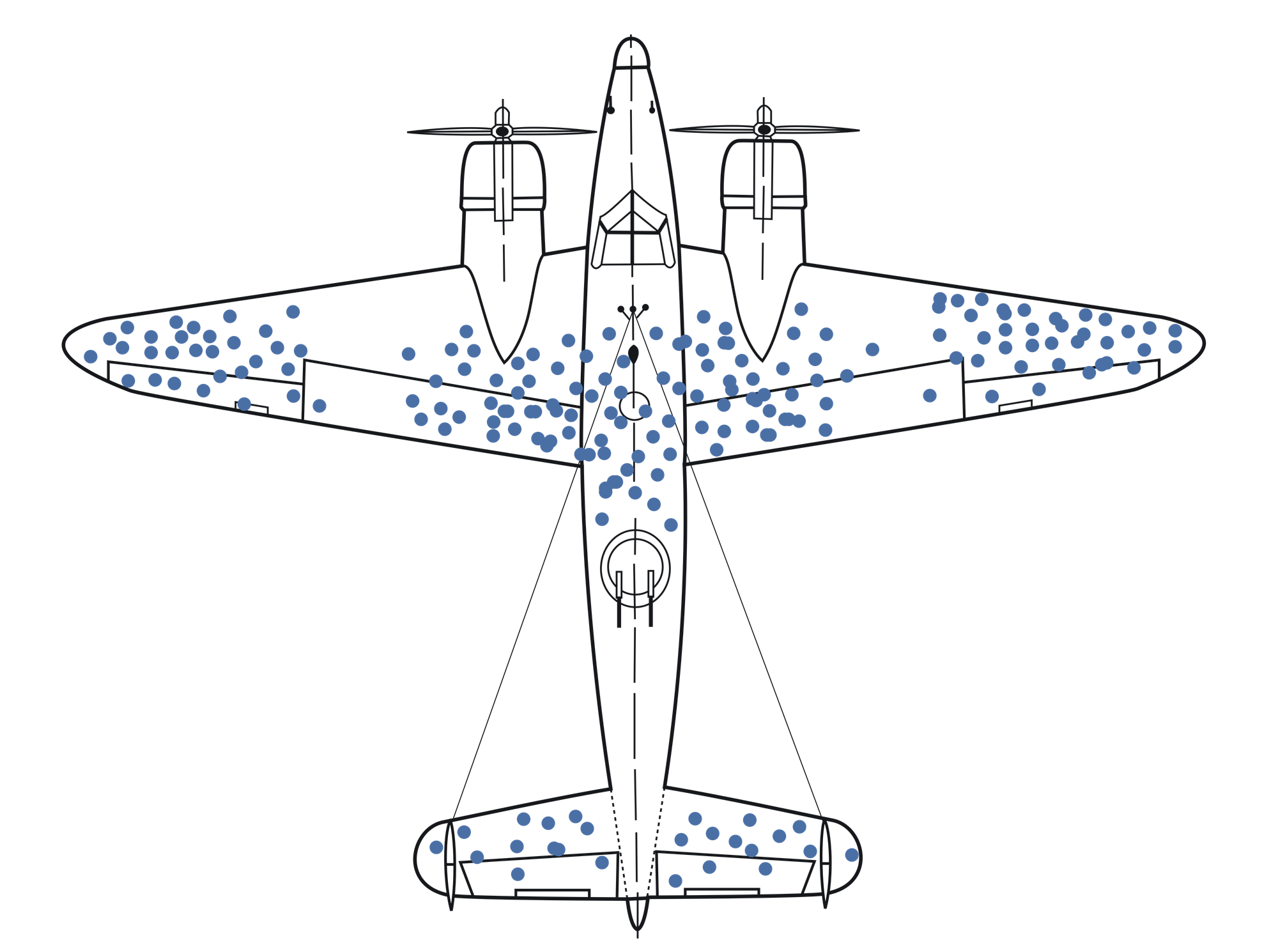
Many of the cases Jesse pointed to, are multisensor sightings like the Nimitz, and are famous for a reason. The corroborated evidence carries, should it exist, has a high likelihood ratio, and that strength is what gets remembered. Here is the catch. That same strength is the filter. A case earns its way into the pile by being strong enough to survive scrutiny, and that is the same reason the pile cannot hand you a rate. Ask what the base rate of genuine anomalies is and answer it from that stack, and you are armoring the bullet holes. The cases that drew a mundane explanation are gone from the pile. The sightings nobody bothered to report never entered it. Whatever number you read off the survivors is a fact about which cases survive, not about how often the real thing happens. And notice what that costs the cases themselves. Nothing. The strength of any one case is a fact about its own readings, and it holds at any base rate. Trusting every case and refusing to count the pile are the same move, not opposite ones. When people refer to bad faith skeptics as priests of a different kind, this is why.
This does not mean the true rate is secretly high. I want to be careful here, because it would be easy to bend survivorship into a cheap reversal, and it is not one. The stack cannot tell you the rate is high. It cannot tell you the rate is low. It in fact cannot tell you the rate at all. That cuts against the believer holding up the famous cases as proof the sky is busy exactly as hard as it cuts against the skeptic reading the same cases as proof it is empty. Neither one is holding the population. Both are holding the survivors.
Here is the part that took me a while to see. Weighing whether one particular case is real and estimating how often such things happen are two different jobs.[29] One is a detection, a decision about the observation in front of you. The other is a census, a count of how often the real thing turns up across every sighting there is, the explained and the unreported included.
Go back to the odds. The odds a specific case is real are the prior odds times the likelihood ratio, and only one of those two terms is the base rate. The base rate sets the prior, the place you start before you look at the evidence. The likelihood ratio is read off the case itself, off how much better a real object explains what these particular sensors recorded than a false alarm does. To weigh the case you need its likelihood ratio. You do not need to know how often the real thing has shown up across fifty years of nuclear sites, because that number lives in the prior odds (or the odds before you've seen the evidence), which only sets the bar. A low prior is a high bar. It is not a locked door.
A bar is something evidence can clear. When several independent instruments agree, and each would have to fail in its own unrelated way to be wrong, their likelihood ratios multiply, and the product climbs past the bar a low prior sets. The honest question was never "the base rate of weird anomalies." It was whether these readings are the kind a false alarm can produce.
One Case at a Time
Evidence and cases are often examined in isolation in bad faith. A drone would move like that. A balloon would look like that. If you hear hoofbeats, think horses. Each explanation is reasonable on its own, and the case seems to close itself. Do it to one sighting and you are being careful. Do it down the whole list, one case at a time, and every last one comes apart in your hands.
So Why Bother to Dig?
For twenty years J. Allen Hynek was the chief scientific consultant[30] to Project Blue Book, the Air Force program built to manage perception of the UFO topic. He arrived a skeptic who enjoyed the debunking, back when the rule was "it can't be, therefore it isn't."[31] He left as one of the phenomenon's most prominent voices, because he watched that reflex harden into policy. The Air Force, he wrote, had settled on a "party line theory."[31:1]
"So this explains, in my opinion, why Blue Book files are crammed with obvious IFO (Identifiable Flying Objects) reports and relatively few truly puzzling reports (which have been, and continue to be, reported through other channels). This also undoubtedly contributed to the adoption by the Air Force of the 'party line theory' that since so many UFO reports prove to have been due to misidentification of meteors, battery cases, and slag, etc., it follows that all reports have a similar origin if one merely digs deeper. (And, of course, the corollary: Since this is so, why bother to dig?)"
The whole trick is in the corollary. So many reports turn out to be balloons and meteors that you assume the rest are too, so why bother to dig? Decide up front that nothing is there, stop looking, and of course you find nothing.
The cost of that habit is not hypothetical. For decades, objects of unknown origin have crossed our most sensitive airspace, and the topic got waved off before anyone asked what they were. That is why no one had a process ready when drones swarmed New Jersey, an incursion never fully accounted for, whatever its origin.[32] Take "aliens" out of the story and what remains is a real security problem, one we let fester for decades behind a deliberate disinformation campaign.[33] The drones only showed how bad it had gotten, and the war in Ukraine has highlighted how costly it could have been. Somehow it has been 80 years of the same reports, and no process or single point of contact exists per NORAD's VanHerck.
"We're one year past Langley drone incursions and almost two years past the People's Republic of China (PRC) spy balloon. Why don't we have a single [point of contact] who is responsible for coordination across all organizations in the government to address this? Instead, everybody's pointing their fingers at each other saying it's not our responsibility."[34]
One honest limit, the same one from the last section. This only works if the cases are independent. If a single thing produced all of them, one instrument fault, one trick of the weather, one hoax repeated, then you do not have a hundred pieces of evidence. You have one, copied a hundred times. For example, hypothetically if we found out the "Tic Tac" was some weird weather phenomenon that exhibited the properties under the conditions we expect, it would deflate most if not all other sightings of that morphology.
That is why you cannot settle the question one case at a time. The answer lives only in the pattern across them, and isolation is built never to look there.
Who Made the Believers?
I stopped following any organized skeptic movement after I noticed it was filled with open misogyny[35] and transphobia.[36] But somewhere in the migration to YouTube and podcasts, the job of skepticism changed. It went from finding out the truth and demanding evidence even if it makes you uncomfortable (most often that discomfort was about religion, the evidence cutting against a believer's worldview) to a kind of debate where one side uses bad-faith tactics to defend their modern worldview. Sagan named the danger at the top of this piece. Be only skeptical, and nothing new ever reaches you.
Mick West could be right. Michael Shermer could be right. Every case in this piece, and every whistleblower, could have a boring answer nobody has found yet, and if it does, I want to know. My quarrel is not that their conclusions are wrong. It is that the method stopped being skeptical.
What actually seems to have moved many modern skeptics' positions is what looks to me like an organized effort, starting with To The Stars Academy, to gradually legitimize the topic, whatever you make of their intentions or whether they turned out to be right. It wasn't the data. Neil deGrasse Tyson spent years waving the subject off,[37] asking for a sharper photograph and a piece of the craft you could set on a table. Then, in July of 2026, he told an interviewer what finally changed his mind, and it was not a sensor record or a declassified file.
"I decided to jump into the ring — not jump in, put a foot into the ring more accurately — when I saw these high-ranking whistleblowers come forward in Congress, sworn testimony, whistleblowers, former intelligence officers, former military folk [...] no longer can you discount the testimony the way you might have done so before with the farmer in the back 40 [...] now when official government people are doing it, then all right, it's time to take it up a notch."
—Neil deGrasse Tyson, on The Diary of a CEO, July 9, 2026.[38]
What brought him to the table was the rank of the people already sitting at it. No different from Sam Harris at the opening of this piece, the honest admission that he took a debunk on faith because the right person handed it to him. Notable people, not looking at the data, deciding what is true by who is saying it.
And it is weak social proof even on its own terms, because the stature is not new. The first Director of the CIA went public with it. Vice Admiral Roscoe Hillenkoetter told the country that "high-ranking Air Force officers are soberly concerned" and accused the Air Force of hiding the facts behind secrecy and ridicule.[39] A three-star general who ran wartime air materiel wrote in 1947 that the discs were "real and not visionary."[40] In 1952 the Director of Air Force Intelligence stood at a press conference and described "credible observers of relatively incredible things."[41] As I point out in Lies Above, there are many more, from all over the world. The people testifying now are not the first of high rank to say the quiet part, and they are not the highest. The evidence did not change. The permission structure did.
Here is the part the movement has to sit with, and it is the one thing that truly sets this subject apart. Astrology, homeopathy, the haunted house, none of them come with a state apparatus built to muddy the water. This one does, and it is on the record. That is not a believer's fantasy. It is the paper trail.[42] Whatever is happening now on top of it stays, fairly, alleged. But a skeptic who prides himself on following the evidence has to reckon with a fact that holds on this subject and almost no other he works, that the evidence was deliberately shaped by people with the motive and the means to shape it.
This is where the reflexive dismissal defeats its own purpose. People can feel the difference between someone taking a good-faith hard look and someone dismissing something they have not reviewed. The research on why people reach for conspiracy theories frequently lands on the same ground, distrust and the sense of being shut out.[43] There is even a name for what rejection from above does to a claim. Michael Barkun called it stigmatized knowledge,[44] the way official dismissal can make an idea more attractive to anyone already inclined to distrust the institution doing the dismissing. Tell a curious person their question is stupid and forbidden and you have not closed the question. You have pushed on the thing people guard hardest,[45] their freedom to make up their own mind. So they go looking for someone who will take them seriously, and what they find, too often, is the worst of the field, the grifters and the fabulists, because those are the only ones left.
Seventy years of "why bother to dig" did not make the believers disappear. It helped manufacture them. If you actually want fewer wild claims about this subject, the answer is not one more debate, but a demand for transparency. It is to look at the data, say plainly what it does and does not show, and a return to science.
Ultimately, despite all of my efforts, I still truly don't know what is or isn't true, and realized that in nearly every case should you remove the stigma of aliens there's often a real underlying issue, such as an issue of overclassification and lack of oversight leading to the data being hidden and withheld, while the public has been actively misled that it doesn't exist.
Carl Sagan, "The Burden of Skepticism," Skeptical Inquirer 12, no. 1 (Fall 1987), https://skepticalinquirer.org/1987/10/the-burden-of-skepticism/. ↩︎
"Reynolds vs. Reynolds: The Cereal Defense," It's Always Sunny in Philadelphia, season 8, episode 2 (FX, October 11, 2012), clip, YouTube, https://www.youtube.com/watch?v=GiJXALBX3KM. ↩︎
Seth Shostak, in UFOs: Investigating the Unknown, "Secret Pentagon Program," National Geographic, April 9, 2023, YouTube, https://www.youtube.com/watch?v=Wt7Riw9jGlQ (~32:37). ↩︎
Thomas Smith, host, "Astrophysicist Wet Blankets All the Alien Talk," Serious Inquiries Only, episode 391, podcast audio, October 9, 2023, https://podcasts.apple.com/us/podcast/serious-inquiries-only/id803584715?i=1000630669361. ↩︎
Sam Harris, interview by Lex Fridman, Lex Fridman Podcast no. 365, March 14, 2023, video, https://www.youtube.com/watch?v=Qyrjgf-_Vdk (~3:40:00). ↩︎
Bill Whitaker, "UFOs Regularly Spotted in Restricted U.S. Airspace," 60 Minutes, CBS News, May 16, 2021, https://www.cbsnews.com/news/ufo-military-intelligence-60-minutes-2021-05-16/. ↩︎
Mick West, analysis of the FLIR1 ("Tic Tac") U.S. Navy video, YouTube, https://www.youtube.com/watch?v=U1di0XIa9RQ&t=263. ↩︎
"A1-F18AC-746-100: ATFLIR Principles of Operation" (U.S. Navy NATOPS document), archived January 20, 2025, https://web.archive.org/web/20250120021604/https://www.scribd.com/document/544867647/a1-f18ac-746-100-Atflir-Principles-of-Operation. ↩︎
Chad Underwood, interview with George Knapp, MysteryWire, 2019, archived August 3, 2021, https://web.archive.org/web/20210803090857/https://www.mysterywire.com/ufo/chad-underwood-tic-tac-pilot/. ↩︎
Tim McMillan, "The Pentagon's New UAP Report Is Seriously Flawed," The Debrief, 2021, https://thedebrief.org/the-pentagons-new-uap-report-is-seriously-flawed/. ↩︎
Tim Phillips, former AARO deputy director, interview on Mick West's podcast, YouTube, https://www.youtube.com/watch?v=wztninfsqu0&t=1680 (~28:00). ↩︎
U.S. Food and Drug Administration, "Common Ingredients in FDA-Approved Vaccines," https://www.fda.gov/vaccines-blood-biologics/safety-availability-biologics/common-ingredients-fda-approved-vaccines. ↩︎
"Vaccine Ingredients: Formaldehyde," Vaccine Education Center, Children's Hospital of Philadelphia, https://www.chop.edu/vaccine-education-center/vaccine-safety/vaccine-ingredients/formaldehyde. ↩︎
David Grusch, remarks on referring firsthand witnesses to the Intelligence Community Inspector General, YouTube, https://www.youtube.com/watch?v=R8TqBrrqL4U&t=875s. ↩︎
Leslie Kean and Ralph Blumenthal, "Intelligence Officials Say U.S. Has Retrieved Craft of Non-Human Origin," The Debrief, June 5, 2023, https://thedebrief.org/intelligence-officials-say-u-s-has-retrieved-non-human-craft/. ↩︎
Report of the Scientific Panel on Unidentified Flying Objects (Robertson Panel Report), January 1953, The Black Vault, https://documents.theblackvault.com/documents/ufos/robertsonpanelreport.pdf. ↩︎
Office of the Director of National Intelligence, 2022 Annual Report on Unidentified Aerial Phenomena (2023), https://www.dni.gov/files/ODNI/documents/assessments/Unclassified-2022-Annual-Report-UAP.pdf. ↩︎
"Navy Pilots Describe Their Encounters with UFOs," CBS News, May 17, 2022, https://www.cbsnews.com/news/tic-tac-ufo-sighting-uap-video-dave-fravor-alex-dietrich-navy-fighter-pilots-house-testimony/. ↩︎
Central Intelligence Agency, declassified UFO document, CIA FOIA Reading Room, https://www.cia.gov/readingroom/document/0000015340. ↩︎
Christopher Mellon, "Why Is the Air Force AWOL on the UAP Issue?," The Debrief, https://thedebrief.org/why-is-the-air-force-awol-on-the-uap-issue/. ↩︎
Office of the Director of National Intelligence, Preliminary Assessment: Unidentified Aerial Phenomena (June 25, 2021), https://www.dni.gov/files/ODNI/documents/assessments/Prelimary-Assessment-UAP-20210625.pdf. ↩︎
David Burkett, "Determining an Acceptable False Positive Rate for Your SOC," Magonia, https://www.magonia.io/research/determining-an-acceptable-false-positive-rate-for-your-soc/. ↩︎
W. W. Peterson, T. G. Birdsall, and W. C. Fox, "The Theory of Signal Detectability," 1954, Defense Technical Information Center, https://apps.dtic.mil/sti/tr/pdf/AD0016786.pdf. ↩︎
John A. Swets, Robyn M. Dawes, and John Monahan, "Psychological Science Can Improve Diagnostic Decisions," Psychological Science in the Public Interest 1, no. 1 (2000): 1–26, https://labs.la.utexas.edu/gilden/files/2016/04/PsychSciImprove.pdf. ↩︎
Michael Shermer, in Jesse Michels, "I Debated UFOs With America's Top Skeptic (It Got Ugly…)," American Alchemy, July 9, 2026, https://www.youtube.com/watch?v=8Rr_nE65KkI (~18:14). Quote transcribed from the video's captions. ↩︎
John T. Wixted and Gary L. Wells, "The Relationship Between Eyewitness Confidence and Identification Accuracy: A New Synthesis," Psychological Science in the Public Interest 18, no. 1 (2017): 10–65, https://journals.sagepub.com/doi/full/10.1177/1529100616686966. ↩︎
Laura Mickes, Heather D. Flowe, and John T. Wixted, "Receiver Operating Characteristic Analysis of Eyewitness Memory," Journal of Experimental Psychology: Applied 18, no. 4 (2012): 361–376, http://wixtedlab.ucsd.edu/publications/wixted2012/Mickes_Flowe_Wixted_2012.pdf. ↩︎
U.S. Air Force, Special Report No. 14: Analysis of Reports of Unidentified Aerial Objects, Project No. 10073 (May 5, 1955), 18 (PDF p. 26), 24 (PDF p. 32), https://www.cia.gov/readingroom/docs/CIA-RDP81R00560R000100060001-5.pdf. ↩︎
Abraham Wald, "Statistical Decision Functions," Annals of Mathematical Statistics 20, no. 2 (1949): 165–205, https://projecteuclid.org/journals/annals-of-mathematical-statistics/volume-20/issue-2/Statistical-Decision-Functions/10.1214/aoms/1177730030.full. ↩︎
"J. Allen Hynek and Project Blue Book," History.com, https://www.history.com/articles/j-allen-hynek-ufos-project-blue-book. ↩︎
J. Allen Hynek, The Hynek UFO Report (New York: Dell, 1977), Internet Archive, https://archive.org/details/TheHynekUFOReport. ↩︎ ↩︎
"Joint Statement from DHS, FBI, FAA, and DoD on Ongoing Response to Reported Drone Sightings," Federal Aviation Administration, December 17, 2024, https://www.faa.gov/newsroom/dhs-fbi-faa-dod-joint-statement-ongoing-response-reported-drone-sightings. ↩︎
Gerald K. Haines, "CIA's Role in the Study of UFOs, 1947–90," Studies in Intelligence 40, no. 5 (1997), Central Intelligence Agency, https://www.cia.gov/resources/csi/static/cia-role-study-UFOs.pdf. ↩︎
Haley Britzky, "Drones Continue to Buzz over US Bases. The Military Isn’t Sure Why or How to Stop Them," CNN, December 21, 2024, https://edition.cnn.com/2024/12/21/politics/drones-us-military-bases. ↩︎
Christopher Hitchens, "Why Women Aren't Funny," Vanity Fair, January 2007, https://www.vanityfair.com/culture/2007/01/hitchens200701. ↩︎
Richard Dawkins, "Will the Supreme Court Gender Case Victors Get the Apologies They Deserve?," The Poetry of Reality (Substack), April 18, 2025, https://richarddawkins.substack.com/p/will-the-supreme-court-gender-case. ↩︎
"Neil deGrasse Tyson Debunks UFO Myths," International Business Times UK, https://www.ibtimes.co.uk/neil-degrasse-tyson-debunks-ufo-myths-1804706. ↩︎
Neil deGrasse Tyson, interview on The Diary of a CEO with Steven Bartlett, July 9, 2026, https://www.youtube.com/watch?v=PHpsdIHpLUE; transcript at https://singjupost.com/diary-of-a-ceo-w-neil-degrasse-tyson-on-aliens-black-holes-ufos-transcript/. ↩︎
Vice Adm. Roscoe H. Hillenkoetter, quoted in "Air Force Order on 'Saucers' Cited," New York Times, February 28, 1960, 30, https://timesmachine.nytimes.com/timesmachine/1960/02/28/119097456.html. ↩︎
Lt. Gen. Nathan F. Twining, "AMC Opinion Concerning 'Flying Discs,'" memorandum, September 23, 1947, Internet Archive, https://archive.org/details/twinning-memo/mode/2up. ↩︎
Maj. Gen. John A. Samford, Director of Air Force Intelligence, Pentagon press conference, July 29, 1952, National Archives film (NAID 25738), https://www.youtube.com/watch?v=nObf79WeVmE. ↩︎
Report of the Scientific Panel on Unidentified Flying Objects (Robertson Panel Report), January 1953, The Black Vault, https://documents.theblackvault.com/documents/ufos/robertsonpanelreport.pdf. ↩︎
Karen M. Douglas, Robbie M. Sutton, and Aleksandra Cichocka, "The Psychology of Conspiracy Theories," Current Directions in Psychological Science 26, no. 6 (2017): 538–542, https://pmc.ncbi.nlm.nih.gov/articles/PMC5724570/. ↩︎
Michael Barkun, A Culture of Conspiracy: Apocalyptic Visions in Contemporary America, 2nd ed. (Berkeley: University of California Press, 2013), https://www.ucpress.edu/books/a-culture-of-conspiracy/paper. ↩︎
Christina Steindl et al., "Understanding Psychological Reactance: New Developments and Findings," Zeitschrift für Psychologie 223, no. 4 (2015): 205–214, https://pmc.ncbi.nlm.nih.gov/articles/PMC4675534/. ↩︎