

“For the Aliens to have reached Earth at all, from any place outside our solar system, we can reliably conclude they’re more advanced than we are, in every way.”
In his new book, Neil deGrasse Tyson notes that whoever was able to traverse the cosmos would be ahead of us in nearly every way. There’s a contradiction in the UAP debate that I never see addressed. Skeptics argue, with good reason, that reaching another star system is prohibitively difficult. Whatever is seen, they say, is most likely advanced terrestrial technology. On the flip side, every physicist I’ve asked who isn’t tied to the topic tells me the flight characteristics reported in the 2004 Nimitz encounter aren’t physically possible.
Dr. Sean Kirkpatrick, who ran the All-domain Anomaly Resolution Office (AARO), the Pentagon office built to settle exactly this, told the Senate Armed Services Committee in April 2023 that AARO had “found no credible evidence thus far of extraterrestrial activity, off-world technology, or objects that defy the known laws of physics.” Those two things cannot both be true about the same object. It’s why critics of AARO keep asking the office to spell out how it would ever conclude something was built by a non-human intelligence. I find my own goalposts moving constantly, and I doubt I’m alone, even among people who wouldn’t admit it or don’t notice themselves doing it. So what would proof look like, short of the government unveiling bodies or intact craft? That’s the “I know it when I see it” standard Potter Stewart reached for when the Supreme Court tried to define obscenity in 1964.
I argue that an object demonstrating capabilities we consider impossible, or near enough to it, is potential proof of non-human technology. Non-human, not just alien. Future humans, a breakaway civilization, something interdimensional. All of them clear that bar without anything crossing interstellar space. Life somewhere else was never the hard part of this argument. Anything being here is. And origin isn’t something you can read off the hardware. Short of watching it arrive, even an occupant telling us where it came from settles nothing. Jacques Vallée has spent decades arguing the phenomenon behaves like a control system, something that shows us what it wants us to see rather than what it is. If that’s even partly right, whatever it tells us about itself is a move, not a disclosure. Which is reason enough to be skeptical of any visitor’s intentions.
When Is Technology Too Advanced to Be Human?
In a paper on the Nimitz encounter published in Entropy, Knuth, Powell, and Reali took the Tic Tac’s acceleration at 5,370 g and assumed a mass of 1,000 kg, a value purposefully on the low side. For reference, the same paper prints the F/A-18’s mass at 14,550 kg.
“The required power peaks at a shocking 1100 GW, which exceeds the total nuclear power production of the United States by more than a factor of ten. For comparison, the largest nuclear power plant in the United States, the Palo Verde Nuclear Generating Station in Arizona, provides about 3.3 GW of power for about four million people.”
Author’s Note
Palo Verde is no longer the largest. Plant Vogtle’s Units 3 and 4 came online in 2023 and 2024, and the EIA wrote at the time that the two new reactors would “make Plant Vogtle the largest nuclear power plant in the country, surpassing the 4,210 MW Palo Verde plant in Arizona.” I’ve used Vogtle below. It’s the bigger plant by what it generates and the smaller one by what it occupies, 3,000 acres against Palo Verde’s 4,000 acres.
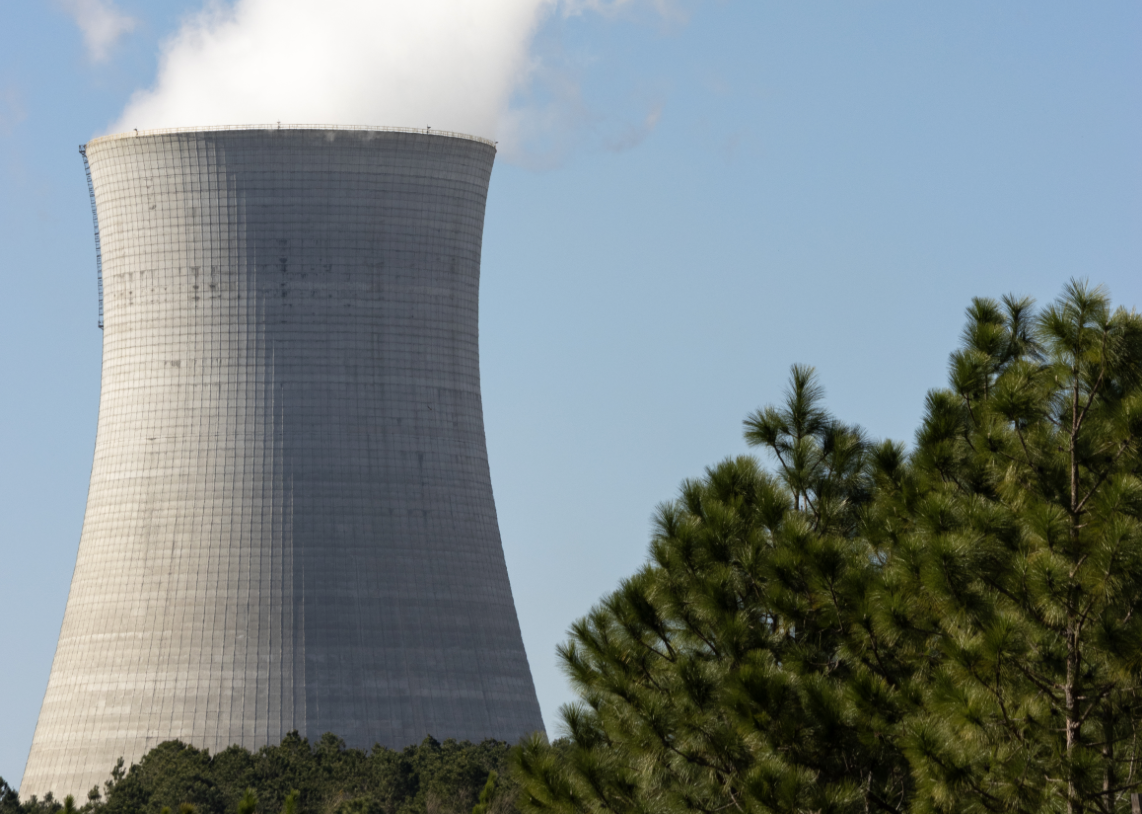

Plant Vogtle generates 4,800 megawatts from about 3,000 acres in Burke County, Georgia. Divide one by the other.
1,073 square miles
229 whole plants, not 229 reactors. Southern Nuclear puts all four Vogtle units on about 3,000 acres, so the acreage scales with the power. 1,073 square miles, against Rhode Island’s land area of 1,034.
That assumes the entire Tic Tac was doing generation and nothing else. That is generating the equivalent of what 229 copies of the country’s largest nuclear plant generated, from inside something forty feet long, in 2004. It is a rate, though, not a total. The same paper puts the whole maneuver at 4.3 × 10¹¹ joules, which is 119 megawatt-hours, or about ninety seconds of Vogtle. The 229 plants are what it takes to deliver that power for the fraction of a second it lasts, not to run anything. If the Tic Tac is American hardware, that capability is twenty-two years old and has never turned up in anything the public can inspect.
It’s important to remember that every number that went into it was chosen on the low end. The sampling put the most probable acceleration at 5,370 g and the mean at 5,950, and the authors used 5,370. They estimated the object at about the size of an F/A-18, whose mass they print at 14,550 kg, and assigned it 1,000. “Since we want a minimal power estimate” is their own reason for both. The 1,100 GW is a floor.
And that floor is for one of them. Figure 3 of the paper analyzes the radar observations of Senior Chief Kevin Day, who was the operations specialist over radar aboard the Princeton. For several days before November 14 he tracked what the Scientific Coalition for UAP Studies’ forensic analysis of the encounter describes as waves of eight to twenty of them appearing above 80,000 feet. The paper’s 0.78-second descent, the one every number here rests on, is the last stretch of that fall, 28,000 feet to sea level. Testifying in September 2025, Senior Chief Alexandro Wiggins told a House Oversight Committee task force that in February 2023, aboard the USS Jackson, off the same coast, a self-luminous Tic Tac–shaped object “was observed emerging from the ocean (transmedium), then linking up with three similar objects.”
The objection I keep seeing is that whatever powers them is either too simple to release or too dangerous to release. Both can be true. Neither answers who is holding it now. The federal government doesn’t manufacture hardware; it contracts for it, so if these are ours, a company with a payroll and a supplier list built them and has said nothing since. The secret is already shared, just not in a way anyone benefits from. It is hidden well enough that if it is ours, it sits outside oversight and its existence is still in question. Keep one parked where it is and connect it to the grid.
Pacifico Energy’s GW Ranch in Pecos County holds what Inside Climate News and the Texas Tribune reported as the largest air-pollution permit in the country. 7.65 gigawatts of gas turbines, permitted to release up to 33 million tons of greenhouse gas a year. Amazon has confirmed that the data center campus it is building on that site is “powered by new on-site generation that won’t raise electricity costs for Texas families.”
7.65 gigawatts on one site, for a campus one company is building. The paper’s floor for a single Tic Tac is 1,100 gigawatts. If that number is real and the objects were built here, the cost of moving off fossil fuels, and the potential economic impact that may bring, I’d argue, would be offset by the near limitless energy we’d have and what it’d allow us to do.
If We Can Leave, Anyone Else Can Get Here
What I love about Dr. Knuth’s SOL Foundation talk is how accessible he made the associated paper’s findings. For the Tic Tac descent Day tracked off the Princeton, the authors put the maximum speed at roughly Mach 60. Their own comparison for that is Hermann Oberth, one of the founders of rocketry, who gave a lecture on UFOs in 1954 and reported a top measured speed of 19 km/s, or Mach 55.
Table 3 covers why people often assume these are spacecraft. As Dr. Knuth points out, it’s because they seem to travel at spacecraft speeds. It lists four star systems and, for five accelerations, how long the crossing takes on the craft’s clock and on ours. The 1.4 days below is that table’s fastest row, 5,000 g, to the nearest of the four. The paper heads that column Proxima Centauri and gives it as 4.37 light years, which is the distance to the Alpha Centauri system rather than to Proxima itself. I’ve used the system name.
1.4 days
“Proving that something is extraterrestrial is extremely difficult, even if one had a craft in hand,” the authors write, and they say it should be strongly emphasized, because incomprehensible technology still wouldn’t rule out someone on Earth having built it. The standard argument against any of this being “alien visitors” is that the distances are prohibitive.
“If we have a future, it means we can leave not the planet, but the solar system. The cosmos are traversable. If we can leave, anything else can visit.”
— Eric Weinstein, The Joe Rogan Experience, February 22, 2023 (emphasis added)
Which leaves the other branch, the one where all of this is ours. Eric Weinstein, a mathematician who took his doctorate at Harvard, was asked whether there is technology in American hands beyond our current understanding of what’s possible. Rogan prefaced the question with “if we are faking a UFO situation,” so it is about a domestic program, and Weinstein says “90% no.” He says that when he talks to Nima Arkani-Hamed, Juan Maldacena, or Nathan Seiberg, all three on the faculty of the Institute for Advanced Study, they don’t know the answer, and they would be the sort of people any such program would require.
“I know that, for example, when I talk to Nima, or when I talk to Juan Maldacena, or when I’ve talked to Natty Seiberg, these people are absolutely brilliant, and they don’t know the answer, unless they’re the greatest actors I’ve ever seen.”
— Eric Weinstein, The Joe Rogan Experience, February 22, 2023
Physical Objects. Not Ours. Not an Adversary.
“This might be explicable if the Navy was detecting highly classified assets from the USAF or a U.S. intelligence agency, but the UAP Task Force reportedly checked with the appropriate security officials and received assurances that was not the case.… The UAP Task Force also found no evidence to suggest any of the 144 UAP it identified were Russian or Chinese.”
— Christopher Mellon, “Why Is the Air Force AWOL on the UAP Issue?” The Debrief, February 3, 2022
Christopher Mellon, a former Deputy Assistant Secretary of Defense for Intelligence who now takes part in Harvard’s Galileo Project, is the source for that. By his account the Task Force went to the people who would know whether these were American black programs, and the answer came back no. His subject is the East Coast ranges where Navy F/A-18s have reported UAP since 2015, not the 2004 Nimitz. He makes the point that members of the oversight committees “are already cleared for most classified DoD programs and some are cleared for all of them, so there would have been no need to mislead Congress.” Two sentences later, in the same paragraph, he adds that “as DoD itself acknowledges, these UAP could be some form of new Russian or Chinese technology.”
The DNI’s assessment says the same thing from the other direction, and more carefully. Developmental programs by U.S. entities get one category between them, and the report allows that some UAP observations “could be attributable” to those programs before saying it was “unable to confirm … that these systems accounted for any of the UAP reports we collected.” That is the absence of a confirmation, not a denial. Of 144 cases, exactly one was identified with high confidence. It was a deflating balloon.
And on what the other 143 were, the report is blunt in a way the rest of it isn’t: “Most of the UAP reported probably do represent physical objects given that a majority of UAP registered across multiple sensors, to include radar, infrared, electro-optical, weapon seekers, and visual observation.” The next paragraph is where it takes that back. In the limited number of incidents where UAP “appeared to exhibit unusual flight characteristics,” the report says, “these observations could be the result of sensor errors, spoofing, or observer misperception and require additional rigorous analysis.” That caveat lands on exactly the cases this piece is about.
Ross Coulthart thinks he knows whose the Tic Tac is. In July 2025 he said, of the Tic Tac specifically, that he now knows categorically it is Lockheed Martin technology. He won’t say who told him, and I don’t know whether he’s right.
What I do know is that if he is, it makes an NHI hypothesis more likely for many UAP sightings. A human-built craft pulling those numbers is a demonstration that the numbers are reachable. And it makes the old cases more difficult to explain, not easier. Lockheed Martin was not flying electrogravitic craft over Washington in 1952.
“We can say that the recent sightings are in no way connected with any secret development by any department of the United States.”
If it can be built, it probably has been built, and we are not the only ones who could have built it, and probably not the first.