For the past three years, I’ve been researching and writing a book on Unidentified Aerial Phenomena (UAP). It's been a true adventure that has been both intellectually stimulating and increasingly disheartening with regard to the state of modern national security reporting. While I was attending an academic conference on the subject, The Wall Street Journal published an article that exemplified many of the issues I’ve come to recognize through my work.
The piece was filled with demonstrably false claims, presented without skepticism, and accepted uncritically as fact, despite originating from officials within institutions that have a well-documented history of misleading the public on this very topic.
It is a documented and provable fact that public-facing UFO and UAP programs have functioned less as a legitimate research initiative and more as a mechanism of perception management, purposefully designed to mislead, obscure, or deflect. Ironically, the article is on this very topic. Against that backdrop, it was alarming to see two national security reporters, and seemingly the editors at The Wall Street Journal, publish such claims without a single visible act of fact-checking or pushback directed at their official sources.
Time and again, I’ve been struck by how mainstream national security reporters fall short of basic due diligence when covering UAP. Too often, stories are constructed to reinforce a preferred narrative—whether to validate or debunk the phenomenon—rather than to seek truth through rigorous evidence, historical grounding, or meaningful source scrutiny.
I repeatedly find myself asking: why am I, a cybersecurity researcher with no institutional media backing, doing more thorough vetting and cross-verification for a book I'm writing as essentially a hobby than reporters with access, credentials, and the explicit mandate to investigate these topics?
I’ve been continually blown away by the people I’ve managed to speak to on the topic, and I’d have to assume the Wall Street Journal has a much easier time getting high level officials to talk with them than I’ve had. So why did they not get any critical perspective?
There’s a saying that cautions against attributing to malice what can be explained by incompetence. I don’t believe the reporters were witting participants in an information operation. Rather, I suspect they hold biases against the UAP issue. Biases that prevented them from engaging in the kind of serious research that would have revealed contradictions in their sources’ claims, and would have allowed them to push back appropriately. Had they looked more closely, they would have found that decades-old public documents already debunk several of the article’s central assertions. Proper research would have shielded them from the criticism they now face.
This pattern of uncritical amplification is not unique to UFO reporting. In an era of rising authoritarianism, driven in part by disinformation disseminated through compliant media, it is imperative that journalists, especially those on the national security beat, learn to push back on official narratives. The costs of journalistic failure are not hypothetical. Similar dynamics underpinned the cascade of misinformation that helped justify the 2003 invasion of Iraq.
It is in that spirit that I offer this case study of The Wall Street Journal’s recent article, an analysis of how it not only recycles discredited talking points but also introduces new disinformation under the guise of investigative reporting. This is not merely a rebuttal to a single piece of journalism; it is an examination of how ostensibly credible media can become vectors of disinformation, undermining democratic oversight while masquerading as accountability.
Introduction: Information Disorder and the Modern Media Landscape
In the age of digital virality and fragmented trust in institutions, the need for rigorous media literacy is more urgent than ever. Central to understanding today’s disinformation challenges is the framework of Information Disorder, introduced by Claire Wardle and Hossein Derakhshan. Their typology outlines three key categories:
- Disinformation: Deliberately false content designed to deceive and cause harm.
- Misinformation: Inaccurate content shared without harmful intent.
- Malinformation: Genuine information shared to cause harm, for example private information moved into the public sphere.
I like Wardle and Derakhshan's framework because it is both simple, while handling the nuance of information ecosystems in which content can migrate fluidly between categories depending on intent, context, and interpretation. This model has since become foundational in analyzing not only overt propaganda but also more subtle techniques of influence and perception management.
Applied to the WSJ article, this lens clarifies how a legacy disinformation campaign, once orchestrated to minimize public concern about UFOs, has evolved into a reflexive media posture that continues to recycle government narratives under the guise of “skepticism.” Rather than scrutinizing sources with documented histories of deception, the article amplifies their claims without interrogation.
Framing the Problem: UFOs and the State-Sponsored Disinformation Legacy
The case of Unidentified Aerial Phenomena (UAP) represents a unique intersection of national security secrecy, media framing, and historical perception management. For over 75 years, U.S. government agencies have orchestrated an elaborate campaign of obfuscation, misdirection, and public manipulation around this issue. Time and again, the framing and objectives of these public-facing efforts were to downplay and obfuscate the topic.
Early projects such as Grudge and Blue Book were more about public relations than they were about genuine inquiry. Project Sign’s genuine analysis, the pro-extraterrestrial “Estimate of the Situation,” was rejected by Air Force leadership and ordered destroyed. Dr. J. Allen Hynek, Blue Book’s scientific consultant for nearly two decades, put it plainly: “Blue Book was now under direct orders to debunk.”
The 1953 Robertson Panel, for example, had a well documented predetermined outcome to downplay the topic. Robertson Panel member Thornton Page recounts:
H.P. Robertson told us in the first private (no outsiders) session that our job was to reduce public concern, and show that UFO reports could be explained by conventional reasoning.
There was even a recommendation that this was to be implemented with the help of mass media outlets and even figures like Walt Disney. As recorded in the Durant Report, the CIA’s report of the panel’s meetings:
Also, someone familiar with mass communications techniques, perhaps an advertising expert, would be helpful. Arthur Godfrey was mentioned as possibly a valuable channel of communication reaching a mass audience of certain levels. Dr. Berkner suggested the U. S. Navy (ONR) Special Devices Center, Sands Point, L. I., as a potentially valuable organization to assist in such an educational program. The teaching techniques used by this agency for aircraft identification during the past war was cited as an example of a similar educational task. The Jam Handy Co. which made World War II training films (motion picture and slide strips) was also suggested, as well as Walt Disney, Inc. animated cartoons.
That legacy lives on. Dr. Sean Kirkpatrick, who would later become AARO’s first director, quipped to a defense-industry audience at Redstone Arsenal in March 2022:
"As an intelligence officer, I would expect all of you to expect me to lie to you."
The line was meant as gallows humor; it instead underscored why so many observers still distrust the Pentagon’s newest UAP shop.
That distrust however seems well founded based on what members of Congress learned behind closed doors at FBI Headquarters. In mid-May 2025, House UAP-caucus lawmakers received two SCIF briefings in a single week, the second at FBI Headquarters on May 15, revealing that the Bureau has maintained a parallel and, by their telling, far more capable UAP investigative team. Within days:
- 15 May 2025 – Rep. Anna Paulina Luna: Emerging from the briefing, Luna called it “Amazing. It was 10 out of 10,” adding that it “makes us reconsider AARO.”
- 15 May 2025 – Rep. Eric Burlison: Told reporters there is “a small, very small team” at the Bureau and that “[s]ome different people on the team have actually seen objects.” Relaying the FBI’s own argument on resources, he noted: “AARO has funding for this specifically, but yet the FBI has all the resources.”
- 28 May 2025 – Rep. Luna, on X: “Clearly, the government has a spending problem. After reviewing our investigations through the Oversight Task Force, I am now convinced that AARO should be defunded. There is another organization doing a better job than AARO [the FBI] — and they’re offering full transparency. Defund AARO!”
These are not fringe accusations; they are matters of historical record. In this context, the Wall Street Journal’s article, "The Pentagon Disinformation That Fueled America’s UFO Mythology," must be evaluated not as a neutral act of reporting, but as a case study in meta-disinformation, or disinformation about disinformation.
Primary Disinformation Tactics Aligned to Frameworks
Disinformation by Omission: The Partisan Framing
In its only mention of congressional interest, The Wall Street Journal casts the issue in partisan terms, describing a caucus “composed mainly of Republicans” and “MAGA skepticism about the ‘deep state,’” and quoting just one legislator, a Republican. What that framing leaves out is a matter of public record. The bipartisan nature of recent UAP legislation is clear: the landmark UAP Disclosure Act, also nicknamed the "Schumer Amendment," was introduced in July 2023 by Senate Majority Leader Chuck Schumer (D-NY) with cosponsors Mike Rounds (R-SD), Marco Rubio (R-FL), Kirsten Gillibrand (D-NY), Todd Young (R-IN), and Martin Heinrich (D-NM). Senator Kirsten Gillibrand (D-NY) has been among the most vocal champions of AARO's formation and oversight. Far from being a partisan issue, UAP inquiry has become a rare area of cross-party unity. This is immediately obvious to anyone that actually watched any of the recent hearings on UAP and contrast them with all other House Oversight Committee hearings.
This is not a matter of interpretation but of public record. Quotes from Democratic leaders reinforce this reality:
"There's been some bipartisan efforts around greater disclosure that are starting to kick in. Additionally, another reason why this is happening right now is that this is a story of organizing. I don't know what to tell you. People may want to be cynical about that, but truly, there are a lot of people in this country who are very interested in this topic, and there has been increasing pressure and organizing that transcends party lines. And that has resulted in the inclusion of several UAP disclosure requirements that Congress included in past defense authorizations. And so there have actually been task forces that were mandated by Congress in recent years, and there's more legislation this year. And there have also been mandated disclosures that have really been the first of their kind in a long time. [...] So anyways, what do I think? Do I think UAPs are real? Are UAPs real? UAP stands for Unidentified Anomalous or Aerial Phenomena. But people say anomalous because now it's water or air. Do I believe that there are phenomena that have been identified by pilots, both commercial, military, et cetera, that have gone unidentified? Sure. Yeah. I think so. I think that's fair to say. We heard from some pretty credible witnesses. One is a commander who has verified video that is unidentified. So by definition, there are phenomena that have gone unidentified. There are plenty of UAP incidents which have been identified, but there are some that have been unidentified." —Rep. Alexandria Ocasio Cortez (AOC)
“Today we know better. UAPs are unexplained, it is true, but they are real. They need to be investigated, and any threats they pose need to be mitigated.” —Rep. André Carson
“That is, instruments report there is something there... measurable by multiple instruments... inconsistent with what we know of physics or science more broadly.” —Rep. Adam Schiff
“Any sort of stigma that prevents our military from reporting this data... is a national security threat.” —Rep. Jim Himes
“There's footage and records of objects in the skies... We can't explain how they moved... They did not have an easily explainable pattern.” —President Barack Obama
After the Intelligence Community Inspector General (IC IG) briefed House Oversight members in a closed session in January 2024, there was bipartisan consensus that there was something to the claims. Rep. Jared Moskowitz (D-FL) said, “It's wild how nonpartisan this really is,” and Rep. Tim Burchett (R-TN) said “everybody left there thinking and knowing that Grusch is legit.” The WSJ's selective portrayal exemplifies what Claire Wardle calls “false context”: genuine content shared with false contextual information. It is my personal opinion that this is likely done purposefully to try and drive a partisan wedge into the issue in an effort to get it to "go away."
Disinformation & Malinformation: The Malmstrom Air Force Base Incident as a Secret E.M.P. Test
The Wall Street Journal’s suggestion that the 1967 missile shutdown at Malmstrom Air Force Base was caused by a portable electromagnetic pulse (EMP) device is technically absurd. In the Journal’s own words: “When activated, this device, placed on a portable platform 60 feet above the facility, would gather power until it glowed, sometimes with a blinding orange light.”
The narrative is attributed to the investigation of former AARO Director Dr. Sean Kirkpatrick (“Kirkpatrick’s team dug into the story and discovered a terrestrial explanation”), yet the article never names the device. Its only documentary support is an image captioned “A model of an electromagnetic pulse testing site, shown in a 1978 Pentagon document.” Within days of publication, researchers identified those sketches as figures from the Defense Nuclear Agency’s 1973 final report on the Transportable Electromagnetic Pulse Simulator (TEMPS), the government’s documented “transportable” EMP simulator of that era.
That identification is fatal to the explanation before any engineering analysis: the TEMPS report states that the request for proposal was issued in March 1971 and that field testing began in mid-August 1972. The system did not exist in March 1967.
Even setting the chronology aside, the report shows what “transportable” actually meant. The TEMPS system, developed under contract with the Defense Nuclear Agency and detailed in its 1973 final report, was a massive industrial simulator designed to replicate the effects of high-altitude nuclear EMPs. Far from “portable” in the colloquial sense, the TEMPS required:
- Dielectric support towers elevating its antenna centerline up to 20 meters (≈ 65.6 feet) above the ground.
- A 1,000-foot-long, 30-foot-diameter cylindrical cage antenna suspended between towers.
- At least ten massive concrete footings, each measuring 5 ft × 4 ft × 20 in and weighing over 3,200 pounds, totaling more than 32,000 pounds of anchoring infrastructure.
- Heavy-duty crane operations to erect the A-frame towers and tension guy-lines anchored by 7,200-pound concrete blocks.
- A central pulser housed in a biconical transmission cage, containing two synchronized Marx generators, each roughly nine feet long and weighing about a ton, to produce its ≥6 MV pulses.
- Field output of ≥50 kV/m at 50 meters, with an 8-nanosecond rise time and a 300-nanosecond decay constant—highly localized and devastating to unshielded electronics.
The system’s one documented relocation, from Camp Parks, California to Woodbridge, Virginia, spanned November 1972 to January 1973.
A full report of the TEMPS requirements can be found here: https://www.theblackvault.com/documentarchive/temps-transportable-electromagnetic-pulse-simulator-final-reports-1973/
This system, while technically “transportable” in the military engineering sense, would dominate the landscape of any missile facility. Suggesting it could be secretly deployed and operated near an active nuclear missile control center without notice—especially by alert security personnel who explicitly reported witnessing a glowing aerial object—is unfounded.
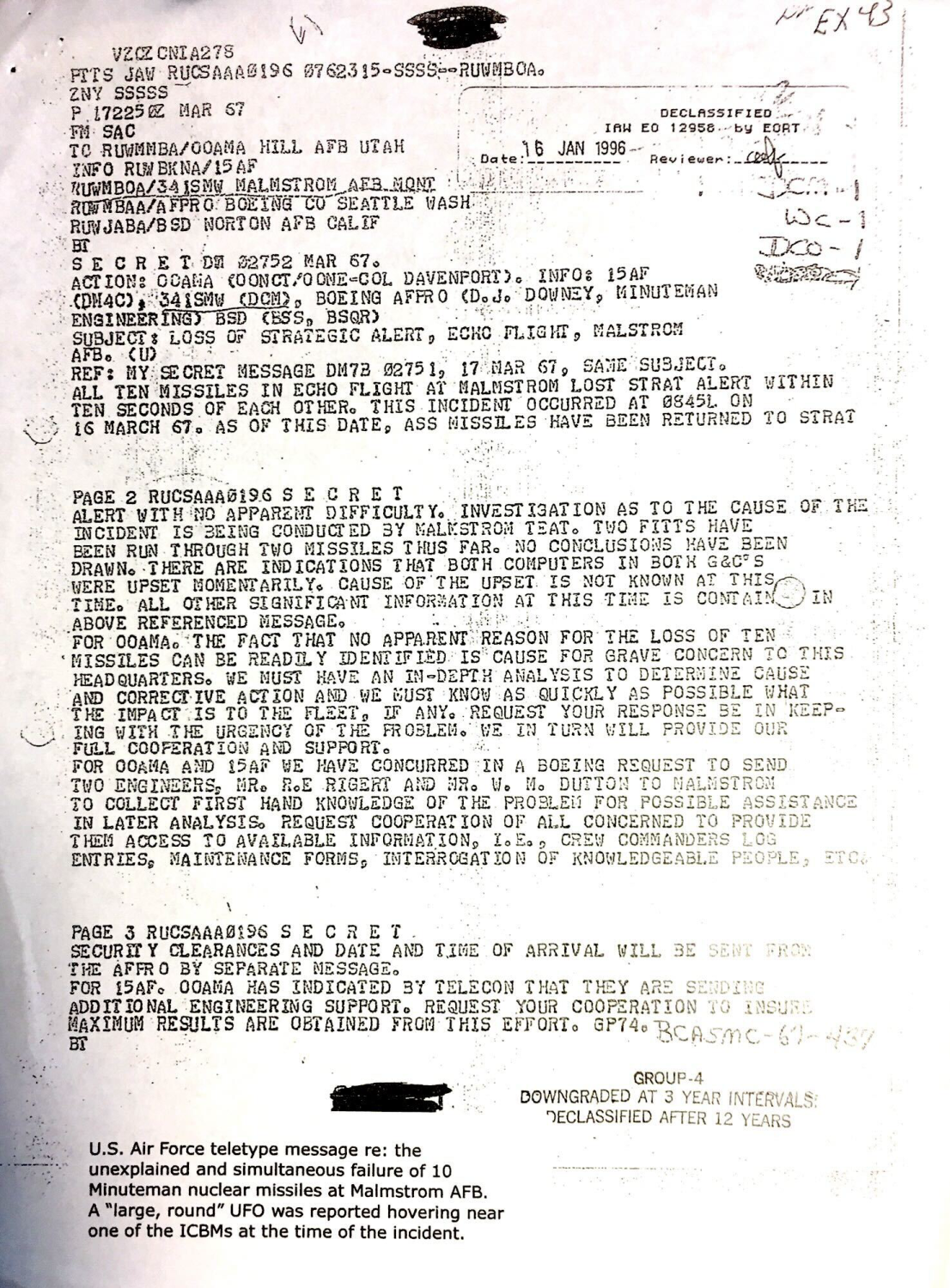
The implausibility compounds when considering operational behavior: if this was a scheduled test, why did Strategic Air Command issue a telex the next day (March 17, 1967) expressing grave concern that ten missiles failed with “no apparent reason”? The document read:
“THE FACT THAT NO APPARENT REASON FOR THE LOSS OF TEN MISSILES CAN BE READILY IDENTIFIED IS CAUSE FOR GRAVE CONCERN TO THIS HEADQUARTERS.”
It should be noted this information has been out in public for quite some time, is not in dispute, and is from the time of the incident.
The WSJ article also fails to question why the U.S. would conduct such a test on live ICBMs, something that would risk both mission capability and international treaty compliance, when dummy warheads or decommissioned systems could serve the same test purpose without catastrophic downside. It seems like a missed opportunity to find out if this sort of thing is still being done today.
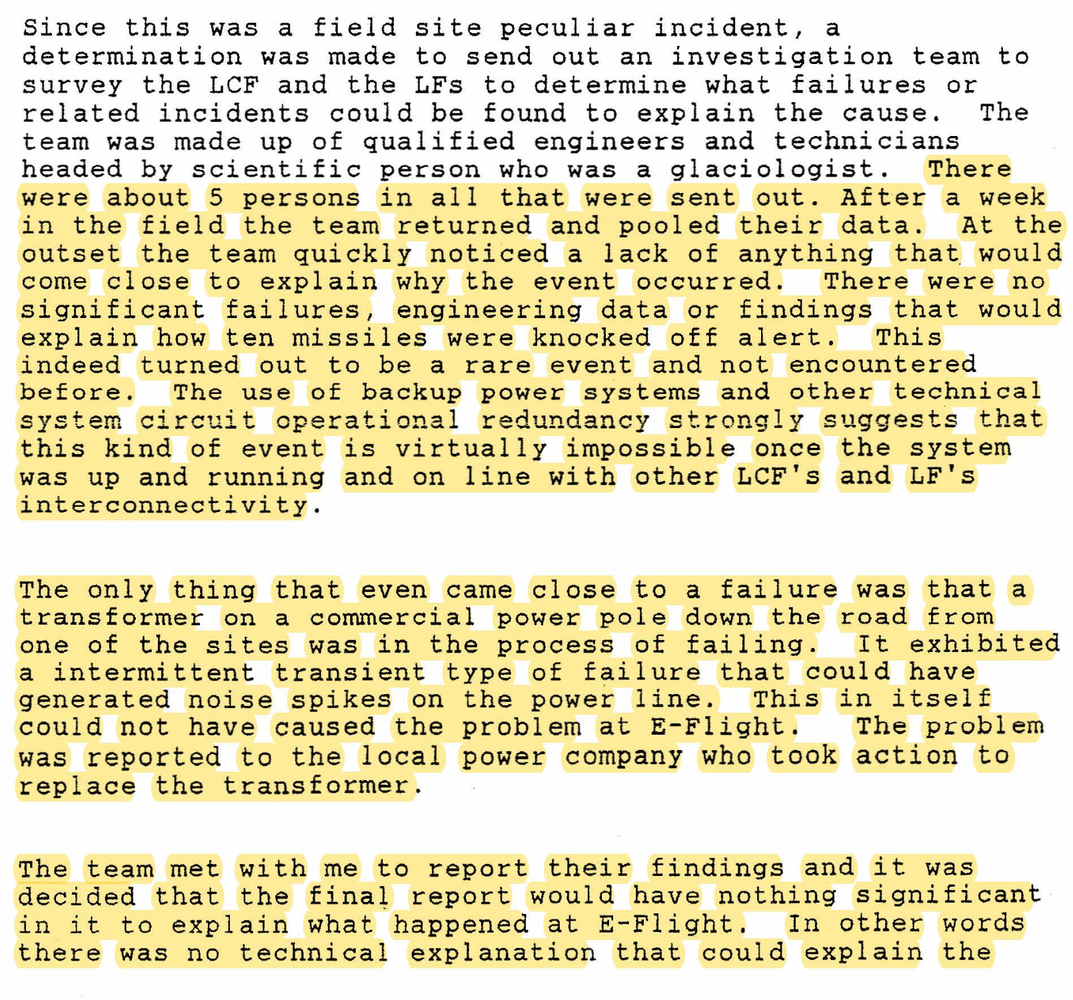
Furthermore, the engineering record undercuts the explanation. EMP effects on electronics range from temporary upset to permanent damage, and a high-field exposure severe enough to require this level of concealment would have risked burning out unshielded 1960s electronics. Yet the 341st Strategic Missile Wing’s unit history records that all ten missiles were returned to strategic alert by the next day, without any launch-facility equipment replacement. Nothing was burned out. Again, it should be noted that documentation from Boeing has been in the public domain for quite some time on this that was conveniently left out.
There were about 5 persons in all that were sent out. After a week in the field the team returned and pooled their data. At the outset the team quickly noticed a lack of anything that would come close to explain why the event occurred. There were no significant failures, engineering data or findings that would explain how ten missiles were knocked off alert. This indeed turned out to be a rare event and not encountered before.
Critically, atomic weapons have been under joint AEC–DoD governance since their agreement of March 21, 1953, and authorized testing on nuclear weapons systems leaves an interagency paper trail. The Department of Energy has stated that no nuclear testing was conducted on March 16 or 24, 1967 that could have been a source of EMP, and no authorization or notification for any EMP test at Malmstrom has ever surfaced. The Journal presented no such documentation, only the image captioned as “a 1978 Pentagon document.” Did the WSJ ask for test authorization records? And if so what was the response?
This entire framing by the Wall Street Journal is a selectively coherent story that retrofits a convenient narrative onto an unresolved event, effectively crowding out more plausible or documented explanations. As Lewandowsky and colleagues note in Psychological Science in the Public Interest, people prefer an incorrect model of events over an incomplete one, and coherent stories are easier to process than nuanced truths.
In addition, the article demonstrates what Wardle and Derakhshan would classify as malinformation: genuine material (sketches from a real EMP-simulator report) presented without context in a way that distorts reality. By ignoring the literal tonnage, physical footprint, manpower, and chronology, the piece recasts an industrial installation whose one documented relocation took two months into a phantom pop-up device.
In short, the Malmstrom EMP test theory isn’t just unsupported, it is chronologically and physically untenable. Its inclusion without skepticism or caveat exemplifies media complicity in spreading misinformation through a veneer of technical specificity.
This contradiction exemplifies the continued influence effect reviewed by Lewandowsky et al. Misleading but coherent narratives endure because they offer explanatory closure. When trusted outlets propagate these narratives, the effect is compounded by source amnesia: audiences remember the claim but forget it came from the Pentagon, a source with a documented history of deception on this very topic.
The WSJ's lack of skepticism amplifies the problem.
Disinformation: Conflicting Statements and Evidence
In the weeks before AARO released its Historical Record Report in March 2024, Dr. Sean Kirkpatrick, who had left the office in December 2023, made a high-profile media push previewing its findings, including a January 2024 op-ed in Scientific American, and continued defending them in interviews after the release. Throughout, he downplayed the scale and credibility of whistleblower claims. Rather than suggesting a decades-long institutional deception, he asserted that the UAP crash retrieval narrative arose from a small cluster of “interconnected believers” recycling each other’s unverified stories. As he put it:
“In many respects, the narrative is a textbook example of circular reporting, with each person relaying what they heard, but the information often ultimately being sourced to the same small group of individuals.”
Kirkpatrick went further, characterizing these individuals as promoting a “whirlwind of tall tales, fabrication and secondhand or thirdhand retellings,” and suggested that many allegations stemmed from inadvertent disclosures of conventional R&D efforts, misinterpreted by those predisposed to belief. This framing was central to his media messaging both before and after the report’s release. To push this framing prior to releasing a counter narrative only serves to muddy the water at best.
Further complicating the narrative is the institutional narrowing of the hazing explanation to the Air Force. As former Deputy Assistant Secretary of Defense Christopher Mellon noted in a 2022 Debrief article, “Why is the Air Force AWOL on the UAP Issue?”, the Air Force has remained conspicuously absent from recent UAP transparency efforts. Most credible whistleblower claims and sightings have come from the Navy, intelligence services, or civilian contractors—not from the Air Force. To suggest now that a culture-bound Air Force prank explains decades of cross-agency testimony risks functioning less as a clarifying account than as a diversionary myth. It should also be noted that the UAP Task Force was run out of the Navy and created by Deputy Secretary of Defense David L. Norquist.
This tension suggests a strategic communications recalibration rather than a genuine correction of the record. The sudden appearance of a retroactive explanation—delivered anonymously, unsupported by documentation, and only after critical coverage—bears the hallmarks of what disinformation researchers call narrative laundering: a shift from outright denial to alternative mythmaking, designed to reabsorb disruptive evidence into an acceptable institutional frame.
While it is entirely possible that “Yankee Blue” hazing occurred, and that its delayed publication reflects bureaucratic caution rather than deliberate obfuscation, the sequencing and inconsistency remain troubling. If this story was known at the time of AARO’s first report, and is now being presented as a primary explanatory mechanism, it should have been disclosed transparently and with evidentiary support—not dangled post hoc as a convenient narrative patch.
Recommendations for Journalists Covering this Topic in the Future
One of the biggest challenges in this field is the deliberate mountain of noise—low-quality, easily debunked claims amplified to deter serious academics and journalists. Still, when you interview an official, a few core questions and techniques can cut through the static:
Trust No One
As Fox Mulder famously warned, kindness doesn’t preclude ulterior motives. Treat every source, no matter how friendly, as potentially self-interested.
Learn From History
Begin with basic due diligence and refuse to repeat past mistakes. History shows that prior UFO programs focused on perception management. Identify the stock explanations, weather, missing data, classified sources, and ask direct questions that challenge them.
Learn the Basics of Existing Public Sensor Capabilities
When an official claims “there’s no data” or a sighting can’t be verified, follow up: Which sensor systems should have detected something? Were those systems off, or is the data classified? If data is withheld, why? If it truly doesn’t exist, why not?
We live in an era of pervasive surveillance—so ask how unknown drones or craft can loiter over nuclear sites or carrier groups without leaving a multi-spectrum trail. The United States can, according to then-President-elect Trump in December 2024, pinpoint where a drone launched even if it lifted off from someone’s garage; why was this missed?
Understand the Logical Implications of each Claim
If officials hint these UAP are adversary technology (AARO’s first director, Sean Kirkpatrick, put it bluntly on his way out: “if we don’t prove it’s aliens, then what we’re finding is evidence of other people doing stuff in our backyard. And that’s not good.”), then we have witnessed breakthrough craft in our airspace for decades without comprehension. That would rival the greatest intelligence failures in modern history. Ask when they realized the U.S. had been technologically leapfrogged, and how they reconcile it with our multi-trillion-dollar defense apparatus. Keep in mind, the most well documented incident was now more than 20 years ago.
If, on the other hand, the craft are our own black projects, then a potentially illegal secret program has evaded oversight while Congress still lacks answers about UAP origins. Either way, the implications deserve airtime and actual investigation, not a shrug.
Verify technical or scientific claims offline
If an official cites, for example, a weather phenomenon to explain an incident, consult independent experts and open-source data. Many such explanations dissolve under scrutiny.
A perfect historical example is the Air Force’s Roswell explanation. The 1995 report, The Roswell Report: Fact versus Fiction in the New Mexico Desert, attributed the debris to Project Mogul Flight No. 4. But the project’s own field diary for that morning reads “No balloon flights again on account of clouds,” no flight records exist for Flight 4, and the identification rests on one participant’s recollection nearly five decades later. The follow-up 1997 report, Case Closed, attributed reports of recovered bodies to anthropomorphic dummies from Project High Dive, tests that began six to seven years after Roswell (1953–1959), a gap the Air Force bridges only by assuming witnesses misdated what they saw by a decade or more.
Does any of this prove aliens? No. But being able to ask informed questions is more likely to get you the truth.
Push back in real-time when possible, but absolutely do follow-ups
If you find evidence contradicting what a source told you, go back to them before publishing. Put the conflicting facts in front of them and allow them to respond or clarify. If they can’t, that tells you something. Include those contradictions in your piece rather than smoothing them over.
At a minimum, responsible reporting on this topic means: corroborating extraordinary claims with documentary evidence; consulting independent experts on technical topics; cross-referencing historical records, like the SAC telex from Malmstrom; acknowledging the bipartisan nature of recent UAP investigations; and recognizing the Pentagon’s historical role in strategic deception.
Conclusion: Journalism at a Crossroads
The Wall Street Journal article in question is a perfect example of how modern journalists and their editors are failing us. It is a textbook example of how legacy media can become a conduit for official narratives that only add more confusion. By failing to critically interrogate its sources and framing, the article recycles old tactics under the guise of transparency. The media, and outlets like The Wall Street Journal, must do better.