
Dr. Harald Malmgren's is a tale of two men. One a defense analyst on anti-ballistic missile policy who, by his own account, moved in high-level intelligence circles. The other a quiet U.S. trade ambassador and economist.
The first was his own. A man who said the CIA legend Richard Bissell had pulled him aside on Friday afternoons after work and told him secrets about otherworldly technology.1 Who said Robert McNamara had put him in charge of designing America's first anti-missile system.2 Who said he had stood in a Pentagon war room during the Cuban Missile Crisis and talked General Curtis LeMay down from a first strike.3 And at the end of his life, telling Jesse Michels that a UFO had been knocked out of the sky during a 1962 nuclear test, and that he had handled materials.4
The second came from Douglas Dean Johnson, who filed Freedom of Information Act requests, pulled Malmgren's certified federal job applications and his declassified FBI background file, and concluded that the grand story was mostly invention.5
Having met Dr. Malmgren and his daughters, spoken with him privately, and seen documentation Ryan Purkey of Unquestionably Skeptical shared with me for an article he has since published, I felt there was more to the story.6 Douglas Dean Johnson's article was also very clearly poorly researched, written to argue a side rather than get to the truth, and with clear bias. I run high-stakes cybersecurity investigations, where bias shapes findings and makes it easy to draw conclusions the evidence doesn't support. I believe Johnson has done that.
Sins of My Father
Growing up, my dad told me he had been in the Navy. Not just in the Navy, but a Navy SEAL.
I never questioned it, and it never really came up as I got older. Then, when I was around fifteen or sixteen, Aaron, still one of my closest friends today, told me he was signing up for the Marines. I don't remember exactly how we got there, but I mentioned that the Marines were a department of the Navy, and that my dad had been a SEAL.
I'll never forget his answer. He told me my aunt had told him my dad was never a SEAL, something my mom eventually confirmed. After that I started finding out how many of his other stories were the same. My grandfather was in the Navy and had met Presidents Kennedy and Reagan. My aunt was with him for the Kennedy meeting, when she was no more than four or five. You'd think she was a friend of the Kennedys the way she talked about them.
My dad was insecure about his own accomplishments. He wanted me to be proud of him, and I would have been either way. What it actually got me was egg on my face in front of a close friend. My aunt, more prone to exaggeration than to making things up, just wanted to be the life of the party. I tell this story because Dr. Malmgren's daughter Pippa may be in the same position, and if she is, I empathize with her in a way I think few can. Ultimately my dad's tall tales drove me away, and is part of what pushed me toward a life of skepticism. I don't take things I'm told at face value, especially the ones I want to be true. This topic has enough misinformation and disinformation without me adding to it.
You should know that my bias is toward writing positively about them. Harald and Pippa were both extremely kind to me, and it's natural not to want to be unkind in return. I recognize it, I've tried not to let it taint the investigation, and I've actively scrutinized my own findings.
This is not a point-by-point rebuttal of Johnson's articles, and I don't plan to address all of his claims. His portrait was extremely biased, and some of what it leaves out sits in the same files he obtained. I'm unsure what he was doing for four months, but it clearly wasn't learning about history or those involved.
This is an active research project for me, and the first in what will likely be a series on his life. Before this article, my knowledge of the time period was very surface level, and there's a great deal of interesting history in it. Since I was one of the few people who had actually met Harald prior to his death, I thought it would be worth getting more familiar with the era.
That said, it will take a while to get through the books relating to the era, and unfortunately my FOIA requests don't seem to have the same turnaround as Johnson's.
Close Encounter of the Personal Kind
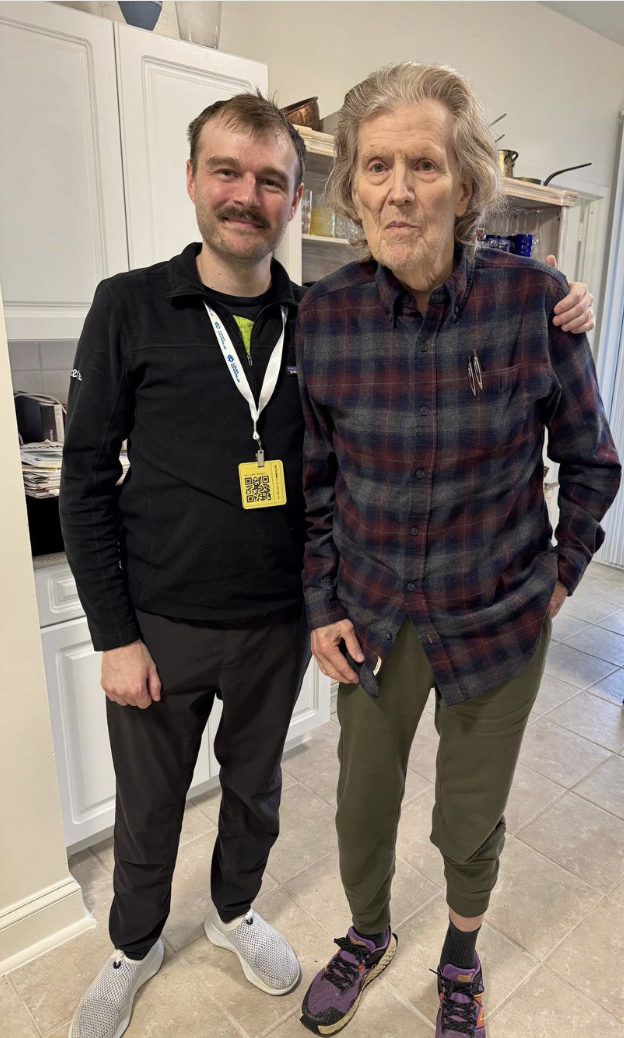
My interaction with the Malmgrens came about completely unexpectedly. While I'd started working on my book, it was still early in the process. I'd only really done research, and I was still trying to build out my network. By that point, I hadn't made much headway getting people to do interviews. I had spoken with Christopher Mellon, and I'd only recently figured out that Logan, who I met at the first SOL Foundation, had been on the UAP Task Force. I hadn't really fully "committed" to writing the book yet. With the book still so far off, and my early interview requests usually met with silence, it was mostly just an idea in my head. I mention all this for reasons that'll matter later. During this stretch, a professional favor for a personal friend, something completely unrelated to the topic, led to the opportunity to interview Dr. Malmgren.
Nearly seven months before Jesse Michels published Presidential Advisor: "I Directly Handled UFO Material" (Ft. Harald Malmgren), I'd have the chance to speak with a man who, just weeks earlier, had claimed to have been briefed on "otherworld technologies" by Richard Bissell, one of the primary architects of the now infamous Area 51.8
My Time with Harald
When I met Dr. Malmgren, he agreed to speak with me as a favor to a mutual friend. At the time, there was little public information about who he was, and he was making claims about UFOs and UAP that were significant if true. Matthew Pines, a national security analyst, and others in the UAP community spoke to his stature.
"Those who know of Dr. Malmgren's storied career know how much weight these words carry."
I'd heard others repeat that he had advised multiple presidents. JFK, LBJ, Nixon, Ford among them.10 The formula was his own. His X bio at the time read "Advisor to Presidents Kennedy, Johnson, Nixon and Ford as well as many global leaders."11 Yet I couldn't find much on him from before his public statements on the subject. Worse, my time with him was cut short. I had a flight to catch ahead of Hurricane Helene having just spoken at a cybersecurity conference in D.C.
“Imminent” a book to be published tomorrow, Aug 20, by Luis Elizondo on what our government knows about UAP, or alien visitors to Earth. This book breaches a dam & I expect will likely be gradually followed by more awakening disclosures ahead
60+ years ago I was provided highest level classifications to lead DOD work on nuclear weapons & anti-missile defense. Informally briefed on “otherworld technologies” by CIA’s Richard Bissel (who had been in charge of Skunkworks, Area 51, Los Alamos, etc.) but sworn to secrecy.
Read the book. Then watch comments of others. Bissell briefed me off the record after his resignation as CIA Deputy Director Specal Ops. I am not seeking public confirmation status—just telling my personal story. Confirmations will be up to others directly involved, in coming…
Some responders to my X messages about Elizondos upcoming book are probing my direct knowledge of government UAP research. I never directly worked on UAPs, nor indirectly used such research in my own work. Therefore, I cannot be treated as a source of confirmation of UAP info.
Read my words carefully. I was never directly involved in UAP research. What I learned was sketchy, slightly illuminated by Bissel as he felt I needed a heads up in case the subject ever came up in my meetings with Presidents or others. I swore secrecy to him, not under any law
I do not know Luis Elizondo, & have no connection with his book’s publication. The contents had been disclosed previously, and I simply thought time has come for the rest of humanity to start thinking about what it means for understanding of the world in which we live
I don’t know you, but having had respected friends urge me look into your book, I went further and urged everyone to pa y attention. Seems my boost aroused a huge Twitter response. Good luck with your attempt to raise visibility of this critically important subject at this time
BEFORE JFK was sworn as POTUS, he was already aware of high level US Government UAP knowledge. I learned later LBJ & Nixon fully briefed.
I find my wording on possible UAPs opened ways for misinterpretations. I did not intend to provide “evidence” from my official work. Aware this topic is of enormous consequence for all humanity, I was just sharing personal impressions in hopes for greater official disclosure.
You asked “is there actual recovered NHI tech?” The answer is yes, in several different hands, both government and private hands. For example, knowing such technology has enabled planning for moon to Mars transportation in days, not years. Don’t ask me who has such tech.
Tweets are reproduced as posted.
I worried I wouldn't know enough to ask the right questions, and that even if I got him talking, I'd have to leave before the conversation went anywhere. And if it did go somewhere, how would I prove it? I couldn't pass up the opportunity. I met him at his home, with his daughter Erika, who is not in the public eye. As I came in, Dr. Malmgren appeared to be consulting on a Zoom call, though on what I'm not sure.
Harald's Own "Great Game"
There's a misconception about many of the prominent figures in the UFO and UAP world, the idea that they're chasing attention. For some, that's true. But I've found the opposite usually holds. The more credible the person, the more guarded they tend to be. Even if you do get them talking, you rarely get much past what they've already said publicly on a podcast, not until you've put in the time to earn their trust. Harald was no different.
On paper, I was the perfect "mark." An independent author writing a book on the topic, with no team of editors behind me, and at the time minimal connections that would have let me verify his claims. The kind of person Harald could have fed tall tales, used to talk up his own background, or steered toward a certain viewpoint or narrative off the record. It's a big part of why Lies Above stays on the public record, no new quotes in the book, no private details. I wanted to avoid this exact situation. And yet getting anything out of him on UAP was like pulling teeth.
If anything, Harald was more interested in asking me questions, especially about my day job as a cybersecurity researcher. I was impressed. For an eighty-nine-year-old, he had better security hygiene than some of the people I know in tech.12 He was excited to show me he used a password manager and 2FA. He didn't just know to use them, but understood the why, right down to a threat model that, as he put it, "made things like that important."13
I wasn't a seasoned interviewer yet, and I've always preferred a candid back-and-forth to a formal sit-down. Talking cybersecurity loosened us both up and moved us toward what I'd actually come to ask him about, UFOs. By the end, it felt more like a retired intelligence professional, collecting intelligence on me.
Tag, That's It?
Ultimately, I couldn't get much out of Dr. Malmgren on UAP, beyond a much more modest version of the tag-along example he covered in his interview with Jesse Michels.16 I don't recall his exact wording on that, so to avoid misattributing anything to him, I'll only confirm that nothing he told me diverged from the tag-along story he gave Jesse, just less detail.
In the moment, he struck me like most senior former officials I'd spoken with, his cards close to his chest, careful not to reveal too much. It was only after watching that interview, and seeing how much Jesse drew out of him, that I started to wonder why. Maybe he had some arrangement with Jesse not to share certain details before the release (I do not think that was the case, though I haven't heard back from Jesse). Maybe he hadn't yet decided how much to disclose. Or maybe he just didn't feel comfortable enough with me to say more.
That's Some Catch that Catch-22
The flight home felt like the start of something. A former presidential advisor had just spent an afternoon with me and, despite being scant on detail, had told me something fairly incredible. If even a fraction of what surrounded his story held up, it would be one of the biggest stories I could imagine. I left buzzing, but I wasn't sure how I could use what we discussed for my book, if at all. I was also extremely aware that anything I was told could have been fabricated, and near impossible for me to prove.
He'd been lucid the entire conversation. He felt credible. I'll be honest about where that feeling came from, though, because it wasn't anything I'd confirmed yet. It came from the reputation others had built for him in public. It helped that I never felt he was trying to convince me of anything. He'd been careful, even modest.
Anything genuinely new he'd told me, my own rule kept out of the book. Besides, it was off the record. Anything already public, I could have found without ever boarding the plane. Conversations like this were more for framing my book and seeing for myself whether the person I spoke with felt credible.
My Dinner with Pippa
About two months after I met her father, I ran into Dr. Pippa Malmgren at the second SOL Foundation symposium, November 22 and 23, 2024, at the Fort Mason Center in San Francisco.18 She knew I was a new author. We went to dinner and talked off the record, about the presentations we'd both just watched, about the UAP subject in general, and about the work of writing a book. She'd published several of her own, and she spent part of the evening giving me practical, specific advice on how to improve my own.19 It was a generous thing to do for a stranger no one has heard of.
I bring her up for a reason. Her credibility and Harald's are tangled together, so what people decide about her colors how they see her father. Is she a serious figure in her own right?
Like her father, Pippa served in government as an economist. American Banker, which profiled her in May 2001 while she was in the job, calls her "a special assistant to the President for economics policy" who "serves on the National Economic Council headed by chief White House economics adviser Lawrence B. Lindsey," and says she started that February.20 When I mentioned that she worked in the Bush administration as an Economist, the cheap shot writes itself, because Bush's name is shorthand for a wrecked economy, and the 2008 crash is the first thing most people attach to it.
In reality, Pippa left the White House around 2002, roughly six years before the housing bubble burst.21 The tax cuts most associated with the deficits came in 2003, after she was gone.22 The homeownership push that fed the subprime machine ran from 2004.23 Bear Stearns, Lehman, and TARP were all 2008.24 Companies House brackets the tenure at both ends. She resigned her Canonbury Group directorship on February 15, 2001, the same month she started at the White House, and was appointed to it again on February 5, 2003.25 She was long gone. Ellen Seidman held the same job in the Clinton administration for more than four years, then ran the Office of Thrift Supervision from 1997.26
The philosophy didn't come after the fact. Pippa took her doctorate at the London School of Economics in 1991, with a thesis on economic statecraft written under Susan Strange, and spent the 1990s as a currency strategist at Bankers Trust and then in global strategy at UBS, paid to watch capital flows and imbalances for a living.27 She's blunt about where the rest came from: "I had a German-style apprenticeship. My father taught me what he knew."28 The way she reads an economy, through debt, capital flows, and the balance of power between states, was formed early, under Harald and on the trading floor.

Her 2015 book Signals and the work that followed read as a sustained argument against the very forces that produced the crash: easy money, understated inflation, and debt piled onto households and governments past the point they can carry.30 She's the economist who popularized "shrinkflation," the idea that hidden inflation shows up first as a shrinking cereal box rather than a higher price.31 One credential in her UnHerd bio doesn't come from economics at all. She "has been a manufacturer of award-winning drones and autonomous robotics," which is her own bio line rather than a filing.32 None of that is a post-hoc rebrand. Pippa isn't overshadowed by her father. She built her own record with what he taught her.
When it came to our conversations, those were completely off the record. However, my impression of her was that, like her father, she is extremely intelligent. Not surprising considering her background. Pippa also had a way of seeing the world through other points of view, and of reading how another culture would see the same thing, striking enough that I recall complimenting her on it. Something that I appreciate especially so as a white guy. It seems like every time we talk she's in another part of the world, speaking on economics. Like Douglas Dean Johnson, I think Pippa sincerely believes her father's claims.33 While our conversation was off the record, I can say at no point did I feel she was trying to spin grandiose tales, that she was bragging, or that she was trying to convince me of anything.
Pippa's Leaked Text Messages
In my interview on the Psicoactivo Podcast, Pavel Ibarra mentioned that some of Pippa's text messages had leaked, and that a member of the group chat left over them. That member was Klaus, co-host of Patterns Tell Stories, who had said:
"I left this group chat after I read this message because I felt like an accessory to treason straight up. This is when I said I'm done."
I hadn't seen them before going on Pavel's podcast. The screenshots were published in a write-up on Project Preserve Destiny.35 This one, from February 9, 2025, carries most of it.36
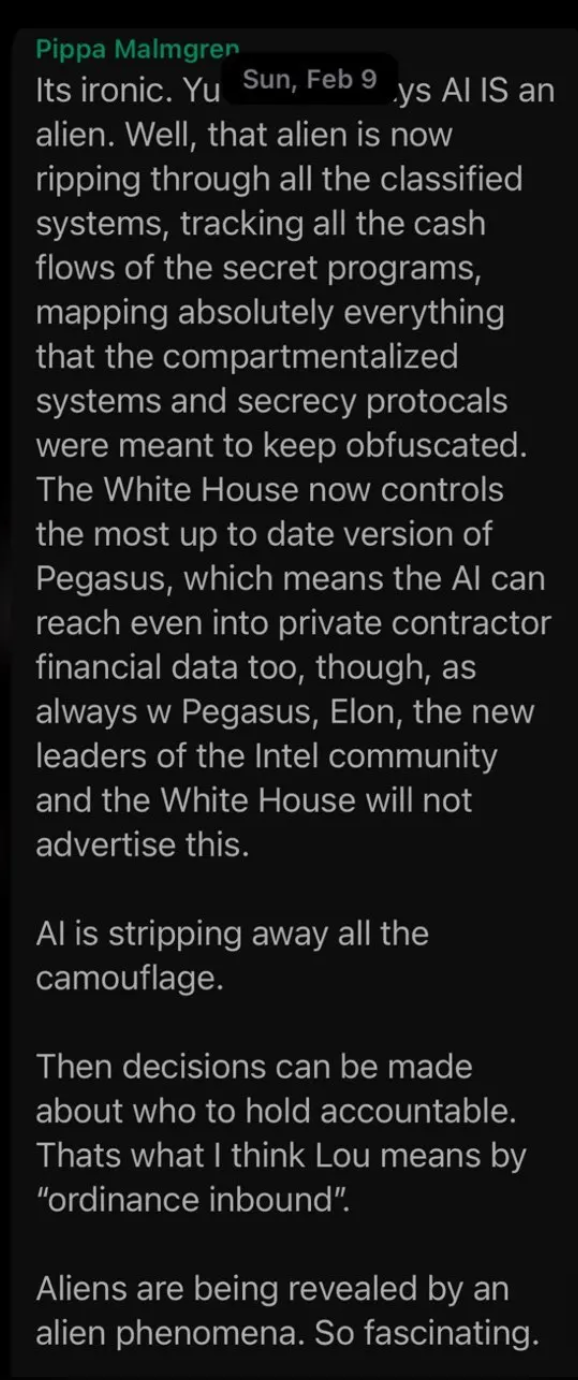
She starts from a line, quoted in the chat, that AI is an "alien."37 That alien is now "ripping through all the classified systems, tracking all the cash flows of the secret programs," and mapping what compartmentalization was built to obscure.38 The White House, she writes, "now controls the most up to date version of Pegasus," which lets the AI reach even into private contractor financial data, and which Elon Musk, the new leaders of the intelligence community, and the White House will not advertise.39 Pegasus is mercenary spyware built by Israel's NSO Group and sold to government clients, who have used it against journalists, lawyers, and politicians, including a Greek Member of the European Parliament hacked while sitting on the committee investigating Pegasus.40 Citizen Lab's forensic work found it recording audio from the microphone, ambient room audio and encrypted calls alike, and taking pictures with the camera.41 End-to-end encryption doesn't matter at that point, because the spyware is reading the messages on the device after they're decrypted.
Despite these text messages, I do not think Pippa or Harald are a part of any sort of secret Thiel plot or psyop.
Everything she was reacting to was public when she typed it. Three days earlier, the Washington Post reported that DOGE was running sensitive Education Department data through AI tools on Microsoft's Azure.42 The day before her text, a federal judge blocked DOGE from Treasury's payment systems.43 Both under Elon. Nine days earlier, WhatsApp notified roughly ninety users, journalists and civil society workers among them, that they had been targeted with Graphite, spyware made by the Israeli company Paragon, a firm Risky Business described days later as "recently bought by US interests for something like $900 million."44
Paragon doesn't make Pegasus, but Pegasus is the name most people reach for when they mean mobile spyware. I did it myself, remembering that episode as being about Pegasus until I went to confirm it. (Though to cut myself some slack, it was nearly a year ago.)
Paragon is also a private company rather than a government agency, though it holds federal contracts. In September 2025 Patrick Gray named one of them. Immigration and Customs Enforcement had a Paragon contract "worth about 2 million bucks," which he thinks was suspended after the controversy over Paragon's dealings with the Italian government.45 Outside the Computer Fraud and Abuse Act, which is very limited in scope, U.S. law mostly reaches spyware through wiretapping statutes. 18 U.S.C. § 2512 prohibits manufacturing, selling, or advertising any device whose design renders it "primarily useful for the purpose of the surreptitious interception" of wire, oral, or electronic communications, with an exception for government actors and the people under contract with them.46 That is why NSO says it sells only to governments, and why MalwareTech, who famously stopped WannaCry, pleaded guilty to advertising an interception device under that statute alongside the Kronos banking trojan he wrote when he was younger.47
In the industry, it was pretty well known that these tools would be used by the government. Seven weeks before her text, the same hosts had covered the acquisition itself:
"An American firm, a US investment group, has acquired an Israeli spyware vendor called Paragon, which is a competitor to NSO Group. I think this is good news . . . and this is great because we're seeing a reward for a company that's kind of doing business the right way, and now it's going to be overseen by a US interest where the US government will have more oversight over an American company."
The day after her text the same network gave Paragon a whole episode. Tom Uren, reading from the Financial Times, said the company "sought a list of allied nations that the US wouldn't object to seeing deploy Paragon's product, which is called graphite," and that "people with knowledge of the matter suggested 35 countries are on that list."49 I can't imagine an economist like Dr. Pippa Malmgren not reading the Financial Times. I don't know that for sure.
Pegasus on a phone also doesn't get you what she is describing. Classified material doesn't live on phones, it lives on accredited systems in rooms where phones aren't allowed, so the spyware would be useful as initial access, a way onto a person rather than onto a network. If you were going to commit a crime at that scale, you would not pick the method that leaves forensic artifacts sitting on a consumer device. That is the method firms like iVerify (who I recommend by the way) and Citizen Lab catch, and then publish.50
Nine months after her text, Gray was describing NSO's new American owners moving to get its sanctions lifted.
"It seems pretty clear what's happening here is US owners are taking over NSO and it is a matter of time before they're going to move to have the sort of sanctions and entity listings against NSO group dropped and they're going to be going after the US market."
Read afterward, the texts land almost exactly like the essays Harald wrote in Robbin Laird's Assessing Global Change: Strategic Perspectives of Dr. Harald Malmgren, which I'm reading now.52 Had I not been in the middle of the book, I may not have noticed the similarity, and to me they read like a compressed version of his essays. The tanks swapped for malware and artificial intelligence. The Pegasus line is her own inference off the public record, drawn the way he often seemed to draw his.
The same show pointed at something else she wrote, in a segment listing figures in this topic drifting toward extremist Curtis Yarvin:
"It's just all in the open now. Pippa Malmgren literally tweeted, follow the dark enlightenment. So masks, if they weren't out before, they're flaunting it."
The post is Erebor, Erewhon, Stablecoins, Zizians and The Dark Enlightenment, published three weeks earlier.54 I don't think it says what he thinks it says, however I understand why he read it that way even if he read past the title. Her account of the Dark Enlightenment is a long quotation from Ava Kofman's New Yorker profile of Yarvin, and none of it is flattering: "the liquidation of democracy, the Constitution, and the rule of law," power handed to a chief executive who would sell off public schools, destroy universities, abolish the press, and imprison "decivilized populations."55 Her own images for it are dark ones, a "digital panopticon," and "a dark star but not necessarily the North Star that humanity is usually relying on to guide us to where we need to be."56
What makes Klaus's reading easy is that she is plainly excited about the economics parts of the article. Erebor "aims to demolish the biggest banks in the market and create an entirely new Kingdom."57 The strategy "looks set to work."58 Old institutions are "set to be besieged" by the startups.59 Then, in the same piece, that financial machinery is what "is enough to begin unleashing The Dark Enlightenment."60 The enthusiasm is in her own voice and the condemnation is in someone else's. If you are skimming for a side, that is the side you will find.
I do not agree with her politics on this at all. But she is an economist, and tracking what moves economic policy is the job. I also understand why someone in her position would find it "exciting" to write about, because whatever either of us thinks of cryptocurrency, the impact is real: the UN Panel of Experts spent 2017 to 2023 investigating fifty-eight North Korean cyberattacks worth roughly $3 billion, and member states told the panel that illicit cyber operations fund a large share of North Korea's weapons programs.61 Ransomware and stolen crypto pay for missiles. That is an economic story no matter how you feel about the technology underneath it, and it's exactly the kind Harald would have covered.
I find Pippa's work to be a bit more openly partisan than her father, though my reading of her work thus far admittedly hasn't been very deep. Reading Harald, I often find myself assuming he holds a certain view, only to see him contradict it elsewhere in a different context, laying out the outcome in a matter-of-fact and authoritative way that captures the nuance of that specific situation rather than tracking a party line.
A recent example of her writing on the same issues she mentions in the leaked texts is Digital Dragnet and Regime Change: Warsh is Replacing the Kleptocrats with Compute.62
TL;DR: Dr. Pippa Malmgren is very kind, and she writes constantly on the topics she mentioned in the texts. I don't believe she has any regular communication with Thiel or Elon, and despite disagreeing with her politics fairly strongly, she doesn't seem to participate in the "culture war," and I have a hard time imagining her knowingly supporting a worldview like Curtis Yarvin's. She's just as genuine and friendly as she appears on Jesse's podcast.
Since those conversations, the interview with Jesse Michels linked above has been released, as well as the Douglas Dean Johnson pieces, which get basic historic facts and framing wrong, while holding a clear bias against Dr. Malmgren.63 With my book wrapped up, I wanted to know more about the context of the time, and the people that surrounded Harald. Not setting out to try and prove or disprove his claims, the most controversial of which are likely close to unprovable. Rather, who were some of the people, groups, and organizations he seemed to associate with? What kind of backgrounds did they have? What I found in most cases contradicted what Johnson's article lays out.
The Best and the Brightest, McNamara and his "Whiz Kids"
In his own telling, Harald was one of McNamara's Whiz Kids.64 McNamara had a circle of bright young men around him at the Pentagon, and that was about the whole of what I knew about the Whiz Kids.
The group started at Ford, not the Pentagon. In 1946 the company was losing money at an alarming rate, and a twenty-eight-year-old Henry Ford II needed help he didn't have.65 He hired a group of ten former Army Air Forces officers who had run statistical control for the air war, because their old commander, Tex Thornton, would only sell them as a package: "all ten, or nothing."66 They came out of wartime statistical control, not out of the car business.67 What they knew was how to measure things and follow the numbers, and they used it to drag Ford's books into the modern world and help save the company.68 The old heads first mocked them as "Quiz Kids," for their youth and all the questions they asked.69 They rebranded themselves the "Whiz Kids."70 One of the ten was a young statistician named Robert McNamara.71
Fifteen years later McNamara carried that same faith in numbers into the Pentagon. When Kennedy made him Secretary of Defense in 1961, he filled the building with economists, physicists, and operations researchers, most of them recruited out of the RAND Corporation, an Air Force think tank in Santa Monica.72 Charles Hitch had run RAND's economics division, and came in as Comptroller.73 Alain Enthoven and Henry Rowen came from RAND too.74 The press, reaching for a label, dusted off McNamara's old Ford nickname, and in 1962 Time pinned "Whiz Kids" on the new Pentagon crowd.75
Time singled out five.76 Alain Enthoven, thirty-one, ran systems analysis and was, the magazine later decided, "by far the whizziest" of them.77 Harold Brown, thirty-four, a physicist who had finished a Columbia doctorate at twenty-one, ran defense research and engineering and would go on to be Secretary of the Air Force and then Secretary of Defense.78 Henry Rowen, thirty-six, ran policy planning.79 Merton Peck, thirty-six, did systems analysis under Enthoven.80 Adam Yarmolinsky, older than the rest, was the group's "elder statesman."81 Enthoven and Peck both worked inside the Comptroller's shop, and above it sat Charles Hitch.82
As far as I can tell, however, there was never an official list. No office, no roster, no appointment letter, and no ID card ever said "Whiz Kid" on it.83 The same Time piece noted that while the ranks were "proliferating," only five "stand out."84 Membership was a matter of journalistic judgment, nothing more.
The label even stretched to men who held no Pentagon post at all. William Kaufmann, the RAND and MIT strategist who helped shape McNamara's nuclear doctrine, was routinely called a Whiz Kid while serving only as an outside consultant.85 The Pentagon's own official history calls him "a McNamara consultant and key adviser on strategic matters," and gives him the initial draft of the speech McNamara delivered to the North Atlantic Council in Athens on May 5, 1962, the one that spelled out counterforce for the allies.86 Kaufmann put his own role lower than that. The same history records that he saw himself chiefly as the explicator of counterforce, and that he named Hitch, Rowen, and Enthoven as the men who actually influenced McNamara.87 An outside consultant who disclaimed the influence still got the label.
Paul Nitze ran International Security Affairs, a Senate-confirmed Assistant Secretary. The Department's own historians rule him out anyway:
"Though at 54, Nitze was too old to be classified as one of the Whiz Kids, he was every bit as active, systematic, and aggressive as his younger colleagues."
What the famous ones had in common was not a title but a type. They were young, they were brilliant, and they believed defense was a problem you solved with economics.
That last point was McNamara's military philosophy. He ran the Pentagon as an economics problem, weighing every weapon and every force by cost against effectiveness, the approach his analysts had brought from RAND and set down in Charles Hitch and Roland McKean's 1960 book The Economics of Defense in the Nuclear Age.89 Their budgeting system rebuilt the entire department around that logic, and the title of the memoir two of the Whiz Kids later wrote, How Much Is Enough?, was the doctrine.90 Enthoven spelled the doctrine out for the Naval War College on June 6, 1963:
"Next, choosing strategies and weapon systems is fundamentally an economic problem, using the term in its precise sense. That is, it is a problem in choosing how best to use our limited dollars and limited resources valued in dollars, such as man hours, materials, plant and equipment, etc."
If you wanted to belong in McNamara's Pentagon, the credential that counted was not a uniform. It was the ability to do defense economics. Which is where Harald's record gets interesting, because on paper he fit the profile almost too well.
Malmgren was twenty-seven when he started at IDA in July 1962, younger than any of Time's five.92
The timing overlaps. His certified federal job applications and his declassified FBI file show him consulting part-time from March to July of 1962 for RAND, the same pipeline that produced Hitch, Enthoven, and Rowen, before he moved full-time that July to the Institute for Defense Analyses, the Pentagon's in-house think tank.93 He held the clearances such work required: a Secret clearance from the Air Force in 1962, tied to his RAND consultancy, and a Top Secret from the Navy granted as he joined IDA.94 He stayed until late 1964.95 McNamara was Secretary of Defense the entire time.
The work fit too. At IDA he was, by his own signed applications, an "Economist" and then "Head, Economics Group." His March 1963 form calls the work "economic and strategic analysis of active defense." The October 1964 form has him supervising "some 20 economists and a dozen research assistants." And when he filled out another one in 1970, the same job had become supervising studies for the Office of the Secretary of Defense and the Joint Chiefs of Staff.96 A 1967 civil service form lists "systems analysis" among the IDA duties, the exact discipline the Whiz Kids were famous for.97 He filled that form out himself, and it copies his 1964 application word for word, with the phrase added at the end. It's on none of his other personnel forms, not 1963, not 1964, not 1970. Block 9(b) of the same item asks what the job took. He wrote: "Establishing good working relations with senior military advisers and experienced consultants; selling results of analytical studies to civilian and military Defense Department officials; selling research proposals to other Government agencies."98 Johnson published that block. What he took from it was "the lack of any reference to the Secretary of Defense, the National Security Council, or the White House."99
Malmgren also had a real connection to the group. On his 1963 job application he listed Alain Enthoven, one of Time's five Whiz Kids, as a personal reference.100 Johnson doesn't deny it. He calls it "that little courtesy," and footnotes Fred Kaplan.
"Enthoven and McNamara got along splendidly, seeing each other nearly every day, an honor that McNamara bestowed to no other Pentagon official below the rank of assistant secretary."
Enthoven was a deputy assistant secretary, below the rank in Kaplan's own sentence. Kaplan sources nothing for it. What his interview list does show is three sittings with Enthoven, in 1980 and 1981. Johnson's "little courtesy" rests on a sentence with nothing behind it.
The label was in print about him in 1990. That year the Center for Public Integrity published America's Frontline Trade Officials, Charles Lewis's study of trade officials who sold access after leaving government. Malmgren is one of the case studies. His biography is on page 105.
"In 1962, he came to Washington as one of Secretary of Defense Robert McNamara's 'Whiz Kids,' working for the Institute for Defense Analysis."
Johnson found the same sentence. Lewis "could only have received this claim from Malmgren, either during the interview or in printed literature, and it is by far the earliest example I have found of Malmgren misappropriating the 'whiz kids' label."103 Thirty-four years before the X posts started.104 I also disagree with Johnson, as anyone that learns about the 'Whiz Kids' or knew their work, could come to that conclusion on their own with basic due diligence on the person they were interviewing based on demonstrable history. Young, at IDA under McNamara, doing defense economics. That was the type. No need for it to come from Malmgren.
Tinker, Tailor, Economist, Spy
On a federal job application he signed on March 24, 1963, Harald listed Richard Bissell as one of five references.105 That fact comes from Johnson, who adds that Malmgren "presumably would have received Bissell's permission," and who is careful to note that Bissell doesn't appear on the October 1964 application, in what Malmgren sent the White House personnel office around the same time, or in the security material Malmgren gave the FBI in 1970 and 1971.106 All of that is fair, and Johnson's own summary of it is that "the two men really were at least a little acquainted."107 What it still leaves is a junior economist two rungs down the org chart putting the president of the Institute for Defense Analyses on a certified federal form as a reference, in the same months Harald says the Friday afternoons started. Johnson makes much of Bissell having left the CIA thirteen months earlier.108 He had. He was also back inside Headquarters on October 12, 1965, giving a SECRET/BYEMAN talk to the Agency's reconnaissance personnel, telling them the gathering was "the clearest sort of evidence of a major and very important change for the better that has occurred since I left."109
Johnson names Bissell dozens of times across the two articles where he appears, and almost always characterizes him by rank or post.110 Previously a deputy director of the CIA.111 Storied CIA/IDA leader.112 The boss of Malmgren's boss, James E. Cross.113 He never once mentions that Bissell was a professional economist.114 Per the Agency's own biographic sheet attached to that 1965 speech, Bissell took a Yale BA in 1932 and a Yale PhD in 1939, taught economics at Yale as an instructor and then assistant professor from 1934 to 1942, and taught it at MIT until 1948.115 Harald took his own economics degree at the same school twenty-five years later.116 Johnson's reporting from the FBI file supplies the third link himself, that Thomas Schelling "had taught Malmgren at Yale and had also been his associate at the Institute for Defense Analyses."117 The case that the association was slight rests on the org chart, Bissell's absence from the later paperwork, and Johnson's word for it, "brief and probably slight."118
Johnson reports that the Eisenhower Library's supervisory archivist found one calendar entry indicating Bissell had met personally with Malmgren, soon after Malmgren was hired, possibly a "welcome to IDA" meeting, plus two occasions when Malmgren was part of a group that met him.119
Where the CIA was actually finding people in exactly those years is documented in the Agency's own internal history of its Junior Officer Training Program.120 In 1959, 25 percent of the trainees came from Ivy League schools and another 10 percent from what the history itself calls "quasi-ivy-league" ones.121 The Inspector General flagged the "tendency to place more emphasis on recruiting in Eastern universities" in a 1956 survey, and recommended greater effort in the far-west and mid-west. The 1960 report "again mentioned the ivy-league dominance and again recommended that it be corrected."122 The program chief's defense was logistics, that there were more recruiters near the Eastern seaboard and "greater interest in international studies" there than in other regions.123
"We were accused of favoring candidates from the East and, particularly, the Ivy League colleges. Our distribution was uneven in the early days not because of prejudice, but the conditions dictated it."
Economists were a named category. An internal account of the program's first twelve years records the change that speeded up candidate processing: "The most significant improvement in processing candidates came when JOT's were placed in the same 'hard-to-get' category as economists and scientists."124 The same account says the specialists mostly went in by another door. "It was easier for recruitment to sell a candidate to almost any substantive division than to JOTP. Files of economists were sent directly to ORR, scientists to OSI, business admins to Log and so on."124 ORR was the Office of Research and Reports, the economic-intelligence shop on the analytic side.
That intake wasn't spread evenly across the Agency either. From late 1953 through 1965, the same history states, the program "became a major source of young officers for DDP assignment with as many as 80 percent of the graduates going into the Clandestine Services." It was renamed Career Training in April 1965, a change the history says "had no effect whatever on the program itself." A report to the Director forwarded on March 29, 1968 still called it "the principal source of DD/P junior officers," an important source for administration, "incidental" for the intelligence directorate and "irrelevant" for science and technology.125 DD/P is the Deputy Director for Plans, whose directorate ran the clandestine service, and Bissell had the job until February 1962.126
"I think there was an Ivy League establishment in the sense of a body of men who had similar backgrounds and knew one another well . . . and they certainly did affect the atmosphere in the Agency."
Harald graduated from Yale in 1957, majoring in Economics.128 Bissell's Yale doctorate, in 1939, was in economics too.
Harald's own account of the IDA job is that it wasn't really the job.
"In formal paper work I was hired to work at the Institute for Defense Analyses, but that was a formality as my assignments were to do official tasks for the Joint Chiefs and the Secretary of Defense on a variety of defense issues."
Jesse Michels, in a January 2026 interview, on Harald's diary:
"We have Richard Bissell all over his diary. So it's like, so clear to me that he was CIA."
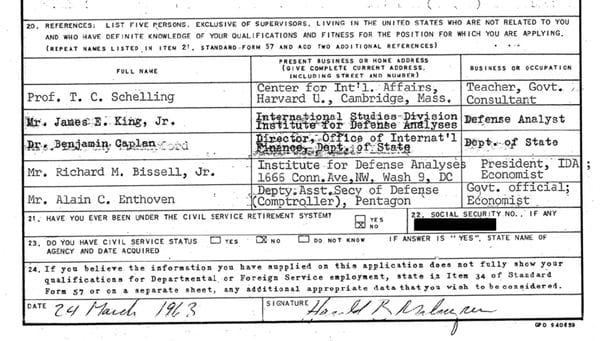
On that March 1963 form Harald listed some seriously prominent individuals as references. James E. King Jr., entered on the application as a Defense Analyst in the International Studies Division at the Institute for Defense Analyses, was one of them. Prof. Thomas Schelling of Harvard's Center for International Affairs. Alain Enthoven, one of Time's five Whiz Kids. Dr. Benjamin Caplan, Director of the Office of International Finance at the State Department. And Richard Bissell, the former CIA Deputy Director for Plans, and by March 1963 the institute's president.131 Two declassified 1979 Agency documents put a James E. King at Headquarters as Coordinator for Academic Relations in the National Foreign Assessment Center, the office that managed the Agency's dealings with universities.132
I'll say what I think, and then what I can't show.
I have a cleaner hypothesis. Malmgren's job application for the State Department role, the one he signed on March 24, 1963, was for a CIA cover position. Johnson's bias prevented him from considering why references may differ on a resume, and that you should tailor your resume for the job that you want.
The other objection is that Bissell fought to move IDA out of the Pentagon.133 He did, and the paperwork shows it. On June 18, 1962, a month before Harald started, Bissell wrote to Robert Loftis, Director of Administrative Services at the Office of the Secretary of Defense, proposing revisions to IDA's contract. IDA's own history of WSEG says the Bell Report prompted them, and that they were meant to make IDA a supplier of services rather than of personnel.
"The self-evident purpose of the language proposed [Bissell wrote] . . . is to emphasize that Contract SD-35 obligates IDA as a corporate entity to perform certain services for specified elements of the Department of Defense, that the members of IDA's professional staff are subject, when working on these tasks, to the supervision of the officers of IDA, and that no individual IDA employees or groups of employees perform their work under the supervision of government officials (except as may be agreed in specific cases)."
Winning a fight for institutional distance from the Joint Chiefs says nothing at all about distance from the Agency he had just left, and would go on to brief, consult for, and defend in public for three decades. I'd be willing to wager a man like that, looking at a well-qualified candidate for the Clandestine Services, would still want him working for the Agency. A policy about where IDA sat has no bearing on one hire. Especially if no one was supposed to know about it. If anything it made IDA a cleaner platform, and Bissell is the last man who would have needed that explained to him.
Bissell was "employed as Consultant concurrently with the Ford Foundation and Mutual Security Agency, as well as ONE/CIA, 1952-54."135 ONE was the Office of National Estimates. Harald came to IDA from RAND in July 1962.136 Bissell came to IDA's presidency the same month and held it until September 1964.137 Jesse Michels says Bissell is all over Harald's diary, with the images recently released in Ryan Purkey's new article.138
The March 1963 form asked for people "who have definite knowledge of your qualifications and fitness for the position for which you are applying," and four of the five have strong defense backgrounds or ties to the intelligence community. Those four point at defense work, or at access to high-profile international figures, or at the man who had run the CIA's clandestine service. The fifth points at the office he was applying to:
- James E. King, a first-rank limited-war and nuclear-strategy theorist, and known to work with and mentor Malmgren on Defense and Nuclear strategy. Sixteen years later, two declassified Agency documents put a James E. King at Headquarters as Coordinator for Academic Relations in the National Foreign Assessment Center, the office handling the Agency's dealings with universities132
- Professor Thomas Schelling, the Harvard economist whose The Strategy of Conflict turned game theory on deterrence and bargaining, and who in February 1963, the month before Malmgren signed the form, chaired the Arms Control Panel of the Air Force Scientific Advisory Board139, during a time known to have been biased toward recruiting clandestine officers from Ivy League universities. Twenty-one years later, in November 1984, CIA listed him as a Panel Member of the Director of Central Intelligence's Military-Economic Advisory Panel139
- Richard Bissell, the former Deputy Director for Plans over clandestine services, and IDA's president at the time Harald worked for them, entered on the form as "President, IDA; Economist"
- Alain Enthoven, one of the original and most well known Whiz Kids, entered on the form as "Depty.Asst.Secy of Defense (Comptroller), Pentagon" and "Govt. official; Economist"
- Dr. Benjamin Caplan, Director of the Office of International Finance at the State Department, the one reference already inside the department he was applying to
In April 1961, King went to a conference in Bologna with Arthur Schlesinger Jr., President Kennedy's Special Assistant.140 Afterward he worked through the senior leadership of Italy alongside the American Chargé.141 President Gronchi.142 Prime Minister Fanfani.143 Aldo Moro, who ran the Christian Democrats.144 Pietro Nenni, who ran the Socialists, for forty minutes.145 He sent his report to Walt Rostow at the National Security Council on May 3.146 The State Department's own published record says how he was regarded, in one sentence.
"Although King explained his status as a private citizen, both U.S. and Italian officials regarded him as an unofficial emissary of the Kennedy administration."
The volume's index of persons lists him as "King, James E., senior analyst, Institute for Defense Analysis, 1961."148
Schelling did more than sit on a form. On September 24, 1964, on Harvard Center for International Affairs letterhead, he wrote to William M. Capron at the Bureau of the Budget, in the Executive Office of the President.
"I understand you are having lunch with Harald Malmgren next week. In case you are interested, I think Hal is extremely good. I have known him since he was an undergraduate at Yale and there is no doubt that he is a person of exceptional talent. You once called me to ask about somebody for a job you wanted done, I believe in the field of intelligence. I don't recall whether I mentioned Malmgren but for something like that he would be extremely good. I mention that because he now is entertaining suggestions about where he should work next. It seems pretty sure that he has decided to leave IDA."
Schelling hedges it twice. He does not recall whether Malmgren's name came up, and he only believes the job was in intelligence. Johnson published the letter, and in his own text he calls it "Schelling's earlier September 1964 letter recommending Malmgren for a job in the STR."150 It is addressed to the Bureau of the Budget and it never mentions the trade office.
Nine months before that March 1963 form, Walt Rostow was setting up a panel on the strategic nuclear balance of 1970 to 1975. On June 20, 1962, on Department of State letterhead as the Counselor, he wrote to John McCone at the Central Intelligence Agency.
"I anticipate that the study will be of special interest to CIA. I should, therefore, like to extend through you, an invitation for Mr. Ray Cline to be a member of the panel. I understand that Professor Schelling has discussed scope and timing of the study with Mr. Cline and that Mr. Cline is willing to participate."
Malmgren had started at IDA on July 23, 1962, eight months before applying to the State Department. The State Department then took him on as a consultant in October 1963, and he stayed at IDA, employed at both at the same time.152 The Optional Form 29 he certified on June 4, 1964 lays out the arrangement in the government's own categories. Dept. of State/Bureau of Economic Affairs, 10/29/63 to 10/28/64, "special Government employee," ten days of service estimated for the year. Under non-federal employment, one line: "Institute for Defense Analyses (Research), Wash. D.C., Head, Economics Group." Under other federal employment he wrote NONE.153
This, I believe, was the start of his cover with the CIA.
Bissell told a closed Council on Foreign Relations session in January 1968 what he thought the Agency most needed to fix.
"That aspect of the Agency's operations most in need of change is the Agency's use and abuse of 'cover.' In this regard, the 'background paper' for this session raised many cover-oriented questions.
"On disclosure of private institutional support of late, it is very clear that we should have had greater compartmenting of operations.
"If the Agency is to be effective, it will have to make use of private institutions on an expanding scale, though those relations which have 'blown' cannot be resurrected.
"We need to operate under deeper cover, with increased attention to the use of 'cut-outs.' CIA's interface with the rest of the world needs to be better protected."
Later in the same session:
"The problem of Agency operations overseas is frequently a problem for the State Department. It tends to be true that local allies find themselves dealing always with an American and an official American, since the cover is almost invariably as a U.S. government employee. There are powerful reasons for this practice, and it will always be desirable to have some CIA personnel housed in the Embassy compound, if only for local 'command post' and communications requirements.
"Nonetheless, it is possible and desirable, although difficult and time-consuming, to build overseas an apparatus of unofficial cover. This would require the use or creation of private organizations, many of the personnel of which would be non-U.S. nationals, with freer entry into the local society and less implication for the official U.S. posture.
". . ."
"Indeed, steps were taken to reduce their size. It is impossible to separate the issue of size from personnel and cover problems. It was Mr. Bissell's impression that the Clandestine Services were becoming increasingly a career service, too much like the Foreign Service (personnel looking to a succession of overt posts in a safe career). One result was the circumscription of local contacts. There was a subtle change taking place, which threatened to degrade some of CIA's former capabilities. Formally, the CIA had a staff with a wide variety of backgrounds, experiences, and capabilities. Its members were recruited from every sort of public and private occupation. If this diversity and variety is lost through the process of recruiting staff members from college, training them in a fairly standard pattern, and carrying them through orderly planned careers in the Agency, one of the organization's most valuable attributes will disappear."
In November 1974:
"The reason the CIA office was located in the embassy—as it is in most of the other countries in the world—is that by presidential order the State Department is responsible for hiding and housing the CIA. Like the intelligence services of most other countries, the CIA has been unwilling to set up foreign offices under its own name, so American embassies—and, less frequently, military bases—provide the needed cover. State confers respectability on the Agency's operatives, dressing them up with the same titles and calling cards that give legitimate diplomats entree into foreign government circles. Protected by diplomatic immunity, the operatives recruit local officials as CIA agents to supply secret intelligence and, especially in the Third World, to help in the Agency's manipulation of a country's internal affairs."
You'll note his next set of references is for a different position. Johnson describes him there as "a candidate for a GS-16 slot as an economist in the Office of the Special Trade Representative, which he got in late 1964."157
The form is signed 8 Oct 64 and it asks for three.158 Schelling again. Caplan again. In King's slot, Dr. Francis M. Bator, address "Executive Offices of the President, Washington, DC," occupation "Economist." There is no State Department supplement this time, so the absence of Bissell and Enthoven is partly the form asking for three names instead of five.
I believe this was an actual economics related job, replacing the defense officials with those that have an economics and trade background. In history those that specialize in trade specifically have been popular due to the fact that trade ties often open up before political ones. On State Department cover, here is John Marks in 1974:
"it is much more difficult and expensive to set up an operative as a businessman (or as a missionary or newsman) than to put him in an embassy. As a 'private' citizen, the operative is not automatically exposed to the host country's key officials and to foreign diplomats, nor does he have direct access to the CIA communications and support facilities which are normally housed in embassies."
"Moreover, as an ex-CIA official explains, 'The deep cover guy has no mobility. He doesn't have the right passport. He is subject to local laws and has to pay local taxes. If you try to put him in an influential business job, you've got to go through all the arrangements with the company.'"
Twenty-two years later, HPSCI's IC21 staff study:
"Clandestine operations managers must concentrate more on building target specific access, a process that, more often than not takes months if not years. Examples are: placing a non-official cover (NOC) officer or recruiting an agent in a company that can plausibly get close to a covert weapons proliferation conduit. . ."
Malmgren's application says he was doing economic and strategic analysis of active defense.
A NOC by design is supposed to be unprovable. A State Department resume for a part time job, carrying references from defense and intelligence officials, one of them the man who had run clandestine operations himself. What I can say is that if you were building this, you would build it out of these parts.
Douglas Dean Johnson: "Real-World History vs. Grandiose Fantasy"
My work in cybersecurity showed me just how much bias can distort an investigation, especially when it comes to attribution. Johnson's articles have some really wonderful examples of the same problem. Johnson wanted to know whether Richard Bissell ever said anything about UFOs.161 He asked the Eisenhower Presidential Library, and he published what came back.162
"Eisenhower Library Supervisory Archivist Jim Ginther found nothing in the Bissell archives indicating that Bissell had expressed opinions or knowledge about UFOs or flying saucers (not surprising no matter what you think the CIA knows about UFOs). However, the library archive contains few records from Bissell's many years at the CIA. I certainly do not know what, if anything, Richard Bissell thought or knew about UFOs, but I highly doubt that he ever discussed the subject with Malmgren. . . ."
He's careful there. He tells you the null result isn't surprising, and he tells you the collection is thin on Bissell's CIA years.164 Then he uses it anyway. The Library however publishes a finding aid for the Bissell Correspondence Series.165 Under the folder Reading File: 1987-1992:
"September 29, 1987, letter from Bissell to Philip J. Klass in which Bissell acknowledges that materials referencing an operation named 'Majestic 12' (MJ-12) materials sent by Lee M. Graham are probably forgeries and that he regrets writing that they appear genuine; July 30, 1987, letter from Bissell to Lee. M. Graham in which Bissell writes that the enclosed documentation concerning materials referencing an operation named 'Majestic 12' (MJ-12) appears authentic and that he has little doubt as to their authenticity."
Bissell wrote about the Majestic 12 documents twice in 1987, said they looked authentic, then took it back two months later.167 Where he landed doesn't matter to the search. The question was whether Bissell had "expressed opinions or knowledge about UFOs or flying saucers," and a man who writes two letters about MJ-12 has expressed an opinion.168
MJ-12 is a famous set of documents that seem to have a mix of both real and disinformation, with some of the documents having profound implications if ever conclusively confirmed as authentic.169 The folder entry describes two letters about MJ-12 and never uses the words "UFO" or "flying saucer." Ask whether Bissell ever expressed opinions or knowledge about UFOs or flying saucers, and this entry doesn't come back.
According to Malmgren, Bissell told him, "You're almost certainly on a curve where you'll continue to be at that level. So there are things you need to know." Then, in Malmgren's telling, "he went into quite a bit, but it was not only about what we still were calling 'UFOs' at that time, but it was about CIA operations worldwide. . ."170
One of the points highlighted by Johnson, "That Malmgren had a close relationship with Richard Bissell, Jr., one of the storied leaders of the early CIA, who imparted to Malmgren many amazing secrets of nonhuman visitation and other things." essentially implying that a high-level retired public official like Bissell telling Malmgren a topic rumored to be more secret than nuclear weapons171 is ludicrous. I have a different, although anecdotal perspective on this. I have no clearance, no working relationship or personal relationship that I'd be allowed to list on a resume, and wrote a book publicly on the topic, continuing to write the occasional article. Yet I get officials of the same caliber or higher telling me similar stories. Give them a bottle of whiskey, the working relationship, and the clearances he did hold, I could absolutely see this being the case, especially as it being an informal discussion by Malmgren's description.
"It sounds to me like the real Harald was pretty busy with all that, with little time left over for masterminding continental missile defense, overseeing White House investigations into an extraterrestrial presence, or receiving weekly briefings at Richard Bissell's home about the Knights of Malta and all the rest."
Malmgren's role was for an estimated ten days. Ten days. That was the annual estimate on a one-year appointment, and the FBI's own file records the consultancy running October 1963 to August 1966, with the clearance terminating the same month.173 As shown, it is my opinion that slot was Malmgren's application for his cover role. Ten days doable to me, especially if the president of the organization I work for and my colleagues are recommending me for the position. After all, for a cover role to work, you do need an actual day job.
I think Johnson's perspective on the Whiz Kids is completely wrong.
But I have yet to find a single book or paper covering McNamara's years as Secretary of Defense that even mentions Harald Malmgren (not counting very recent writings by enthusiasts who are merely repeating the unsupported Malmgren claims), including books written by bona fide McNamara "whiz kids." For example: Two of the most prominent "whiz kids" were Alain C. Enthoven and K. Wayne Smith. They co-authored a book titled How Much Is Enough? Shaping the Defense Program, 1961–1969. It was originally published in 1971, and republished in 2005 by the RAND Corporation. The 2005 edition, embedded below, is 396 pages long. It contains extensive information drawn from the McNamara/whiz kid era, including abundant material on such issues as the development of missile defense systems. The name "Malmgren" appears nowhere in the book.
Two problems. By Johnson's own standard of evidence, K. Wayne Smith was not a prominent Whiz Kid.175 And the book fails that same test on the men who were.
The name started at Ford, where McNamara was one of ten officers hired in 1946 to fix the company's books.176 In 1962 Time pinned it on the Pentagon crowd and singled out five:177
- Alain C. Enthoven
- Harold Brown
- Henry S. Rowen
- Merton Joseph Peck
- Adam Yarmolinsky
Enthoven wrote the book.178 Of the other original four, Adam Yarmolinsky, the group's "elder statesman," is not in it at all.179 Harold Brown and Henry Rowen each appear once.180 Merton Peck appears twice, once in the acknowledgments and once in a citation note.181 Several more men on the retrospective roster are also absent entirely.182
Four mentions between the four of them.
The only place I could find K. Wayne Smith called a Whiz Kid is a blurb reprinted on the opening pages of the later RAND edition of the cited book, and it is about him and Enthoven together:183
"McNamara's decisions were not always right. But a lucid new book by two of his former Whiz Kids demonstrates that his choices usually were based on 'explicit criteria of the national interest.' Decisions by the military services are often compromises to protect 'various institutional, parochial or other vested interests.'"
That review is the only source I could find calling K. Wayne Smith a Whiz Kid. So in January 1966 the Systems Analysis roster is printed in full and one of Johnson's two most prominent Whiz Kids isn't on it.185 He was an Army officer teaching social science at West Point.186 He wouldn't come to the Pentagon until four years after Malmgren. Johnson's test is that the name "Malmgren" appears nowhere in the book, and that there is virtually no reference to Malmgren as a Whiz Kid. He admits there was no formal list, and the definition he does give is loose: the men "whom Robert McNamara brought in with him to help him reform the Department of Defense." On the type the label actually described, I think Malmgren's background fits more closely than K. Wayne Smith's, and Smith is the man Johnson calls one of the most prominent Whiz Kids.187 For the record, I think Smith was a Whiz Kid. I built the case against him to show what happens when Johnson's standard gets pointed at one of his own examples.
Reading the book, I hit a name I knew and couldn't place. Stephen Enke. He sits fourth in a list of Systems Analysis colleagues.188 On Harald's certified 1963 federal job application, signed under penalty of law, his immediate supervisor at IDA is "Dr. Stephen Enke," title "Acting Director, Economics Group."189
"We owe a great deal to our colleagues in the Systems Analysis office, an unusually talented group of men who gave generously of themselves to produce a great deal of analytical work of high quality. Mentioning a few of the leaders of the office necessarily means leaving out many other very able men. However, special mention should be made of Russell Murray II, the Principal Deputy Assistant Secretary of Defense for Systems Analysis, whose calm and evident integrity brought many a stormy controversy to a reasoned conclusion, and Harold Asher, William Brehm, Charles DiBona, Stephen Enke, Arthur Herrington, Victor Heyman, Fred Hoffman, Laurence Lynn, Merton J. Peck, Daniel Rathbun, Herbert Rosenzweig, Charles Rossotti, Dieter Schwebs, Ivan Selin, Jacob Stockfisch, and Robert Valtz."
Four Levels Below
The heading is Johnson's. Enthoven, he notes, was "the deputy assistant secretary of defense (comptroller)," and "a deputy assistant secretary is a position four levels below the Secretary of Defense." His next sentence: "Still, Enthoven actually was a 'whiz kid' personal associate of McNamara."191
The Pentagon's own history of McNamara's first three years, the one that ruled Paul Nitze out as too old, says in the same passage that McNamara "had insisted on being able to install his own team at Defense, a privilege not granted other senior cabinet members," and that out of that team he "also selected a cadre of civilian specialists and professionals, among them a bright young group dubbed the 'Whiz Kids,' who clustered mostly in the newly created Office of Systems Analysis." Then:
"Much of the debate then and later over McNamara's management style stemmed from charges that he placed too much responsibility in the Whiz Kids' hands and that he allowed them—indeed, encouraged them—to interfere in military planning, using them in ways that undermined the authority of State."
Enthoven and Smith describe the office this way:
"The office was led by a Presidentially appointed civilian because it was established to give the Secretary of Defense a point of view that was independent of the military authority structure and individual Service interests. . . . What McNamara saw in the Systems Analysis office was a group of men who worked for him and him alone."
For example, How Much Is Enough? has a chapter called "Why Independent Analysts?" It is the same book Johnson searched for Malmgren's name, and it is Enthoven and Smith explaining what the Systems Analysis office was for.193 Their answer is that the civilian analysts were useful precisely because nothing about the military hierarchy applied to them:
"By way of contrast, intellectual and career independence were the chief characteristics of civilian analysts in the Systems Analysis office. Relatively unhampered by tradition or institutional restraints, free from the need to build consensus, without a predetermined position to sell, and without the need to be good soldiers, these analysts could more easily ask the hard questions and pose genuine alternatives, arriving at a recommendation via a more rational and objective process. They were not constrained to defer to rank, age, experience, or chain of command."
Twenty-two pages earlier, same chapter, the book reproduces the charter that made Systems Analysis a separate office under an Assistant Secretary of Defense in 1965. Then this.
"This charter clearly put the civilian-led Systems Analysis office into an area that had been the exclusive preserve of the military professionals on the Service and JCS staffs. Yet there was no requirement, written or unwritten, that members of the Systems Analysis office have any formal military training, or, indeed, even any prior military experience. Nor was there any requirement that a certain percentage of the office's personnel be career military officers. (In fact, the number of such officers averaged about one-third, and they made a significant contribution.)"
On page 100 they say what the analysts did with that freedom.
"One of the most important contributions of civilian analysts in the Systems Analysis office has been to identify such ideas, bring them to the attention of the Secretary of Defense, and get a hearing on their merits."
Army officers had been pushing an airmobile concept and getting nowhere through their own chain. Two memorandums dated April 19, 1962 went to the Secretary of the Army over McNamara's signature, ordering a re-examination of Army aviation, and the second names nine men who should run the review, from Lt. Gen. Hamilton H. Howze down to Mr. Edward H. Heinemann. The Howze Board came out of those memorandums. The 11th Air Assault Division came out of the Howze Board, and the 1st Cavalry Division (Airmobile) came out of that.
"The two memorandums, which are reprinted below, were drafted for the Secretary of Defense's signature by the Systems Analysis office."
Harald's 1967 Executive Inventory Record lists "systems analysis" among his duties at IDA and the Secretary of Defense was Robert McNamara.
The freedom they are describing belonged to McNamara's own staff. Later in the same chapter Enthoven and Smith separate that staff from the outside think tanks the Services and the JCS maintain, RAND and the Center for Naval Analyses and the Research Analysis Corporation, which they say "tend to take on the philosophical coloration of their sponsoring organization." Policing those studies was part of what the Systems Analysis office was for. IDA is that kind of institution, and it never appears in the book.
The analysts were young civilian economists with no rank at all. Enthoven was thirty in 1961, running one of two directorates inside the comptroller's office under a deputy assistant secretary named Hugh McCullough.198 Richard Zeckhauser arrived the following summer straight out of Harvard College.199 "At that point there were 11 people in the office; I was the most junior."200 His first assignment was the size of the Air Force. "There were about 900,000 people in the Air Force and the question was should it be 900,000 or 890,000, or 880,000. I was supposed to figure it out."201 They ended at 890,000.202
Johnson grants that Malmgren "surely would have had interactions with some political appointees at the Department of Defense, including a few 'whiz kids,'" and expects those interactions "would have been at a level far below that of the Secretary of Defense."203 The officers who were actually there spent the decade complaining about the reverse.
Late in 1961 Admiral George W. Anderson, the Chief of Naval Operations, asked General Lemnitzer to arrange a special meeting with McNamara and the Joint Chiefs. Anderson told the Joint History Office about it seventeen years later, and Poole wrote it down.
"At this meeting, Anderson made three points. First, OSD systems analysts were encroaching upon his statutory responsibilities. Anderson particularly resented efforts by budget analysts to usurp his authority by determining how many attack carriers the Navy needed. Second, public affairs officials in OSD were questioning the Navy's civilian orientation cruise program. Third, Special Assistant Adam Yarmolinsky had been quoted as saying at a dinner party that he 'made or broke general and flag officers.' But then the discussion strayed from Anderson's purpose as General LeMay talked about the future inadequacy of strategic retaliatory forces. Afterwards, as the story filtered back to Anderson, McNamara told several of his people that the Chief of Naval Operations had 'put them on report.'"
General Thomas D. White, a former Air Force Chief of Staff, wrote in 1963:
"In common with many other military men, active and retired, I am profoundly apprehensive of the pipe-smoking, tree-full-of-owls type of so-called professional 'defense intellectuals' who have been brought into this nation's capitol. I don't believe a lot of these often over-confident, sometimes arrogant young professors, mathematicians and other theorists have sufficient worldliness or motivation to stand up to the kind of enemy we face."
Enthoven and Smith say another former Air Force Chief of Staff, General Curtis LeMay, "echoed these sentiments" five years later in the preface to his own book.206 The military profession "has been invaded by pundits who set themselves up as popular oracles on military strategy," those "defense intellectuals" "go unchallenged simply because the experienced professional active duty officers are officially prohibited from entering into public debate," and "the end result is that the military is often saddled with unprofessional strategies."207
Vice Admiral Hyman Rickover told a House appropriations subcommittee the same thing in May 1968.208 The analysts "have little or no scientific training or technical expertise," their studies "read more like the rules of a game of classroom logic than like a prognosis of real events in the real world," and "we are unwise to put the fate of the United States into their inexperienced hands."209 Enthoven and Smith print all three and then answer them. "Arguments against civilian participation in the strategy and force planning process on the grounds of a lack of training and experience will not stand up to close scrutiny. (Indeed, our experience has been that it is often the civilian analysts who have studied in detail and mastered the military aspects of problems under consideration.)"210 The Saturday Evening Post and the subcommittee hearing show a Chief of Staff and a Vice Admiral complaining in public that young civilians with no military background were being listened to.
In 1961, a thirty-year-old Daniel Ellsberg was a RAND consultant with no Pentagon rank at all, drafting questions for Deputy Secretary of Defense Roswell Gilpatric about the general war plans Eisenhower had left behind.211 They went out on May 9 as a two-part memorandum over Gilpatric's name, which the Joint Chiefs cabled to the field commanders, Top Secret.212
"When I showed the draft list to Robert Komer of the NSC staff, he picked out one of the questions and sent it to the chiefs as a presidential query. The question was: 'If existing general war plans were carried out as planned, how many people would be killed in the Soviet Union and China alone?'"
The Joint Chiefs answered within a day or two.214 McNamara had already invited the man who wrote the question, Daniel Ellsberg, to lunch.215
"McNamara's assistant Adam Yarmolinsky had joined us for the last part of the lunch. After we left McNamara's office, Adam took me into his small adjoining room and said, 'You must tell no one outside this room what Secretary McNamara has told you.'"
So was Dr. Harald Malmgren a "Whiz Kid"? I think there's quite a bit of evidence to support it, and he fits the profile almost too well. As Johnson points out, there is no official record. What there is sits on the forms and files Johnson published. A part-time RAND consultancy in 1962. A personal reference from a whiz kid in Enthoven. Systems analysis among his documented duties at IDA. That is on paper, not just on Malmgren's word. And my own experience with him was that he was incredibly smart. When comparing this to K. Wayne Smith, I think Malmgren fits the mold much better.
No Reason to Lie
Johnson's case on the Q clearance is that the Standard Form 86 was sworn under legal penalty, so leaving one off it "would have been inexplicably self-defeating" and "also would have been a crime." Disclosing it could be treated as mishandling classified information. I covered this in my article on whistleblower protections.217 The Intelligence Authorization Act for Fiscal Year 2024 was necessary because CIA sexual assault victims were told that revealing the location of the assault or the real names involved would make them "guilty of mishandling classified information," and were instructed to make false statements to law enforcement.218 Nine months after it passed, at an internal CIA town hall, the agency's own chief operating officer admitted officers were still unsure how to report a crime without breaking the law.219
The CIA is supposed to keep an FBI agent embedded in its Office of Security for exactly these cases, as the Yale Law & Policy Review documented. Jane Doe, a senior officer who came forward in the months after Rachel Cuda's allegations, says the office either couldn't or wouldn't give her that contact, and handed her the FBI's open, nonsecure phone number instead. Both the Office of Security and the Office of General Counsel then warned her that naming her assailant to law enforcement would get her clearance revoked for mishandling classified information. Her attorney intervened, the CIA agreed she could give the name to local law enforcement, and three days after she made the report the agency had authorized, OGC told her she had mishandled classified information by making it.
Johnson follows this topic closely, and it comes up constantly that even members of the congressional oversight committees with the appropriate clearances aren't legally allowed to know what exists, with some in the field going so far as to say they would lie to Congress if necessary. John Kiriakou, who I wrote about in that same article, went to prison over the CIA's torture program, punished not for the torture but for talking about it.220
Johnson's own appendix has an example of how incomplete that paperwork can be. He includes a letter sent to the Senate Foreign Relations Committee on April 21, 1972, while Malmgren's nomination as Deputy Special Representative for Trade Negotiations was pending.221
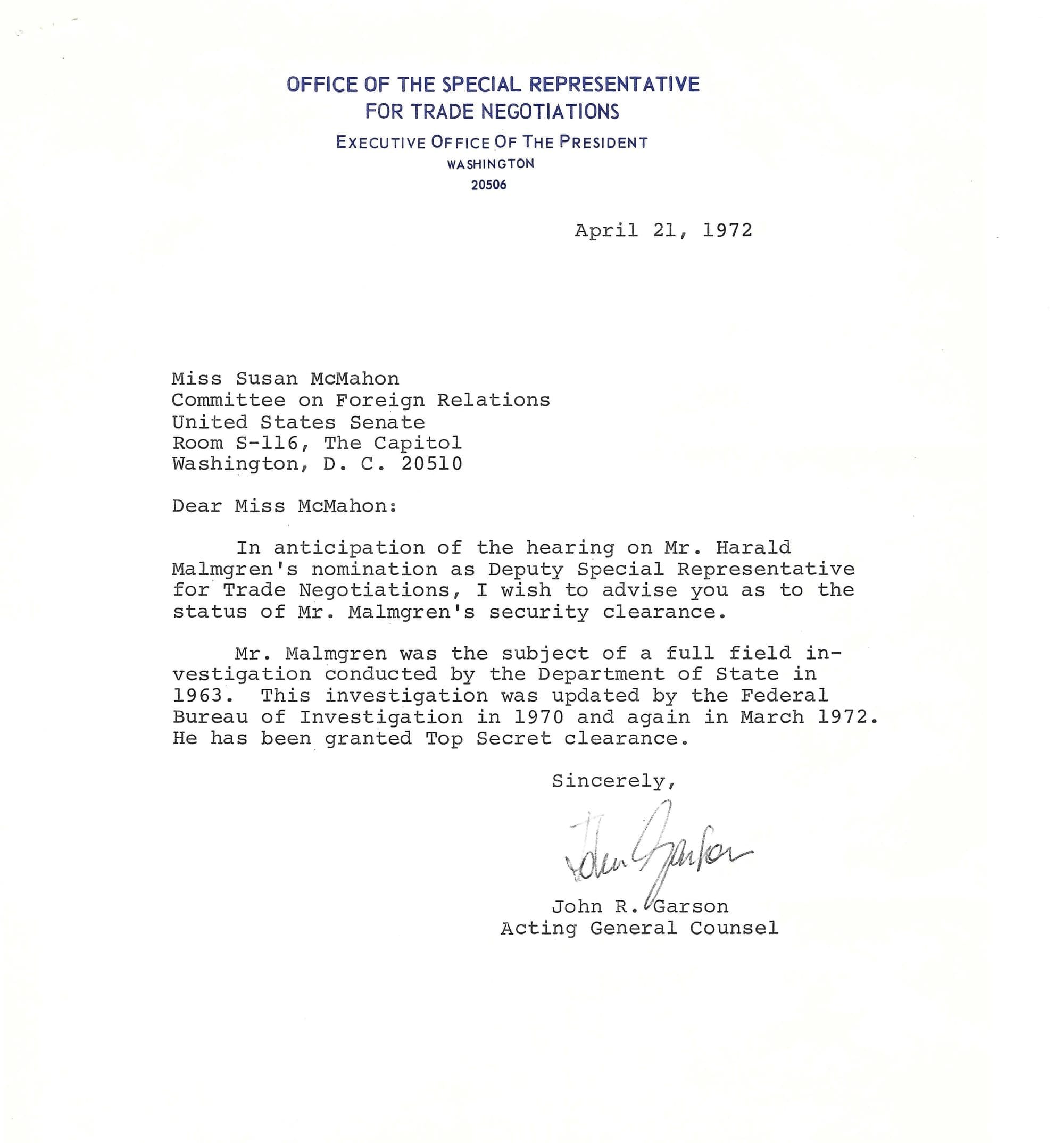
It is four sentences. It advises the committee "as to the status of Mr. Malmgren's security clearance," names a State Department full field investigation in 1963, and ends "He has been granted Top Secret clearance." The FBI file Johnson published records two clearances the letter never mentions: an Air Force Secret in 1962 for the RAND work, and a Navy Top Secret granted July 9, 1962 that ran until August 31, 1967.222
A 1972 letter about a trade nomination has no reason to reach back to a Navy clearance that ended four years and seven months earlier. Its third sentence names the FBI's 1970 update anyway, and that report is the one carrying the Clearances page. A document about a man's security clearance can leave out clearances he held, and this one left out two.
Johnson's own exhibit has the same hole in it. Question 27 of the Standard Form 86 asks whether the signer has, to his knowledge, "ever been the subject of a full field or background personal investigation by any agency of the federal government," and if so for "(1) the name of the investigating agency (2) the approximate date of investigation, and (3) the level of security clearance granted, if known." Malmgren's attachment to the January 28, 1970 form names three. The Institute for Defense Analyses (Navy Department) in 1962, the State Department in 1963, the Executive Office of the President in 1964 and 1969. His attachment to the August 25, 1971 form names four, adding the President's Advisory Council on Executive Organization in January 1970. Neither names the Air Force.
Johnson describes that form as a list of "all of his previous security clearance investigations." It is a list of investigations, not a list of clearances, and the FBI's own report puts a clearance on the record that neither list carries.223
The Top Secret the State Department granted after that 1963 investigation came with a printed limit. Johnson reproduces the notification in his own appendix.
"If appointed, employee may be permitted access to classified information up to and including Top Secret as necessary for the performance of official duties. NO ACCESS may be allowed to information subject to special controls established by statute or executive directives, including Restricted Data (atomic energy information), communications intelligence data, or cryptographic data, without prior approval of the Office of Security, except that the requirement for prior approval of the Office of Security for access to cryptographic data shall not apply to the persons described on the reverse side of this form."
Top Secret bought him nothing on the atomic side by itself. That took a second approval from a different office, and the form says so in capitals. Johnson says the same thing in his own voice, that nuclear secrets are "governed by a system of classification that is somewhat segregated from the classification system applied to other military and intelligence matters." A document reporting that a man holds Top Secret is not a document that would report a Q.224
There is also no single organization that tracks security clearances, least of all for unacknowledged special access programs.225 The government's own annual count of the cleared population is produced by querying three repositories owned by three different agencies and then deleting the duplicates. The closest thing the Intelligence Community has to an authoritative list is permitted by its own guidance to omit "classes of personnel exempted due to specific mission concerns" and to record specific people under pseudonym.226 On August 19, 2026, after Johnson appealed an initial refusal, the NNSA's Office of Defense Nuclear Security reported that it had searched its personnel security tracking system, its electronic repositories, and paper clearance records for calendar year 1962, under combinations of Harold, Harald, Bernard, and Malmgren, along with all 1962 Atomic Energy Commission records pertaining to Q clearances.227
Section 143 of the Atomic Energy Act is what an empty AEC file does not rule out. In the text that was law in October 1962, the certification that put a Defense contractor's employee in front of Restricted Data came from the Defense side, not from the Commission.
"The Commission may authorize any of its employees, or employees of any contractor, prospective contractor, licensee or prospective licensee of the Commission or any other person authorized access to Restricted Data by the Commission under section 2165(b) and (c) of this title to permit any employee of an agency of the Department of Defense or of its contractors, or any member of the Armed Forces to have access to Restricted Data required in the performance of his duties and so certified by the head of the appropriate agency of the Department of Defense or his designee: Provided, however, That the head of the appropriate agency of the Department of Defense or his designee has determined, in accordance with the established personnel security procedures and standards of such agency, that permitting the member or employee to have access to such Restricted Data will not endanger the common defense and security: And provided further, That the Secretary of Defense finds that the established personnel and other security procedures and standards of such agency are adequate and in reasonable conformity to the standards established by the Commission under section 2165 of this title."
That is not a Q clearance. It is duty-limited, it turns on a named Defense official's certification and it could explain the empty file. A man cleared that way leaves nothing in the Commission's personnel security records, which is where NNSA and the National Archives looked.228
Johnson's reason for expecting a thicker file is the investigation.
"But a much deeper level of investigative scrutiny would have been required by the Atomic Energy Commission before it would have issued a Q clearance, including review by the AEC's Personnel Security Board."
Congress had taken the second investigation out ten months before Malmgren started at IDA. Public Law 87-206, signed September 6, 1961, added a subsection c. to section 145: "In lieu of the investigation and report to be made by the Civil Service Commission pursuant to subsection b. of this section, the Commission may accept an investigation and report on the character, associations, and loyalty of an individual made by another Government agency which conducts personnel security investigations, provided that a security clearance has been granted to such individual by another Government agency based on such investigation and report." Malmgren had his Navy Top Secret on a background investigation. The Joint Committee on Atomic Energy printed the case that prompted the change.
"Illustrative of this problem is the case of the Central Intelligence Agency, whose employees are granted security clearance by means of CIA's own investigative procedures. CIA employees thus requiring access to restricted data in the atomic energy program have been required to undergo another full field investigation by either the FBI or CSC."
In fairness, section 145 c. removes the second investigation and nothing else. The Commission still had to determine that access "will not endanger the common defense and security," and a determination is a record. It doesn't explain an empty file. Section 143 might.
Ryan Purkey's research article on Dr. Malmgren shows fairly strong evidence to the contrary, that he more likely than not held a Q clearance.230
"Gentlemen, You Can't Fight in Here! This Is the War Room!"
The books and the government's own histories describe an October 1962 that looks almost nothing like the one I read in Johnson's articles. I went looking for a way to test whether a junior analyst could have stood in one of those rooms without leaving a trace, assuming the answer would be no.
"We know a very great deal about who was saying what to whom among the nation's senior political and military leadership on every day of the crisis."
The paperwork is far worse at settling that question than I assumed.
A State Department record of the meeting on October 19 lists eighteen names under PARTICIPANTS.232 Its second paragraph: "Then ensued a military photographic intelligence briefing on installations in Cuba, presented by a CIA representative (Arthur Lundahl)." Lundahl is not one of the eighteen. Four days later John McCone's memorandum of the Executive Committee meeting of October 23 opens with eleven people listed under the word PRESENT.233 Its first numbered item then reports that "Lundahl displayed the most recent photographs and a map showing 97 per cent coverage of the island."234 Arthur Lundahl is not one of the eleven.
Six days later White House photographer Cecil Stoughton took a single frame of the same committee in session, and the Kennedy Library's record of it indexes eighteen people, among them Bromley Smith.235 The summary record of that meeting names Smith as its author only.236 It never names him as someone in the room. Walter Poole's official history of the Joint Chiefs of Staff records in a footnote that "Vice Chiefs and Operations Deputies often attended as well," and the surviving notes for October 18 open a session with "JCS meeting at 1400, attended by Operations Deputies" and then name none of them.237 In that same October 23 memorandum, Maxwell Taylor agreed to take up and confirm a CIA request that its representatives be stationed "with JCS planning staff and in the Flag Plot and in the JCS War Room."238 The memo does not name them.
McCone wrote the Committee up again after it met at six that evening, the meeting where the President signed the quarantine proclamation. His whole record of who was in the room is one phrase: "All members present plus Counsel for Defense Department."239 A man sat through that meeting and the Director of Central Intelligence entered him as a job title.
Three days later the Committee met again at ten in the morning. McCone's memorandum enters the whole room under one heading, IN ATTENDANCE: "All members plus Governor Stevenson and Mr. McCloy".240 McGeorge Bundy's record of action for that same meeting runs to nine numbered items and carries no attendance list at all.241
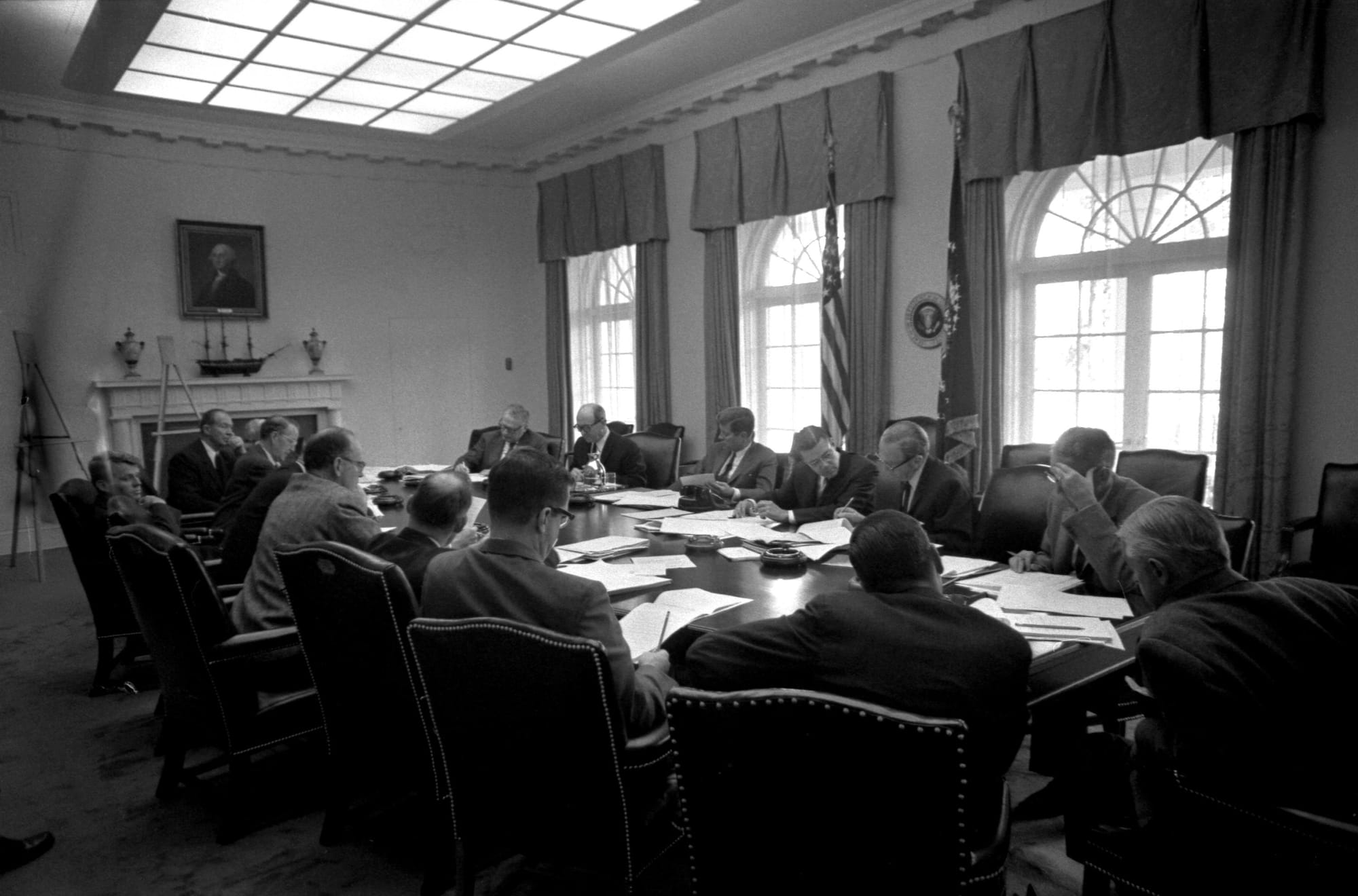
Two meetings on October 16 are barely in the record at all. The State Department's own note at the head of that transcript has Rusk, Ball, Martin, U. Alexis Johnson, Bohlen, Thompson, and Stevenson meeting to discuss Cuba that afternoon, and many of the men at the evening meeting going on to the State Department afterward until about eleven that night. Of the first: "No record of these discussions has been found but they are cited in Rusk's Appointment Book." Of the second: "No other record of these discussions has been found."243
The record also has gaps the participants put there themselves. There were no formal minutes of the Executive Committee's first four meetings, and Bromley Smith began keeping them with the fifth, on October 25.244 The tape of the October 23 meeting has a hole in it because the President appears to have switched the recorder off and then switched it back on.245 The microphone at the evening meeting on October 16 kept running after the meeting broke up, and the transcript credits two speaking turns to "Cleaning man."246 It credits another 135 to "Speaker ?". The Joint Chiefs taped and transcribed their own meetings and then destroyed the tapes and the transcripts in the 1970s, after the Supreme Court ordered Nixon to hand his over, and what survives is Walter Poole's handwritten notes from 1976, typed up in 1993.247 The notes for October 19 are printed with "[illegible in the original]" standing in for words nobody could read.248 They are also missing a line Poole's own history prints. At the 0900 meeting that morning, after the intelligence briefing, Lieutenant General David Burchinal, the Air Force's deputy chief of staff for plans and programs and not a member of the Joint Chiefs, interjected "God! What are we waiting for?" Poole's footnote:249
"Burchinal was Deputy Chief of Staff, Plans and Programs. In 1976, W. S. Poole read his remark but did not include it in the 'Notes Taken From Transcripts.'"
Poole did it again at the end of the same chapter, summing up how each of the Chiefs had performed. This time the man he quotes is the Air Force Chief of Staff.
"General LeMay damaged himself with his outspokenness. 'We're spending $50 billion,' he remarked during a JCS meeting; 'if we can't take care of Cuba we should go home.'"
The footnote to that sentence, on page 339: "In 1976, W. S. Poole read but did not record these remarks in the JCS Minutes."
The other problem isn't documentary. A memoir or an oral history that never mentions a junior man is not a record that excludes him, and I have a hard time believing anyone's recall is good enough to make it one. Sheldon Stern was the Kennedy Library's historian and the first person outside the Executive Committee to hear the tapes. He lists Robert Kennedy's account of Dean Rusk's attendance among the claims in Thirteen Days that the recordings contradict, and puts Rusk at nineteen of the twenty recorded meetings.252 I can't produce the names of everyone I sat in a room with fifteen years ago, and I worked beside some of them nearly every day.
Two years after the crisis the Kennedy Library sat Adam Yarmolinsky down with Daniel Ellsberg. His first answer on Cuba was that he did not know what he could contribute, that he had heard about it from McNamara the morning after the discovery was made. Ellsberg asked whether McNamara had discussed that week's deliberations with him.
"Only in fragmentary fashion. He did, a little; Gilpatric did, a little; as I was involved in various fact-finding."
"Strike First, Strike Hard, No Mercy"
Douglas Dean Johnson grants the first-strike advocacy himself. He writes that "during the period of approximately 1949-1955, there is credible evidence that LeMay, internally within the military, argued for a policy of a 'preventive' nuclear first strike against the Soviet Union," and that this backdrop provides "no support at all" for the position Malmgren describes seven years later.254 Then he narrows it. Those views "did not gain broad military support and were never formally proposed to civilian authorities."255 LeMay was famously known as Curtis "Bombs Away" LeMay after he had stripped his B-29s of guns and sent them in low over Japan in 1945, and his own command's report on the March raid over Tokyo counted 15.8 square miles of the city destroyed.256
Set that against what the words meant in 1962.
Three different things get flattened into "first strike," and Johnson is the one that flattens them. Preventive war is starting a war now because the balance will be worse later. Pre-emption is striking an attack you believe is already coming. First use is using nuclear weapons first in a war someone else started, to stop a conventional attack you cannot stop any other way. Johnson is right that the United States rejected preventive war. It rejected it in writing, in the same paper that made first use national policy.
NSC 5906/1, the Basic National Security Policy approved in August 1959, says both. Paragraph 27: "The United States and its allies must reject the concept of preventive war or acts intended to provoke war." Paragraph 12: "It is the policy of the United States to place main, but not sole, reliance on nuclear weapons . . . and to use them when required to meet the nation's war objectives." Paragraph 20: "the United States should reaffirm that its nuclear weapons will be used, as necessary, to defend Free World interests."257
Kennedy did not replace that paper. He rescinded it on January 17, 1963, three months after the missile crisis.258 It was however the approved basic national security policy of the United States for every day of October 1962.
NATO's operative strategic concept said it more plainly. MC 14/2, approved in 1957 and not superseded until the end of 1967, was in force through both the Berlin and Cuban crises: "we must be prepared to take the initiative in their use," and NATO defense "depends upon an immediate exploitation of our nuclear capability, whether or not the Soviets employ nuclear weapons." The Joint Chiefs' own official history puts it without hedging. Under MC 14/2, "NATO would respond with nuclear weapons, regardless of whether the Soviets did so, in all situations except incursion, infiltration, or local hostile action."259
A year before the crisis Kennedy signed the escalation sequence himself. His October 20, 1961 guidance to Norstad on Berlin sets out four steps. The fourth is the nuclear one: "If, despite Allied use of substantial non-nuclear forces, the Soviets continue to encroach upon our vital interests, then the Allies should use nuclear weapons," running from a demonstration shot through tactical use to "General Nuclear war."260
And five months before the missile crisis, McNamara told the North Atlantic Council in closed session what the arithmetic actually was.
"The United States is also prepared to counter with nuclear weapons any Soviet conventional attack so strong that it cannot be dealt with by conventional means. But let us be quite clear what we are saying and what we have to face. Owing to our non-nuclear deficiencies, there is, first, a high probability that in an ambiguous situation the West, not the East, would have to make the decision to initiate the use of nuclear weapons."
Every one of those documents is an argument for going first less often. The Athens speech is a plea for conventional forces. McNamara calls a demonstration shot "a next-to-last option we cannot dismiss" and says he hesitates to predict what it would cost politically. MC 14/2 carves incursions and infiltrations out of nuclear response entirely. That is the point. The administration working hardest to get out from under first use still had it as declared policy, still wrote it into the President's own signed guidance as the last rung, and still told the alliance in classified session that the West would probably be the one to go first.
Nobody has to "smuggle" first use into 1962. It was the policy.
Thirteen months before the Cuban Missile Crisis, the commander of the Strategic Air Command told the President what he believed.
"In response to questions by the President, General Power indicated his belief that the time of our greatest danger of a Soviet surprise attack is now and during the coming year. If a general atomic war is inevitable, the U.S. should strike first—presumably after locating the essential Soviet nuclear targets."
That is General Thomas Power, and he was answering the President's questions rather than volunteering a demand. General Lyman Lemnitzer, the Chairman of the Joint Chiefs, and Taylor were sitting there.263 LeMay is in the same memorandum on a different fight, and not in the room for it. Kennedy directs Taylor to find out why Power and LeMay disagreed about what could be done. Power told the meeting that American cameras had usable coverage of only ten percent of the Soviet Union, and Lemnitzer and Taylor contested the figure.264

The paper underneath that meeting came out of the White House. Two weeks earlier a National Security Council staffer named Carl Kaysen sent Taylor thirty-one pages arguing that SIOP-62, the standing war plan, was the wrong instrument for a Berlin crisis, because its scale guaranteed Soviet retaliation against American and European cities.265 He proposed something smaller.
"What is required in these circumstances is something quite different. We should be prepared to initiate general war by our own first strike, but one planned for this occasion, rather than planned to implement a strategy of massive retaliation. We should seek the smallest possible list of targets, focussing on the long-range striking capacity of the Soviets, and avoiding, as much as possible, casualties and damage in Soviet civil society."
Taylor forwarded it to Lemnitzer the next day on White House letterhead and asked the Joint Chiefs to evaluate it.267 Kennedy read a summary.268 On September 19 Taylor handed Lemnitzer a list of the President's questions about the war plan, and William Burr, who got the file declassified and published it, writes that "undoubtedly influenced by Kaysen's report, Kennedy also asked questions about the feasibility of a limited first strike."269 Lemnitzer answered on October 11 defending the plan he had, and made no complaint about the first-strike proposal itself.270 In September 1961 it was written down by a civilian, routed to the Chiefs by the President's own military representative, put to the Chairman as a presidential question, and answered.
His own expert supplies the rest.
"There are particular problems with Malmgren's fanciful LeMay story if one knows more about the actual operational plans of the U.S. Air Force and the Strategic Air Command during this period. In the plans in place in 1962, there were certain situations, if a strike on the U.S. seemed imminent, in which the Strategic Air Command would very much have wished to conduct a massive preemptive attack on Soviet nuclear forces. But that has little to do with Malmgren's colorful invention."
Zelikow calls the story fanciful at the start of that paragraph and a colorful invention at the end. In between, he describes plans in place in 1962 under which, if a strike on the U.S. seemed imminent, SAC would very much have wished to conduct a massive preemptive attack.
Three days before the alert the Chiefs went to the White House. Johnson quotes President Kennedy from that meeting, on what a nuclear exchange would mean. "You're talking about the destruction of a country."272 Curtis LeMay was in the same room.
"Now, as for the Berlin situation, I don't share your view that if we knock off Cuba, they're going to knock off Berlin. . . . So I see no other solution. This blockade and political action I see leading into war. I don't see any other solution to it. It will lead right into war. This is almost as bad as the appeasement at Munich."
He is arguing against the blockade and for conventional action on Cuba. Johnson concedes that much, and his own expert says so in the same article.274
On the morning of October 22 it was Curtis LeMay who asked the Joint Chiefs for a worldwide DEFCON 3 and for SAC alone at DEFCON 2, and those were the two requests the Chiefs would not approve themselves.275 McNamara took the first and held the second for the President, who decided it the following night.276 At ten the next morning, as the quarantine came into effect, General Thomas Power ordered SAC to DEFCON 2. About six hours earlier, SAC headquarters had sent every unit its guidance for the new posture. "The emphasis was upon covertly attaining the maximum state of readiness."277 An hour later he used the Primary Alerting System to address his forces, and on his own initiative sent the message in the clear.278 He wanted the Soviets to hear it, and they did. The order had been approved up the chain to the President. The decision to send it unencrypted had not.
The Chiefs taped their own meetings that month and destroyed the tapes and the transcripts in the 1970s.279 What survives is the handwritten notes Poole made in 1976, typed up in 1993. He went on to write the Joint Chiefs' own official history.280 In the debrief that begins at half past six on the evening of Saturday, October 27, hours after a surface-to-air missile killed Major Rudolf Anderson over Cuba and on the same day LeMay had pushed to execute OPLAN 312 followed by the invasion plan, Taylor asks the Chiefs a narrower question.281 LeMay answers as CSAF, Chief of Staff of the Air Force.
"CJCS: Should we take out a SAM site?
"CSAF: No, we would open ourselves to retaliation. We have little to gain and a lot to lose."
Those are the notes Johnson reprints as his Appendix A.283 He never quotes that exchange.284
Five days later, at two in the afternoon on November 1, General Earle Wheeler brought the Chiefs guidance the President had given the day before.285 Kennedy wanted the Cuba operation big enough to move fast, and was willing to thin the forces held back for Berlin to get it.
"If trouble did develop, he would authorize the use of tactical weapons in Europe immediately.
"CJCS: President knows I disagree with him, but he seems very uneasy about it. I will discuss this with him."
The man talking about authorizing tactical weapons in Europe is the President. Taylor, the Chairman, is the one who disagrees.
Robert McNamara described the end of October 1962 to Errol Morris in 2003.
"In a sense, we'd won. We got the missiles out without war. My deputy and I brought the five Chiefs over and we sat down with Kennedy. And he said, 'Gentlemen, we won. I don't want you ever to say it, but you know we won, I know we won.'
"And LeMay said, 'Won? Hell, we lost. We should go in and wipe 'em out today.'
"LeMay believed that ultimately we're going to confront these people in a conflict with nuclear weapons. And, by God, we better do it when we have greater superiority than we will have in the future.
"At the time, we had a 17 to 1 strategic advantage in nuclear numbers."
The last three sentences are civilian Secretary of Defense Robert McNamara himself. What LeMay is quoted saying is about invading Cuba. What the Secretary of Defense says he believed is about the Soviet Union, and about timing.
McNamara spent thirty years finding out how close it had come. In January 1992, at a conference in Havana chaired by Castro, he learned that 162 nuclear warheads had been on the island during the crisis, 90 of them tactical.288 He put three questions to Castro: did you know they were there, would you have recommended their use if the U.S. attacked, and what would have happened to Cuba.
"He said, 'Number one, I knew they were there. Number two, I would not have recommended to Khrushchev, I did recommend to Khrushchev that they be used. Number three, "What would have happened to Cuba?" It would have been totally destroyed.' That's how close we were."
It ran on the wire in 1989. Reporting a Moscow conference on the crisis, the Associated Press moved the story on January 30 under the headline "Castro urged Soviets to hit U.S. with nuclear bombs in '62 crisis."290
Nikita Khrushchev's own account came out twenty months later. He had dictated his memoirs in the late 1960s under house arrest at Petrovo-Dalneye, his family held part of the recordings back for fear he had been too candid, and Time acquired them in 1989. The Associated Press printed the passage on September 24, 1990.
"Castro suggested that to prevent our nuclear missiles from being destroyed, we should launch a pre-emptive strike against the U.S. . . . My comrades in the leadership and I realized that our friend Fidel totally failed to understand our purpose. We had installed the missiles not for the purpose of attacking the U.S. but to keep the U.S. from attacking Cuba."
Khrushchev puts the suggestion after intelligence reports told the Kremlin that an American invasion of Cuba was unavoidable.291 Castro released a letter in November 1990 that put his own recommendation at the point of a United States invasion to occupy the island.292 The two of them disagree about which it was.
The argument Johnson leans on hardest is that none of this could have stayed quiet. If any military leader had urged a first strike during the crisis, he writes, "it would have become known immediately to the President and other top civilian leaders," and "it also would have become common knowledge and very widely discussed during the ensuing decades."293 He is right that the crisis has been discussed for decades. McNamara went on camera about it himself. (I suggest watching The Fog of War, it's great.)
Carl Kaysen's memorandum is the counterexample. Kaysen was on the National Security Council staff, and on September 5, 1961, with Khrushchev's December deadline on West Berlin still standing and the wall three weeks old, he wrote to General Maxwell Taylor, the President's Military Representative, that SIOP-62 would kill 54 percent of the Soviet population and destroy 82 percent of its buildings by floor space, then asked whether that was "really an appropriate next step" to the repulse of a three-division attack across the German border. He wanted a different plan. Taylor put a summary of it in front of Kennedy on September 19. The National Security Archive published it on September 25, 2001, forty years later, still excised and still under appeal at the Defense Department, in the briefing book it posted to accompany Fred Kaplan's Atlantic article on the episode.294 Johnson cites Kaplan in both articles, always The Wizards of Armageddon.295 Berlin appears in neither.296
Ten and a half months after the crisis, on September 12, 1963, the National Security Council met to hear the Net Evaluation Subcommittee's annual report on what a nuclear exchange would cost. Taylor presented it and introduced General Leon Johnson, who took the President's questions. McNamara told the room that "under no circumstances" had he been able to get American casualties under 30 million, and that in the many studies done for him he had not found a situation in which pre-empting would be advantageous.297 The record of the discussion is not a transcript. It is notes taken by members of the subcommittee.
"Speaker—President—I have been told that if I ever released a nuclear weapon on the battlefield I should start a pre-emptive attack on the Soviet Union as the use of nuclear weapons was bound to escalate and we might as well get the advantage by going first.
"Speaker—Gen. Johnson—Stated he did not consider this necessarily true under the circumstances which exist."
He never says who told him. McGeorge Bundy, in the same discussion, called the report itself "one state secret which has been well kept."299
By the definition at the top of this section that is not pre-emption. Nobody believed an attack was coming. Getting the advantage by going first because the balance will be worse later is preventive war.
Pride and Prejudice
Johnson found a defense paper Harald wrote, and graded it. Bias and emotion so clouded his judgment that it seems clear he's searched to win an argument rather than to find the truth. Something all too common among the modern skeptic movement that I've criticized in the past.
"It would probably have earned an upperclassman an A or at least a B if turned in as a term paper at a military academy, but as evidence of high-level expertise in nuclear strategy it is pretty weak tea. The Army editors mentioned only Malmgren's role with the trade negotiation office, not any Department of Defense credential."
He embedded the paper underneath that paragraph so readers could check him.301 What he embedded is the May 1965 Military Review printing, which is a digest.302 The article ran first in Orbis in the fall of 1964, and the Army editors cut the opening footnote when they condensed it.303
Here is the footnote the editors of the reprint cut.304
"The author is indebted to Walter F. Hahn for helpful comments, and to James E. King who provided much of the inspiration for this article. The views expressed are those of the author, and should not be interpreted as reflecting the official opinion or policy of the Institute for Defense Analyses or of any department or agency of the U.S. government."

The Department of Defense credential he says is missing sits in the sentence the Army cut. So is King, whose unpublished IDA paper of February 13, 1964, is the second footnote of the piece Johnson graded, and whom Johnson introduces in a different part of the same article as an IDA division director.306 Albert Wohlstetter had named King alongside Kissinger as a leading limited-war writer six years before that.307
It is also not the only defense byline. On January 11, 1964, nine months before Orbis, The New Republic ran "Europe and American Defense," Malmgren's review of Alastair Buchan and Philip Windsor's Arms and Stability in Europe. The opening column is his own argument rather than the book's. Both superpowers now hold missile forces neither side can destroy in a first strike, so using those weapons even for European defense is "less credible than ever." His conclusion: "It follows that the need for Europe as a strategic base for American defense has disappeared." On the Multilateral Force, the Kennedy administration's plan for shared nuclear control inside NATO, he calls the book's description of it fair, "a device that provides the appearance of European participation in American strategic decisions without the reality."
Four pages later the issue's "Notes on Contributors" runs one line about him. "Harald Malmgren is an economist at the Institute for Defense Analyses."308
The grade is worth a second look too. Military Review is the professional journal of the U.S. Army Command and General Staff College at Fort Leavenworth. Its masthead says it exists for military thought on doctrine at the division level and above.309 Johnson's joke is that the piece reads like an upperclassman's term paper at a military academy. The Army reprinted it for the officers to learn from. Robbin Laird's collection of Harald's essays opens with three appreciations, each on its own page.
- An American perspective from Michael W. Wynne, the 21st Secretary of the United States Air Force.
- A European perspective from Lieutenant General (Retired) Pasquale Preziosa, the former chief of the Italian Air Force.
- An Australian perspective from Air Vice-Marshal John Blackburn AO (Retd), once Deputy Chief of the Royal Australian Air Force.310
Three countries, three careers spent in defense, and not one of them reads Harald the way Johnson does.
Enthoven and Smith, in the book Johnson searched for Malmgren's name, take up the same comparison.
"What is commonly called 'military science' is not scientific in the same sense as law or medicine or engineering. It encompasses no agreed-upon body of knowledge, no prescribed curriculum, no universally recognized principles that one must master to qualify as a military professional."
On the next page they write that "while there has been some recent improvement in this regard, even our most highly trained officers, the graduates of the four-year military academies, still receive very little instruction in planning or analyzing strategy and force requirements," and that "what instruction they do receive along these lines is based largely on the works of civilians." Then they name the civilians. "Military professionals are among the most infrequent contributors to the basic literature on military strategy and defense policy. Most such contributors are civilians: Bernard Brodie, Paul Hammond, Malcolm Hoag, Samuel Huntington, Herman Kahn, Henry Kissinger, Thomas Schelling, Albert Wohlstetter, to name only a few." Schelling taught Harald at Yale and put his name in front of the Bureau of the Budget. Albert Wohlstetter is the one who had named James King alongside Kissinger as a leading limited-war writer.
"When I started this journalistic project, I thought that I already knew a fair amount about the episode. I found that much of what I thought I knew was wrong."
Johnson describes his own work as "a journalistic investigation so far extending more than four months."312 In the same article he wrote down the standard he was measuring everyone else against.
"Some platforms (e.g., NewsNation, the UK Daily Mail, a number of UFO-oriented YouTube channels, Christopher Sharp's Liberation Times blog, etc.) have so far transmitted Malmgren's extraordinary claims without any apparent significant factchecking, much less any searching historical scrutiny."
I agree with the standard. It's the one I've tried to hold this piece to. It is also the standard his own article fails, on documents he went and got himself.
Then there's the register. "Wide-eyed podcasters and content-producers." "Stenography as 'journalism.'" "Palpably absurd." "Laughably transparent." "I challenge promoters of the Malmgren mythology to produce such documents."314
I can't see inside his head, and his articles don't let me guess. Here is what they do let me say. Every one of his errors runs the same way. Not one of them lands in Harald's favor. Carelessness is random, and over four months some of it should have fallen the other direction.
Closing
Johnson graded one of Malmgren's defense papers a B, maybe an A, right before tearing into it. I won't return the favor with a grade of my own. A grade compresses everything down to one symbol. The actual finding is bigger than a symbol. Every error in four months of research broke the same direction. Not one of them favored Harald.
Ultimately, I think this article demonstrated a few things:
- Was he a Whiz Kid?
- Yes.
- Was he likely CIA?
- I think so, with fairly high confidence.
- Was he a Kennedy insider?
- Maybe. He may have had a strong professional relationship and confused it with a personal one, though it seems likely exaggerated.
- Did he stand up to LeMay?
- Probably not.
- Was it common for Whiz Kids to interfere with top military brass, despite their age?
- Yes, LeMay included.
- Was it possible for someone, especially a junior aide likely in the CIA, to not be documented?
- I think I fairly showed that.
- Was nuclear first strike discussed during the Cuban Missile Crisis?
- Yes
- Were nuclear strikes discussed in the years around it?
- Yes.
Individually, any one of Malmgren's claims could be true. It seems very unlikely that they all are. That he doesn't show up at all, if the showdown was real, is suspect. Taken together, most of the legend Harald told about the Cuban Missile Crisis seems fabricated, though if I find evidence to the contrary I'll state it.
What seems most likely is that Malmgren held a cover position for the CIA and genuinely moved in high-level intelligence circles. However, his Cuban Missile Crisis story seems more likely to be an amalgamation of behind-the-scenes experiences of his own, other people's experiences told as his own, and a mix of fabricated sections. I don't know that we'll ever learn the whole truth, but Malmgren is a much more complicated man than the one painted by Johnson.
Notes
- 1Jesse Michels, "Presidential Advisor: 'I Directly Handled UFO Material' (Ft. Harald Malmgren)," YouTube video, 3:49:17, at 1:20:49, April 22, 2025, https://www.youtube.com/watch?v=09KP8XVf5nY.
- 2Michels, "Presidential Advisor," 55:31; Douglas Dean Johnson, "Harald Malmgren: Real-World History vs. Grandiose Fantasy," Mirador, May 20, 2025, https://douglasjohnson.ghost.io/harald-malmgren-history-vs-fantasy/.
- 3Harald Malmgren, post on X, December 22, 2024, quoted in Douglas Dean Johnson, "Harald Malmgren Saves the World: A Fantasy Set during the Cuban Missile Crisis," Mirador, June 9, 2025, https://douglasjohnson.ghost.io/harald-malmgren-saves-the-world/.
- 4Michels, "Presidential Advisor," 3:13.
- 5Johnson, "Real-World History."
- 6Ryan Purkey, "Harald Malmgren: The Insider Who Front-Ran Washington on UFO Disclosure," Unquestionably Skeptical (Substack), August 25, 2026, https://unquestionablyskeptical.com/p/harald-malmgren.
- 7Ronald Reagan, "Address Before a Joint Session of the Indiana State Legislature in Indianapolis," Ronald Reagan Presidential Library & Museum, February 9, 1982, https://www.reaganlibrary.gov/archives/speech/address-joint-session-indiana-state-legislature-indianapolis.
- 8Michels, "Presidential Advisor"; Harald Malmgren (@Halsrethink), X post, August 19, 2024, https://x.com/Halsrethink/status/1825658208175702074.
- 9Matthew Pines (@matthew_pines), X post, August 19, 2024, https://x.com/matthew_pines/status/1825633094411628727.
- 10Douglas Charles, "Former Senior Presidential Advisor Claims CIA Briefed Him On 'Otherworld Technologies,'" BroBible, August 29, 2024, https://brobible.com/culture/article/former-presidential-advisor-malmgren-cia-otherworld-technologies/; Harry McGee, "Meet the Malmgrens: The Extraordinary Family US Presidents Turned To," Irish Times, November 8, 2017, https://www.irishtimes.com/news/world/meet-the-malmgrens-the-extraordinary-family-us-presidents-turned-to-1.3284559.
- 11Harald Malmgren (@Halsrethink), X profile, https://x.com/Halsrethink.
- 12"Obituary for Harald B. Malmgren," Joynes Funeral Home, Inc., February 2025, https://www.joynesfuneralhome.com/obituary/Harald-Malmgren.
- 13Harald Malmgren, interview by the author, September 2024.
- 14Michels, "Presidential Advisor," 59:57.
- 15Michels, "Presidential Advisor," 1:01:26.
- 16Michels, "Presidential Advisor," 54:45-1:00:22.
- 17Michels, "Presidential Advisor," video description; Michels, "Presidential Advisor," April 22, 2025.
- 18The Sol Foundation, "Sol's 2024 Symposium," accessed June 7, 2026, https://thesolfoundation.org/events/sols-2024-symposium/.
- 19Wikipedia, s.v. "Pippa Malmgren," last modified June 15, 2025, 10:44, https://en.wikipedia.org/wiki/Pippa_Malmgren.
- 20"Adviser on Banking Gives Bush a Trader's-Eye View," American Banker, May 24, 2001, https://www.americanbanker.com/news/adviser-on-banking-gives-bush-a-traders-eye-view.
- 21"Dr. Harald Malmgren, Dr. Pippa Malmgren: Post-Election Special," MacroVoices, November 2016, https://www.macrovoices.com/212-pippa-harald-malmgren.
- 22Wikipedia, s.v. "Jobs and Growth Tax Relief Reconciliation Act of 2003," last modified June 10, 2026, 15:11, https://en.wikipedia.org/wiki/Jobs_and_Growth_Tax_Relief_Reconciliation_Act_of_2003.
- 23Wikipedia, s.v. "Ownership society," last modified October 19, 2025, 19:04, https://en.wikipedia.org/wiki/Ownership_society.
- 24Wikipedia, s.v. "2008 financial crisis," last modified August 23, 2026, 03:06, https://en.wikipedia.org/wiki/2008_financial_crisis.
- 25Companies House, "Karen Philippa Malmgren: Personal Appointments," officer ID za_sDdpYBBZU6Wn4VAHzshPK800, accessed June 7, 2026, https://find-and-update.company-information.service.gov.uk/officers/za_sDdpYBBZU6Wn4VAHzshPK800/appointments. Canonbury Group Limited, company no. 03535111: director appointed July 1, 2000 and resigned February 15, 2001; secretary appointed October 9, 2000 and resigned February 15, 2001; director appointed again February 5, 2003. The register keys officer records to name plus month and year of birth rather than to verified identity, and the May 1962 date of birth on this record matches American Banker's description of her as having just turned thirty-nine in May 2001. The two rows bound the tenure at each end; they do not date the exit.
- 26"Adviser on Banking Gives Bush a Trader's-Eye View."
- 27Karen Philippa Malmgren, "Economic Statecraft: United States Antidumping and Countervailing Duty Policy" (PhD diss., London School of Economics and Political Science, 1991), https://researchonline.lse.ac.uk/132079; Paddy Briggs, "Pensions People: Pippa Malmgren," Pensions Age, April 2014, https://www.pensionsage.com/pa/apr-pensions-people-pippa-malmgren.php; American Banker, "Trader's-Eye View."
- 28McGee, "Meet the Malmgrens."
- 29Wikipedia, s.v. "Stelios Haji-Ioannou," last modified August 19, 2026, 12:19, https://en.wikipedia.org/wiki/Stelios_Haji-Ioannou, citing "Easyjet Founder Stelios Knighted," BBC News, June 16, 2006; Wikipedia, "Pippa Malmgren."
- 30Philippa Malmgren, Signals: The Breakdown of the Social Contract and the Rise of Geopolitics (Guildford, UK: Grosvenor House Publishing, 2015); reissued as Pippa Malmgren, Signals: How Everyday Signs Can Help Us Navigate the World’s Turbulent Economy (London: Weidenfeld & Nicolson, 2016).
- 31Wikipedia, s.v. "Shrinkflation," last modified August 25, 2026, 03:08, https://en.wikipedia.org/wiki/Shrinkflation.
- 32Harald Malmgren and Pippa Malmgren, "America and China Should Kiss and Make Up," UnHerd, November 15, 2023, contributor biography, https://unherd.com/2023/11/america-and-china-should-kiss-and-make-up/.
- 33Johnson, "Real-World History."
- 34Klaus, "Project Preserve Destiny," Patterns Tell Stories, podcast, July 31, 2025, at [00:08:40], https://podcasters.spotify.com/pod/show/s105/episodes/Project-Preserve-Destiny-e36a4sc. Klaus is describing his own departure, in the first person. Neither of his two tellings in this episode (the second at [00:29:03]) names Pippa Malmgren or Peter Thiel, and the message he reads aloud at [00:08:08] attributes Pegasus to the White House rather than to any private individual. Transcript held by the author.
- 35"Escape Velocity" (@EscapeVelocity1), "Terrifying Concerns about the Project Preserve Destiny UFO/NHI Program Moving from DoD to Executive," Medium, August 2, 2025, https://medium.com/@EscapeVelocity1/terrifying-concerns-about-the-project-preserve-destiny-ufo-nhi-program-moving-from-dod-to-executive-5146cd8f8bcf.
- 36"Escape Velocity," "Terrifying Concerns."
- 37"Escape Velocity," "Terrifying Concerns."
- 38"Escape Velocity," "Terrifying Concerns."
- 39"Escape Velocity," "Terrifying Concerns"; Klaus, "Project Preserve Destiny."
- 40John Scott-Railton, Bill Marczak, Bahr Abdul Razzak, Kate Pundyk, Siena Anstis, and Ron Deibert, "Member of Committee Investigating Spyware Hacked with Pegasus," Citizen Lab, University of Toronto, July 3, 2026, https://citizenlab.ca/research/member-of-committee-investigating-spyware-hacked-with-pegasus/.
- 41Bill Marczak, John Scott-Railton, Noura Aljizawi, Siena Anstis, and Ron Deibert, "The Great iPwn: Journalists Hacked with Suspected NSO Group iMessage Zero-Click Exploit," Citizen Lab, University of Toronto, December 20, 2020, https://citizenlab.ca/research/the-great-ipwn-journalists-hacked-with-suspected-nso-group-imessage-zero-click-exploit/.
- 42Hannah Natanson, Gerrit De Vynck, Elizabeth Dwoskin, and Danielle Douglas-Gabriel, "Elon Musk’s DOGE Is Feeding Sensitive Federal Data into AI to Target Cuts," Washington Post, February 6, 2025, https://www.washingtonpost.com/nation/2025/02/06/elon-musk-doge-ai-department-education/. See also: https://web.archive.org/web/20250206174702/https://www.washingtonpost.com/nation/2025/02/06/elon-musk-doge-ai-department-education/.
- 43The Associated Press, "Federal Judge Blocks DOGE from Accessing Sensitive U.S. Treasury Department Material," NPR, February 8, 2025, https://www.npr.org/2025/02/08/g-s1-47350/states-sue-to-stop-doge-accessing-personal-data.
- 44Bill Marczak, John Scott-Railton, Kate Robertson, Astrid Perry, Rebekah Brown, Bahr Abdul Razzak, Siena Anstis, and Ron Deibert, "A First Look at Paragon's Proliferating Spyware Operations," Citizen Lab, University of Toronto, March 19, 2025, https://citizenlab.ca/research/a-first-look-at-paragons-proliferating-spyware-operations/; Patrick Gray and Adam Boileau, "Risky Business Weekly (778): Musk's Child Soldiers Seize Control of FedGov IT Systems," Risky Business Media, YouTube video, 56:16, at 23:14, February 5, 2025, https://www.youtube.com/watch?v=A2SLP2LdAyA&t=1394.
- 45Patrick Gray and Adam Boileau, "Risky Business Weekly (805)," Risky Business Media, YouTube video, 61:55, at 41:36, September 3, 2025, https://www.youtube.com/watch?v=SKWooX9Kg3k&t=2496. Gray's words are "I think they suspended that contract"; the procurement record itself is not in the copy I have.
- 4618 U.S.C. § 2512, https://www.law.cornell.edu/uscode/text/18/2512.
- 47U.S. Attorney's Office, Eastern District of Wisconsin, "Marcus Hutchins Pleads Guilty to Creating and Distributing the Kronos Banking Trojan and UPAS Kit Malware," press release, U.S. Department of Justice, https://www.justice.gov/usao-edwi/pr/marcus-hutchins-pleads-guilty-creating-and-distributing-kronos-banking-trojan-and-upas May 3, 2019. See also Judgment in a Criminal Case, United States v. Hutchins, No. 2:17-cr-00124-JPS (E.D. Wis. July 29, 2019), ECF No. 140, at 1 (Count Two, 18 U.S.C. §§ 2, 2512(1)(c)(i), "Advertisement of wire, oral, or electronic communication-intercepting devices"), https://storage.courtlistener.com/recap/gov.uscourts.wied.77855/gov.uscourts.wied.77855.140.0.pdf.
- 48Patrick Gray and Adam Boileau, "Risky Business Weekly (775): Cl0p Is Back, SEC Hack Disclosures Disappoint," Risky Business Media, YouTube video, 61:06, at 30:51, December 18, 2024, https://www.youtube.com/watch?v=RquLQQyrP-I&t=1851.
- 49Tom Uren and The Grugq, "Between Two Nerds: A Paragon of Virtue," Risky Business Media, YouTube video, 24:52, at 2:12 and 9:41, February 10, 2025, https://www.youtube.com/watch?v=lsLx_lezmVs&t=132. Between Two Nerds is a different show on the same network, with different hosts from the Risky Business Weekly episodes cited elsewhere in this section. Uren is reading from Financial Times reporting; I have not read the original article.
- 50Patrick Gray and Adam Boileau, "Risky Business Weekly (795): How the Com Is Hacking Salesforce Tenants," Risky Business Media, YouTube video, 67:34, at 7:09, June 11, 2025, https://www.youtube.com/watch?v=elVFqcIWphQ&t=429.
- 51Patrick Gray and Adam Boileau, "Risky Business Weekly (814)," Risky Business Media, YouTube video, 63:19, at 16:35, November 12, 2025, https://www.youtube.com/watch?v=SVgSbsbAaIs&t=995.
- 52Robbin Laird, Assessing Global Change: Strategic Perspectives of Dr. Harald Malmgren (2025), Defense.info, August 11, 2024, https://defense.info/book-review/2024/08/assessing-global-change-strategic-perspectives-of-dr-harald-malmgren/.
- 53Klaus, "Project Preserve Destiny."
- 54Pippa Malmgren, "Erebor, Erewhon, Stablecoins, Zizians and The Dark Enlightenment," Dr. Pippa (Substack), July 7, 2025, https://drpippa.substack.com/p/erebor-erewhon-stablecoins-zizians.
- 55Malmgren, "Erebor, Erewhon"; Ava Kofman, "Curtis Yarvin's Plot Against America," The New Yorker, June 9, 2025, https://www.newyorker.com/magazine/2025/06/09/curtis-yarvin-profile.
- 56Malmgren, "Erebor, Erewhon."
- 57Malmgren, "Erebor, Erewhon."
- 58Malmgren, "Erebor, Erewhon."
- 59Malmgren, "Erebor, Erewhon."
- 60Malmgren, "Erebor, Erewhon."
- 61Patrick Martin, "North Korea Is Behind Cyberattacks Worth $US3 Billion and Is Stealing Cryptocurrency to Fund Weapons Programs, UN Report Finds," ABC News (Australia), March 22, 2024, https://www.abc.net.au/news/2024-03-22/north-korea-stealing-cryptocurrency-to-fund-nuclear-weapons/103618152.
- 62Pippa Malmgren, "Digital Dragnet and Regime Change: Warsh Is Replacing the Kleptocrats with Compute," Dr. Pippa (Substack), June 9, 2026, https://drpippa.substack.com/p/digital-dragnet-and-regime-change.
- 63Michels, "Presidential Advisor"; Johnson, "Real-World History"; Douglas Dean Johnson, "Bluegill Triple Prime: Did a Nuclear Test Knock Down a Nonhuman Craft in 1962?," Mirador, May 21, 2025, https://douglasjohnson.ghost.io/bluegill-triple-prime-nuclear-ufo/; Douglas Dean Johnson, "Harald Malmgren Saves the World: A Fantasy Set during the Cuban Missile Crisis," Mirador, June 9, 2025, https://douglasjohnson.ghost.io/harald-malmgren-saves-the-world/.
- 64Harald Malmgren, interview, "69. Harald Malmgren," Nothing Exempt, YouTube video, 54:45, at 23:29, August 2, 2018, https://www.youtube.com/watch?v=5LNuOorn44Y.
- 65Wikipedia, s.v. "Whiz Kids (Ford)," last modified August 14, 2026, 23:15, https://en.wikipedia.org/wiki/Whiz_Kids_%28Ford%29; "The Whiz Kids," DBusiness Magazine, https://www.dbusiness.com/from-the-magazine/the-whiz-kids/.
- 66Kirkus Reviews, review of The Whiz Kids: Ten Founding Fathers of American Business and the Legacy They Left Us, by John A. Byrne, September 1, 1993, https://www.kirkusreviews.com/book-reviews/john-a-byrne/the-whiz-kids/; Wikipedia, "Whiz Kids (Ford)."
- 67Wikipedia, "Whiz Kids (Ford)."
- 68"The Whiz Kids," DBusiness.
- 69Wikipedia, s.v. "Robert McNamara," last modified August 12, 2026, 14:13, https://en.wikipedia.org/wiki/Robert_McNamara.
- 70Wikipedia, "Robert McNamara."
- 71Wikipedia, "Whiz Kids (Ford)."
- 72Wikipedia, s.v. "Whiz Kids (Department of Defense)," last modified August 14, 2026, 23:39, https://en.wikipedia.org/wiki/Whiz_Kids_%28Department_of_Defense%29.
- 73Lawrence S. Kaplan, Ronald D. Landa, and Edward J. Drea, The McNamara Ascendancy, 1961–1965, History of the Office of the Secretary of Defense, vol. V (Washington, DC: Historical Office, Office of the Secretary of Defense, 2006), 74.
- 74Wikipedia, "Whiz Kids (DoD)."
- 75"Nation: The Pentagon's Whiz Kids," Time, August 3, 1962, https://time.com/archive/6831428/nation-the-pentagons-whiz-kids/.
- 76Time, "Pentagon's Whiz Kids."
- 77Time, "Pentagon's Whiz Kids"; "Defense: The Whizziest Kid," Time, June 28, 1963, https://time.com/archive/6812673/defense-the-whizziest-kid/.
- 78Time, "Pentagon's Whiz Kids."
- 79Time, "Pentagon's Whiz Kids."
- 80Time, "Pentagon's Whiz Kids."
- 81Time, "Pentagon's Whiz Kids."
- 82Kaplan, Landa, and Drea, McNamara Ascendancy, 74, 76. Hitch's appointment is at 74 and Enthoven's weapons systems analysis directorate inside the comptroller's office at 76. The history does not mention Peck, whose place under Enthoven is Time's.
- 83Johnson, "Real-World History."
- 84Time, "Pentagon's Whiz Kids."
- 85Wikipedia, "Whiz Kids (DoD)."
- 86Kaplan, Landa, and Drea, McNamara Ascendancy, 305.
- 87Kaplan, Landa, and Drea, McNamara Ascendancy, 310. The characterization is the historians' own summary of Kaufmann's view, not a quotation of Kaufmann.
- 88Historical Office, Office of the Secretary of Defense, The Ascendancy of the Secretary of Defense: Robert S. McNamara, 1961–1963, Cold War Foreign Policy Series, Special Study 4, ed. Erin R. Mahan and Jeffrey A. Larsen (Washington, DC: Historical Office, Office of the Secretary of Defense, July 2013), 13, https://history.defense.gov/Portals/70/Documents/special_studies/SpecStudy4.pdf. The same page gives Nitze as Assistant Secretary for International Security Affairs from 1961 to 1963.
- 89Charles J. Hitch and Roland N. McKean, The Economics of Defense in the Nuclear Age (Cambridge, MA: Harvard University Press, 1960). On McNamara's adoption of the framework, see Kaplan, Landa, and Drea, McNamara Ascendancy, 74.
- 90Alain C. Enthoven and K. Wayne Smith, How Much Is Enough? Shaping the Defense Program, 1961–1969 (New York: Harper & Row, 1971; repr., Santa Monica, CA: RAND, 2005), https://www.rand.org/pubs/commercial_books/CB403.html.
- 91Alain C. Enthoven, "Choosing Strategies and Selecting Weapon Systems," U.S. Naval Institute Proceedings 90, no. 1 (January 1964), https://www.usni.org/magazines/proceedings/1964/january/choosing-strategies-and-selecting-weapon-systems. The text is Enthoven's lecture to the Naval War College, Newport, Rhode Island, June 6, 1963, printed in full. In the same lecture he carves out "military operational command, which is a very different matter," and describes the professional training of civilians in the Office of the Secretary of Defense as economic, scientific, technical and diplomatic rather than economic alone.
- 92Malmgren, Standard Form 57, March 24, 1963, item 14 (birth date, July 13, 1935) and item 19 (IDA start date). The October 8, 1964 form gives the start date as July 23, 1962 rather than July 25.
- 93Johnson, "Real-World History"; Federal Bureau of Investigation, declassified background-investigation file on Harald B. Malmgren, 33 pp., DOCID 34687837, released May 9, 2025 (FOIA), reproduced in Douglas Dean Johnson, "Harald Malmgren: Real-World History vs. Grandiose Fantasy," https://douglasjohnson.ghost.io/harald-malmgren-history-vs-fantasy/.
- 94FBI, Malmgren background file.
- 95Johnson, "Real-World History."
- 96Harald B. Malmgren, Standard Form 57, "Application for Federal Employment," March 24, 1963, and October 8, 1964, and Standard Form 171, "Personal Qualifications Statement," January 29, 1970, Official Personnel Folder (declassified, obtained via FOIA), reproduced in Johnson, "Real-World History." "Economist" and "economic and strategic analysis of active defense" are from the 1963 form; "Head, Economics Group" and "some 20 economists and a dozen research assistants" are from the 1964 form; the reference to the Office of the Secretary of Defense and the Joint Chiefs of Staff is from the 1970 form.
- 97Harald B. Malmgren, "Executive Inventory Record," Standard Form 151 (April 1967), U.S. Civil Service Commission, Bureau of Executive Manpower, FPM Chap. 305, no. 144581, signed June 28, 1967, Part II, block B, item 9a, published by Douglas Dean Johnson, https://douglasjohnson.ghost.io/content/files/2025/05/Malmgren-Executive-Inventory-6-28-67_Redacted-1.pdf.
- 98Malmgren, "Executive Inventory Record," item 9b. Read from the page image; the OCR renders "Defense" as "Befense."
- 99Johnson, "Real-World History." The sentence continues, in parentheses, "or to any training or expertise in any field of science or engineering."
- 100Johnson, "Real-World History."
- 101Fred Kaplan, The Wizards of Armageddon (New York: Simon and Schuster, 1983), 254. Johnson quotes the same sentence at his note 5, adding that "Enthoven was a deputy assistant secretary." Page confirmed by two independent full-text instruments. The book's note run for pages 252–255 carries a single note keyed to page 254, and it sources a different quotation to Henry L. Trewhitt, McNamara (New York: Harper & Row, 1971), 13; the near-daily-access sentence carries no note at all. Kaplan's list of interviews, 431, records Enthoven at Palo Alto on September 2 and December 12, 1980, and June 10, 1981.
- 102Charles Lewis, America's Frontline Trade Officials (Washington, DC: Center for Public Integrity, 1990), 105, https://douglasjohnson.ghost.io/content/files/2025/05/America-s-Frontline-Trade-Officials---Charles-Lewis-CPI--1990-.pdf. The report misnames the Institute for Defense Analyses as the "Institute for Defense Analysis."
- 103Johnson, "Real-World History."
- 104Johnson, "Real-World History," note 1, dating Malmgren's Cuban Missile Crisis and UFO accounts to "his posts on X (formerly Twitter) starting in the summer of 2024."
- 105Johnson, "Real-World History."
- 106Johnson, "Real-World History."
- 107Johnson, "Real-World History."
- 108Johnson, "Real-World History."
- 109Richard M. Bissell Jr., transcript of speech given at Central Intelligence Agency Headquarters, October 12, 1965 (SECRET/BYEMAN; released sanitized February 25, 2014, MDR case EOM-2013-02065), governmentattic.org, https://www.governmentattic.org/11docs/CIA-1965Bissellspeech_2014.pdf.
- 110Johnson, "Real-World History"; Johnson, "Malmgren Saves the World."
- 111Johnson, "Malmgren Saves the World."
- 112Johnson, "Malmgren Saves the World."
- 113Johnson, "Real-World History."
- 114Johnson, "Real-World History"; Johnson, "Malmgren Saves the World." IDA's own history describes him the same way: "Dr. Bissell, an economist by training, was an MIT professor in the latter 1940's, an assistant administrator and acting administrator in the foreign aid program (the European Cooperation Administration) in the early 1950's, and a CIA official from 1954 to 1962." John Ponturo, Analytical Support for the Joint Chiefs of Staff: The WSEG Experience, 1948–1976, IDA Study S-507 (Arlington, VA: Institute for Defense Analyses, July 1979), 212n187, DTIC ADA090946.
- 115Bissell, 1965 CIA Headquarters speech.
- 116Robbin Laird, "The Career of Dr. Harald Malmgren: Learning and Influencing America in Change" (profile, June 7, 2024), hosted by Douglas Dean Johnson, https://douglasjohnson.ghost.io/content/files/2025/05/Robbin-Laird-profile-of-Harald-Malmgren--6-7-24-.pdf; Johnson, "Real-World History."
- 117Johnson, "Real-World History."
- 118Johnson, "Real-World History."
- 119Johnson, "Real-World History."
- 120Central Intelligence Agency, Office of Training, The Junior Officer Training Program, 1950–1966 (OTR-11 monograph, declassified), CIA-RDP90-00708R000300100001-5, https://www.cia.gov/readingroom/document/cia-rdp90-00708r000300100001-5.
- 121CIA, Junior Officer Training Program History.
- 122CIA, Junior Officer Training Program History.
- 123CIA, Junior Officer Training Program History.
- 124Central Intelligence Agency, "The Evolution of the Junior Officer Training Program, 1951–1963" (CONFIDENTIAL), 34, 40, 44, CIA-RDP78-06365A000200070001-3, CIA Reading Room.
- 125CIA, Junior Officer Training Program History; U.S. Department of State, Foreign Relations of the United States, 1964–1968, Volume XXXIII, Organization and Management of Foreign Policy; United Nations, Document 275, "Précis Prepared by the Executive Director-Comptroller of the Central Intelligence Agency (White)," forwarded to Helms and Taylor March 29, 1968, https://history.state.gov/historicaldocuments/frus1964-68v33/d275.
- 126Dwight D. Eisenhower Presidential Library, Richard M. Bissell Jr. Papers (Accession 09-01), biographical appendix and chronology, Abilene, Kansas. See also: https://www.eisenhowerlibrary.gov/research/finding-aids/bissell-richard-m-jr.
- 127Richard M. Bissell Jr., Reflections of a Cold Warrior: A Key Player Looks Back (New Haven: Yale University Press, 1996), 7, quoted in H. Bradford Westerfield, review, "Reflections of a Cold Warrior: From Yalta to the Bay of Pigs," Studies in Intelligence (Winter 1998–99), https://www.cia.gov/resources/csi/studies-in-intelligence/studies-in-intelligence-winter-1998-1999/reflections-of-a-cold-warrior-from-yalta-to-the-bay-of-pigs.
- 128Laird, "Career of Dr. Harald Malmgren."
- 129Laird, "Career of Dr. Harald Malmgren."
- 130Jesse Michels, "The Pentagon's UFO Program Is Real [Here's How It Works!] ft. UAPGerb," YouTube video, 3:51:52, at 1:07:00, January 11, 2026, https://www.youtube.com/watch?v=u7g5Sn1DJF4&t=4020.
- 131Supplement to Standard Form 57 (Form DSP-34), Department of State, item 20, "References," in Harald B. Malmgren, Application for Federal Employment, signed March 24, 1963. Published in Douglas Dean Johnson, "Harald Malmgren: Real-World History vs. Grandiose Fantasy," Mirador, May 20, 2025, https://douglasjohnson.ghost.io/harald-malmgren-history-vs-fantasy/.
- 132Central Intelligence Agency, "Central America After Somoza Dinner/Discussion" participant list, Room 7D64, CIA Headquarters, August 2, 1979 (CIA-RDP86B00985R000200200006-3), archive.org mirror, https://archive.org/details/cia-readingroom-document-cia-rdp86b00985r000200200006-3; Central Intelligence Agency, "DCI Dinner/Discussion, 20 September 1979" participant list, September 20, 1979 (CIA-RDP86B00985R000200210008-0), archive.org mirror, https://archive.org/details/cia-readingroom-document-cia-rdp86b00985r000200210008-0.
- 133Evan Thomas, The Very Best Men: The Daring Early Years of the CIA (New York: Simon & Schuster, 1995), 314, quoting Norman Christeller, quoted in Douglas Dean Johnson, "Harald Malmgren: Real-World History vs. Grandiose Fantasy," Mirador, May 20, 2025, https://douglasjohnson.ghost.io/harald-malmgren-history-vs-fantasy/.
- 134Richard M. Bissell Jr. to Robert Loftis, Director, Administrative Services, Office of the Secretary of Defense, June 18, 1962, quoted in John Ponturo, Analytical Support for the Joint Chiefs of Staff: The WSEG Experience, 1948–1976, IDA Study S-507 (Arlington, VA: Institute for Defense Analyses, July 1979), 213 and 213n189, DTIC ADA090946.
- 135Bissell, 1965 CIA Headquarters speech.
- 136Federal Bureau of Investigation, Background Investigation of Harald Bernard Malmgren (declassified May 9, 2025), 33 pp., DOCID 34687837, https://douglasjohnson.ghost.io/content/files/2025/05/Malmgren-FBI-declassified-5-9-25-33-pages-DOCID-34687837-REDACTED-SSN-and-searchable.pdf; Bissell, 1965 CIA Headquarters speech.
- 137Eisenhower Library, Bissell Papers appendix.
- 138Michels, "Pentagon's UFO Program."
- 139Thomas C. Schelling, The Strategy of Conflict (Cambridge, MA: Harvard University Press, 1960); "Scientific Advisory Board Membership (As of 15 February 1963)," CIA-RDP66R00546R000200060023-3, approved for release August 28, 2000, https://archive.org/details/cia-readingroom-document-cia-rdp66r00546r000200060023-3. Schelling is listed as Chairman of the Arms Control Panel, a two-man panel whose other member was Maj. Gen. James McCormack, USAF (Ret.). The roster is headed only "Scientific Advisory Board"; it is the Air Force board, whose Chairman Emeritus, Theodore von Karman, founded it, and whose Military Director was Lt. Gen. James Ferguson, USAF. Schelling dates his own turn to the subject to 1957, when Luce and Raiffa's Games and Decisions became "my professional introduction to game theory," and writes that he came to "appreciate that the most immediate and important application of the kind of 'game theory' I was pursuing was in military foreign policy, especially nuclear weapons policy." Thomas C. Schelling, "Biographical," The Nobel Prize, https://www.nobelprize.org/prizes/economic-sciences/2005/schelling/biographical/. On the 1984 panel: Douglas J. MacEachin, Director of Soviet Analysis, "Request for Approval To Incur Expenses," November 13, 1984, SECRET, CIA-RDP89B00423R000100110014-8, https://archive.org/details/cia-readingroom-document-cia-rdp89b00423r000100110014-8. The memorandum names those "designated to be present" at the panel's November 30 to December 1, 1984 meeting, among them chairman Ivan Selin, Abraham S. Becker of the RAND Corporation, Director of Central Intelligence William Casey and Deputy Director for Intelligence Robert M. Gates. A 1988 memorandum from MacEachin states that "the Military Economic Advisory Panel advises the DCI on all economic, military-economic, and some military issues related to the Soviet Union and Eastern Europe," and that it met biannually: CIA-RDP90G01353R000500540001-1, https://archive.org/details/cia-readingroom-document-cia-rdp90g01353r000500540001-1. The 1984 roster reads "Professor Thomas Schelling / Panel Member / Harvard University," without a middle initial.
- 140U.S. Department of State, Foreign Relations of the United States, 1961–1963, Volume XIII, Western Europe and Canada, Editorial Note 283, https://history.state.gov/historicaldocuments/frus1961-63v13/d283.
- 141FRUS 1961–63, vol. XIII, ed. note 283.
- 142FRUS 1961–63, vol. XIII, ed. note 283.
- 143FRUS 1961–63, vol. XIII, ed. note 283.
- 144FRUS 1961–63, vol. XIII, ed. note 283.
- 145FRUS 1961–63, vol. XIII, ed. note 283.
- 146FRUS 1961–63, vol. XIII, ed. note 283.
- 147FRUS 1961–63, vol. XIII, ed. note 283.
- 148U.S. Department of State, Foreign Relations of the United States, 1961–1963, Volume XIII, Western Europe and Canada, List of Persons, https://history.state.gov/historicaldocuments/frus1961-63v13/persons.
- 149Thomas C. Schelling to William M. Capron, September 24, 1964, Harvard University Center for International Affairs letterhead, reproduced in Douglas Dean Johnson, "Harald Malmgren: Real-World History vs. Grandiose Fantasy," Mirador, May 20, 2025, https://douglasjohnson.ghost.io/harald-malmgren-history-vs-fantasy/.
- 150Johnson, "Real-World History."
- 151Walt W. Rostow, Counselor of the Department of State, to John A. McCone, Director of Central Intelligence, June 20, 1962, SECRET, CIA-RDP80B01676R002900240011-5, https://archive.org/details/cia-readingroom-document-cia-rdp80b01676r002900240011-5. The typed signature line is degraded on the released copy and the archive.org item title renders it as "W. L. Bostow"; the letterhead is "Department of State / The Counselor," the signature is a handwritten "Walt," and Walt W. Rostow held that post from December 1961. Enclosed with the letter is Rostow's letter of the same date to Paul H. Nitze, Assistant Secretary of Defense for International Security Affairs, setting out the questions the panel was to examine. The letter names only "Professor Schelling," without a first name.
- 152U.S. Department of State, Notification of Personnel Action, Form DS-1032, Harald B. Malmgren, excepted appointment (NTE 1 year) (WAE), effective October 29, 1963, position E-03007-00, International Economist (General) (Consultant-WAE), EC-0110, grade 15, Bureau of Economic Affairs, Office of the Assistant Secretary; Malmgren federal personnel file, released under the Freedom of Information Act and published in Douglas Dean Johnson, "Harald Malmgren: Real-World History vs. Grandiose Fantasy," Mirador, May 20, 2025, https://douglasjohnson.ghost.io/harald-malmgren-history-vs-fantasy/.
- 153Harald B. Malmgren, "Statement of Employment and Financial Interests," Optional Form 29, U.S. Civil Service Commission, FPM Chap. 735, Department of State / Bureau of Economic Affairs, certified June 4, 1964, reproduced in Douglas Dean Johnson, "Harald Malmgren: Real-World History vs. Grandiose Fantasy," Mirador, May 20, 2025, https://douglasjohnson.ghost.io/harald-malmgren-history-vs-fantasy/.
- 154Council on Foreign Relations, Discussion Group on Intelligence and Foreign Policy, minutes of the third meeting, Harold Pratt House, January 8, 1968, https://info.publicintelligence.net/CFR-BissellMeeting.pdf. The minutes are the rapporteur's summary rather than a transcript, introduced by the line "Mr. Bissell provided a brief critique of covert operations, along the following lines:" and carrying his views in the third person throughout, including "Mr. Bissell thought" and "It was Mr. Bissell's impression that." The passages quoted here are the ones where the attribution tag was dropped.
- 155CFR, Discussion Group minutes, Jan. 8, 1968, PDF pp. 8-9 of the copy at https://info.publicintelligence.net/CFR-BissellMeeting.pdf (the document carries no printed page numbers). The transcription reads "local allies ' find themselves" and "official American-since"; the stray apostrophe is dropped and the hyphen rendered as a comma. The ellipsis marks 596 words, four paragraphs, on the recruitment of non-U.S. nationals as career agents, the planning of covert action country by country, the overt conduct of covertly funded programs, and the declining value of propaganda operations. Two further stray marks in the transcription are silently normalized: it reads "This would. require the use or creation of private organizations" and "in a safe career) . One result." As at note 154, the third-person framing is the rapporteur's; the final paragraph quoted here keeps it visible in "It was Mr. Bissell's impression that." "Formally" in that paragraph is the transcription's own word.
- 156John Marks, "How to Spot a Spook," The Washington Monthly 6 (November 1974): 5–11, https://archive.org/details/marks-john-how-to-spot-a-spook-washington-monthly-nov.-1974-pp.-5-11. See also the CIA's FOIA copy, CIA-RDP78-04722A000300030018-3.
- 157Johnson, "Real-World History," caption to the White House personnel interview notes.
- 158Harald B. Malmgren, Application for Federal Employment, Standard Form 57 (rev. March 1961), signed October 8, 1964, items 17 and 24; Malmgren federal personnel file, released under the Freedom of Information Act and published in Douglas Dean Johnson, "Harald Malmgren: Real-World History vs. Grandiose Fantasy," Mirador, May 20, 2025, https://douglasjohnson.ghost.io/harald-malmgren-history-vs-fantasy/.
- 159Marks, "How to Spot a Spook." Marks identifies the speaker only as a former CIA official.
- 160House Permanent Select Committee on Intelligence, IC21: The Intelligence Community in the 21st Century, staff study, 104th Cong., 2d sess., 1996, "The Clandestine Service," https://irp.fas.org/congress/1996_rpt/ic21/ic21009.htm. The quoted passage is the first item in a three-item list; the sentence continues past the ellipsis with two further examples.
- 161Johnson, "Real-World History."
- 162Johnson, "Real-World History."
- 163Johnson, "Real-World History," End Note 3.
- 164Johnson, "Real-World History," End Note 3.
- 165Richard M. Bissell Jr. Papers, Correspondence Series (Abilene, KS: Dwight D. Eisenhower Presidential Library, [n.d.]), finding aid, https://www.eisenhowerlibrary.gov/sites/default/files/finding-aids/pdf/bissell-richard-m-jr-papers/correspondence-series.pdf.
- 166Bissell Papers, Correspondence Series Finding Aid, "Reading File: 1987-1992."
- 167Bissell Papers, Correspondence Series Finding Aid, "Reading File: 1987-1992."
- 168Johnson, "Real-World History," End Note 3.
- 169Wikipedia, s.v. "Majestic 12," last modified July 29, 2026, 02:17, https://en.wikipedia.org/wiki/Majestic_12.
- 170Michels, "Presidential Advisor," 1:22:57; transcription as printed in Johnson, "Real-World History."
- 171The sentiment titles a book. Timothy Good, Above Top Secret: The Worldwide U.F.O. Cover-Up (New York: William Morrow, 1988), https://archive.org/details/abovetopsecretwo0000good.
- 172Johnson, "Real-World History."
- 173Federal Bureau of Investigation, Background Investigation of Harald Bernard Malmgren, report of March 11, 1970, 2 (file p. 17) and 7 (file p. 22), DOCID 34687837, released May 9, 2025, https://douglasjohnson.ghost.io/content/files/2025/05/Malmgren-FBI-declassified-5-9-25-33-pages-DOCID-34687837-REDACTED-SSN-and-searchable.pdf.
- 174Johnson, "Real-World History."
- 175Alain C. Enthoven and K. Wayne Smith, How Much Is Enough? Shaping the Defense Program, 1961–1969 (New York: Harper & Row, 1971; repr., Santa Monica, CA: RAND, 2005), 7, 333, 336, 366; U.S. Congress, Joint Committee on Printing, Official Congressional Directory, 89th Cong., 2d sess. (Washington, DC: GPO, January 1966), 453–454, https://archive.org/details/officialcongress1966unit; U.S. Congress, Joint Committee on Printing, Official Congressional Directory, 90th Cong., 2d sess. (Washington, DC: GPO, January 1968), 448, https://babel.hathitrust.org/cgi/pt?id=osu.32435023178999; "The Pentagon's Whiz Kids," Time, August 3, 1962, https://time.com/archive/6831428/nation-the-pentagons-whiz-kids/.
- 176"Whiz Kids (Ford)."
- 177"Pentagon's Whiz Kids."
- 178Enthoven and Smith, How Much Is Enough?, 365–366.
- 179"Pentagon's Whiz Kids"; Enthoven and Smith, How Much Is Enough?, full-text search.
- 180Enthoven and Smith, How Much Is Enough?, xx; chap. 5 n. 2.
- 181Enthoven and Smith, How Much Is Enough?, xix; chap. 1 n. 18.
- 182Wikipedia, "Whiz Kids (DoD)."
- 183Enthoven and Smith, How Much Is Enough?, front matter.
- 184[Review of How Much Is Enough? Shaping the Defense Program, 1961–1969], New York Times, March 1971, quoted in the publisher’s blurbs page, Alain C. Enthoven and K. Wayne Smith, How Much Is Enough? Shaping the Defense Program, 1961–1969 (New York: Harper & Row, 1971; repr., Santa Monica, CA: RAND, 2005), unnumbered front matter, https://www.rand.org/pubs/commercial_books/CB403.html. The reprint credits the review only to "New York Times, March 1971"; no reviewer, day or page is given, and the original review has not been located.
- 185Johnson, "Real-World History"; Congressional Directory, January 1966, 453–454.
- 186United States Military Academy, Catalogue, 1964–65 (West Point, NY: The Academy, [1964]), faculty roster, https://babel.hathitrust.org/cgi/pt?id=osu.32435064058860; United States Military Academy, Official Register, 8 June 1966 (West Point, NY: The Academy, 1966), 17, https://babel.hathitrust.org/cgi/pt?id=osu.32435023991086.
- 187Johnson, "Real-World History."
- 188Enthoven and Smith, How Much Is Enough?, xix.
- 189Harald B. Malmgren, U.S. Civil Service Commission Standard Form 57, "Application for Federal Employment," signed and certified March 24, 1963, item 19 ("Name, title, and present address of immediate supervisor").
- 190Enthoven and Smith, How Much Is Enough?, xix.
- 191Johnson, "Real-World History."
- 192Enthoven and Smith, How Much Is Enough?, 80.
- 193Johnson, "Real-World History."
- 194Alain C. Enthoven and K. Wayne Smith, How Much Is Enough? Shaping the Defense Program, 1961–1969 (New York: Harper & Row, 1971; repr., Santa Monica, CA: RAND, 2005), 99, https://www.rand.org/pubs/commercial_books/CB403.html.
- 195Enthoven and Smith, How Much Is Enough?, 77.
- 196Enthoven and Smith, How Much Is Enough?, 100.
- 197Enthoven and Smith, How Much Is Enough?, 101. The two memorandums, both dated April 19, 1962 and both signed by Robert S. McNamara, are reprinted at 101–104; the second, addressed "MEMORANDUM FOR MR. STAHR," names Lt. Gen. Hamilton H. Howze, Brig. Gen. Delk M. Oden, Brig. Gen. Walter B. Richardson, Col. Robert R. Williams, Col. John Norton, Col. A. J. Rankin, Mr. Frank A. Parker, Dr. Edwin W. Paxson, and Mr. Edward H. Heinemann as candidates for the managing group.
- 198Kaplan, Landa, and Drea, McNamara Ascendancy, 76.
- 199Richard Zeckhauser, interviewed by Thomas J. Kniesner, "On Balance: Interview With Richard Zeckhauser," Society for Benefit-Cost Analysis blog, August 14, 2019, https://sbca.memberclicks.net/index.php?day=13&id=36%3Aon-balance-interview-with-richard-zeckhauser&month=08&option=com_dailyplanetblog&view=entry&year=2019.
- 200Zeckhauser, "On Balance" interview.
- 201Zeckhauser, "On Balance" interview.
- 202Zeckhauser, "On Balance" interview.
- 203Johnson, "Real-World History."
- 204Walter S. Poole, The Joint Chiefs of Staff and National Policy, 1961–1964, History of the Joint Chiefs of Staff, vol. VIII (Washington, DC: Office of Joint History, Office of the Chairman of the Joint Chiefs of Staff, 2011), 299, https://www.jcs.mil/Portals/36/Documents/History/Policy/Policy_V008.pdf, citing Adm. George W. Anderson, interview by W. S. Poole, November 7, 1978, Joint History Office.
- 205Gen. Thomas D. White, "Strategy and the Defense Intellectuals," Saturday Evening Post 236 (May 4, 1963): 10, quoted in Alain C. Enthoven and K. Wayne Smith, How Much Is Enough? Shaping the Defense Program, 1961–1969 (New York: Harper & Row, 1971; repr., Santa Monica, CA: RAND, 2005), 78, https://www.rand.org/pubs/commercial_books/CB403.html.
- 206Gen. Curtis E. LeMay, America Is in Danger (New York: Funk and Wagnalls, 1968), viii, x, quoted in Alain C. Enthoven and K. Wayne Smith, How Much Is Enough? Shaping the Defense Program, 1961–1969 (New York: Harper & Row, 1971; repr., Santa Monica, CA: RAND, 2005), 78, https://www.rand.org/pubs/commercial_books/CB403.html.
- 207LeMay, America Is in Danger, viii, x, quoted in Enthoven and Smith, 78.
- 208Vice Adm. Hyman G. Rickover, testimony, U.S. House Appropriations Subcommittee, Hearings on Department of Defense Appropriations for 1969, 90th Cong., 2nd sess. (Washington, DC: GPO, 1968), 54–55, quoted in Alain C. Enthoven and K. Wayne Smith, How Much Is Enough? Shaping the Defense Program, 1961–1969 (New York: Harper & Row, 1971; repr., Santa Monica, CA: RAND, 2005), 78–79, https://www.rand.org/pubs/commercial_books/CB403.html.
- 209Rickover testimony, quoted in Enthoven and Smith, 78–79.
- 210Enthoven and Smith, How Much Is Enough?, 114.
- 211Daniel Ellsberg, Secrets: A Memoir of Vietnam and the Pentagon Papers (New York: Viking, 2002), 57–58, https://archive.org/details/secretsmemoirofv02ells.
- 212JCS to CINCAL et al., May 9, 1961, Top Secret, National Archives, RG 218, Records of the Joint Chiefs of Staff, file CCS 3001 (9 May 1961), in William Burr, ed., "New Evidence on the Origins of Overkill," National Security Archive Electronic Briefing Book No. 236, Document 1, https://nsarchive2.gwu.edu/nukevault/ebb236/index.htm. Burr's authority for the drafting attribution is Ellsberg, Secrets, 57–58, the same pages cited above, so this is not independent corroboration of it. I have not read the cable, only Burr's headnote.
- 213Ellsberg, Secrets, 58.
- 214Ellsberg, Secrets, 58.
- 215Ellsberg, Secrets, 57–58.
- 216Ellsberg, Secrets, 60.
- 217David Burkett, "Releasing the UFO Files is Not Enough, The UFO Trojan Horse Part 1: Whistleblowers," Lies Above, https://liesabove.com/articles/releasing-the-fuo-documents-is-not-enough-part-1-whistleblower-protections/.
- 218U.S. Congress, Intelligence Authorization Act for Fiscal Year 2024, Division G of the National Defense Authorization Act for Fiscal Year 2024, Pub. L. No. 118-31, § 7339 (2023), https://www.govinfo.gov/app/details/PLAW-118publ31; Katie Bo Lillis, "Exclusive: CIA Struggles With Its Own #MeToo Moment as Allegations of Sexual Assault Spill Into the Open," CNN, October 9, 2024, https://www.cnn.com/2024/10/09/politics/cia-sexual-assault-allegations/index.html.
- 219Lillis, "CIA's #MeToo Moment."
- 220John Kiriakou, "I Went to Prison for Disclosing the CIA's Torture. Gina Haspel Helped Cover It Up," Washington Post, March 15, 2018, https://www.washingtonpost.com/outlook/i-went-to-prison-for-disclosing-the-cias-torture-gina-haspel-helped-cover-it-up/2018/03/15/9507884e-27f8-11e8-874b-d517e912f125_story.html; Wikipedia, s.v. "John Kiriakou," last modified August 23, 2026, 07:22, https://en.wikipedia.org/wiki/John_Kiriakou.
- 221John R. Garson, Acting General Counsel, Office of the Special Representative for Trade Negotiations, to Susan McMahon, Committee on Foreign Relations, U.S. Senate, April 21, 1972, reproduced in Douglas Dean Johnson, "Harald Malmgren: Real-World History vs. Grandiose Fantasy," Appendix B, https://douglasjohnson.ghost.io/harald-malmgren-history-vs-fantasy/.
- 222FBI, Malmgren Background Investigation, report of March 11, 1970, "Clearances," 7 (file p. 22).
- 223Standard Form 86, "Security Investigation Data for Sensitive Position," certified by Harald B. Malmgren, January 28, 1970 (item 27 attachment) and August 25, 1971 (Additional Sheet #3, item 27), Federal Bureau of Investigation file on Harald Bernard Malmgren, NW 89007, DocId 34687837, pp. 7, 30, 33; Federal Bureau of Investigation, report on Harald Bernard Malmgren, March 11, 1970, 7 (file p. 22). All three are reproduced in Johnson, "Real-World History." The printed wording of item 27 is quoted from the August 25, 1971 form, the copy in the file with a marked YES box; on the January 28, 1970 form neither box is marked and the answer reads "see attached."
- 224Department of State, "Notification of Security Clearance: Final Clearance," Form DS-1507 (10-62), Harold B. Malmgren, October 7, 1963, reproduced in Johnson, "Real-World History," Appendix B. The form spells the name "Harold"; the FBI file records that the Bureau of Vital Statistics, Boston, lists his name as Harold Bernard Malmgren. Johnson on the segregated nuclear classification system appears in the same article.
- 225Office of the Director of National Intelligence, National Counterintelligence and Security Center, Fiscal Year 2017 Annual Report on Security Clearance Determinations (Washington, DC: ODNI, 2018), 3, https://www.dni.gov/files/NCSC/documents/features/20180827-security-clearance-determinations.pdf.
- 226ODNI, FY2017 Annual Report on Security Clearance Determinations; Office of the Director of National Intelligence, Intelligence Community Policy Guidance (ICPG) 704.5, "Intelligence Community Personnel Security Database Scattered Castles" (Washington, DC: ODNI, February 25, 2020), 2, https://www.dni.gov/files/documents/ICPG/ICPG-704-5-IC_Personnel_Security_Database_Scattered_Castles_2020-02-25.pdf.
- 227Douglas Dean Johnson, "Harald Malmgren: Real-World History vs. Grandiose Fantasy," Mirador, May 20, 2025, update of August 19, 2026, https://douglasjohnson.ghost.io/harald-malmgren-history-vs-fantasy/, quoting National Nuclear Security Administration, FOIA appeal determination letter, August 19, 2026.
- 228Atomic Energy Act of 1954, § 143, 68 Stat. 941, as amended by Pub. L. 84-1006, § 14, August 6, 1956, 70 Stat. 1071, and Pub. L. 87-206, § 5, September 6, 1961, 75 Stat. 476, codified at 42 U.S.C. § 2163, https://www.govinfo.gov/content/pkg/USCODE-2023-title42/pdf/USCODE-2023-title42-chap23-divsnA-subchapXI-sec2163.pdf. The section was last substantively amended in 1961 and renumbered into title I by Pub. L. 102-486, § 902(a)(8) (1992), so the text quoted is the text that was law in October 1962. Compare Johnson, "Real-World History," conceding that the Navy Top Secret would not have reached "Restricted Data concerning technical details of nuclear weapons."
- 229Joint Committee on Atomic Energy, Amendments to the Atomic Energy Act of 1954, as Amended, and the Euratom Cooperation Act of 1958, H. Rept. 87-963, 87th Cong., 1st sess. (Washington, DC: GPO, 1961), 7, https://www.govinfo.gov/content/pkg/SERIALSET-12342_00_00-019-0963-0000/pdf/SERIALSET-12342_00_00-019-0963-0000.pdf.
- 230Purkey, "Harald Malmgren," section "The Clearance Q."
- 231Johnson, "Malmgren Saves the World."
- 232Record of Meeting, Washington, October 19, 1962, 11 a.m., in Foreign Relations of the United States, 1961–1963, vol. XI, Cuban Missile Crisis and Aftermath (Washington, DC: GPO, 1996), Document 31, https://history.state.gov/historicaldocuments/frus1961-63v11/d31. Secret; drafted by Leonard C. Meeker; the meeting was held in Ball’s conference room.
- 233John A. McCone, memorandum of meeting of the Executive Committee of the National Security Council, October 23, 1962, in Foreign Relations of the United States, 1961–1963, vols. X/XI/XII, Microfiche Supplement, American Republics; Cuba 1961–1962; Cuban Missile Crisis and Aftermath (Washington, DC: GPO, 1998), Document 370, https://history.state.gov/historicaldocuments/frus1961-63v10-12mSupp/d370.
- 234McCone memorandum, October 23, 1962, FRUS Doc. 370.
- 235"National Security Council Executive Committee (EXCOMM) Meeting, 10:10AM," October 29, 1962, JFKWHP-1962-10-29-A, John F. Kennedy Presidential Library and Museum, https://www.jfklibrary.org/asset-viewer/archives/jfkwhp-1962-10-29-a.
- 236"Summary Record of the 11th Meeting of the Executive Committee of the National Security Council," October 29, 1962, in Foreign Relations of the United States, 1961–1963, vol. XI, Cuban Missile Crisis and Aftermath (Washington, DC: GPO, 1996), Document 108, https://history.state.gov/historicaldocuments/frus1961-63v11/d108.
- 237Poole, Joint Chiefs of Staff and National Policy, vol. VIII, ch. 11 n. 31, https://www.jcs.mil/Portals/36/Documents/History/Policy/Policy_V008.pdf; "Notes from Transcripts of JCS Meeting, October 18, 1962," in Foreign Relations of the United States, 1961–1963, vols. X/XI/XII, Microfiche Supplement, American Republics; Cuba 1961–1962; Cuban Missile Crisis and Aftermath (Washington, DC: GPO, 1998), Document 331, https://history.state.gov/historicaldocuments/frus1961-63v10-12mSupp/d331.
- 238McCone memorandum, October 23, 1962, FRUS Doc. 370.
- 239John A. McCone, "Memorandum for the Files," October 23, 1962, in Foreign Relations of the United States, 1961–1963, vol. XI, Cuban Missile Crisis and Aftermath (Washington, DC: GPO, 1996), Document 51, https://history.state.gov/historicaldocuments/frus1961-63v11/d51. Source: Central Intelligence Agency, DCI/McCone Files, Job 80-B01285A, Meetings with the President. Top Secret; Eyes Only. Drafted by McCone.
- 240John A. McCone, memorandum for the file, "Meeting of the NSC Executive Committee, 26 October, 1962 10:00 A.M.," October 26, 1962, in Foreign Relations of the United States, 1961–1963, vols. X/XI/XII, Microfiche Supplement, American Republics; Cuba 1961–1962; Cuban Missile Crisis and Aftermath (Washington, DC: GPO, 1998), Document 416, https://history.state.gov/historicaldocuments/frus1961-63v10-12mSupp/d416.
- 241"NSC Executive Committee Record of Action, October 26, 1962, 10:00 AM," Meeting No. 6, ibid., Document 417, https://history.state.gov/historicaldocuments/frus1961-63v10-12mSupp/d417. The record names McCone, the President, Bundy, the Secretary of Defense, Rusk and Stevenson across its nine items; what it carries is no attendance list.
- 242John F. Kennedy Presidential Library and Museum, "National Security Council Executive Committee (EXCOMM) Meeting, 10:10AM," photograph, October 29, 1962, JFKWHP-1962-10-29-A, https://www.jfklibrary.org/asset-viewer/archives/jfkwhp-1962-10-29-a.
- 243Source note to "Off the Record Meeting on Cuba," October 16, 1962, in Foreign Relations of the United States, 1961–1963, vol. XI, Cuban Missile Crisis and Aftermath (Washington, DC: GPO, 1996), Document 21, https://microsites.jfklibrary.org/cmc/oct16/doc3.html. "Has been found" is the 1996 volume’s formulation, not a claim that no record exists.
- 244Marc Trachtenberg, "Documentation: White House Tapes and Minutes of the Cuban Missile Crisis," International Security 10, no. 1 (Summer 1985): 164–203, at 165, https://www.sscnet.ucla.edu/polisci/faculty/trachtenberg/cv/CMCdocs.pdf.
- 245"ExComm Meeting on Cuba, October 23, 1962," Presidential Recordings Digital Edition, University of Virginia Press / Miller Center, https://prde.upress.virginia.edu/conversations/8030007.
- 246"Off the Record Meeting on Cuba," October 16, 1962, 6:30–7:55 p.m., in Foreign Relations of the United States, 1961–1963, vol. XI, Cuban Missile Crisis and Aftermath (Washington, DC: GPO, 1996), Document 21, 49–93, https://microsites.jfklibrary.org/cmc/oct16/doc3.html.
- 247"Notes Taken from Transcripts of Meetings of the Joint Chiefs of Staff, October–November 1962, Dealing with the Cuban Missile Crisis," National Security Archive, https://nsarchive.gwu.edu/document/29345-oct-27-joint-chiefs-notes-cuban-missile-crisis-oct-27-62.
- 248"Notes from Transcripts of JCS Meetings, October 19, 1962," in Foreign Relations of the United States, 1961–1963, vols. X/XI/XII, Microfiche Supplement, American Republics; Cuba 1961–1962; Cuban Missile Crisis and Aftermath (Washington, DC: GPO, 1998), Document 337, https://history.state.gov/historicaldocuments/frus1961-63v10-12mSupp/d337.
- 249Poole, Joint Chiefs of Staff and National Policy, vol. VIII, 169.
- 250Poole, Joint Chiefs of Staff and National Policy, vol. VIII, 336.
- 251Poole, Joint Chiefs of Staff and National Policy, vol. VIII, 184, ch. 11 n. 107 (p. 339), https://www.jcs.mil/Portals/36/Documents/History/Policy/Policy_V008.pdf. Neither Poole’s sentence nor the note dates the meeting.
- 252Sheldon M. Stern, "The Cuban Missile Crisis ExComm Meetings: Getting It Right After 50 Years," History News Network, October 15, 2012, https://www.historynewsnetwork.org/article/the-cuban-missile-crisis-excomm-meetings-getting-i. Stern, the John F. Kennedy Library’s historian and the first non-participant to hear the ExComm tapes, gives Rusk’s attendance as nineteen of the twenty recorded meetings.
- 253Adam Yarmolinsky, oral history interview by Daniel Ellsberg, December 5, 1964, John F. Kennedy Presidential Library and Museum, JFKOH-AY-03, https://www.jfklibrary.org/asset-viewer/archives/jfkoh-ay-03.
- 254Johnson, "Malmgren Saves the World."
- 255Johnson, "Malmgren Saves the World."
- 256Walter J. Boyne, "LeMay," Air & Space Forces Magazine, March 1, 1998, https://www.airandspaceforces.com/article/0398lemay/; Headquarters, XXI Bomber Command, "Tactical Mission Report, Mission No. 40 Flown 10 March 1945," n.d., Secret, National Security Archive, https://nsarchive.gwu.edu/document/28509-document-8-headquarters-xxi-bomber-command-tactical-mission-report-mission-no-40.
- 257National Security Council Report, NSC 5906/1, "Basic National Security Policy," Washington, August 5, 1959, in Foreign Relations of the United States, 1958–1960, vol. III, National Security Policy; Arms Control and Disarmament (Washington, DC: Government Printing Office, 1996), doc. 70, paras. 4 (p. 293), 12(a) (p. 295), 20 (p. 297), and 27 (p. 299), https://history.state.gov/historicaldocuments/frus1958-60v03/d70. Paragraph 4 states separately that "the initiation by the United States of preventive war to reduce Soviet or Chinese Communist military power is not an acceptable course either to the United States or its major allies."
- 258Editorial Note, Foreign Relations of the United States, 1961–1963, vol. VIII, National Security Policy, doc. 123, https://history.state.gov/historicaldocuments/frus1961-63v08/d123. In a memorandum of January 17, 1963 to the holders of NSC 5906/1, Bromley Smith recorded that the President had authorized its rescission, effective immediately. "For the present, current policy guidance is to be found in existing major statements of the President and Cabinet Officers, both classified and unclassified."
- 259North Atlantic Military Committee, MC 14/2 (Revised) (Final Decision), 23 May 1957: Overall Strategic Concept for the Defense of the North Atlantic Treaty Organization Area, enclosure paras. 13(c), 14, and 25(b), in Gregory W. Pedlow, ed., NATO Strategy Documents 1949–1969, https://www.nato.int/content/dam/nato/webready/documents/Archives/stratdoc/eng/a570523a.pdf. Paragraph 26 of the same document exempts the lesser cases, requiring NATO to be able to meet "any other aggressions against NATO territory, such as infiltrations, incursions or hostile local actions without necessarily having recourse to nuclear weapons." MC 14/2 was superseded only by MC 14/3 (Final) of January 16, 1968, whose final decision sheet states at para. 3: "This document supersedes MC 14/2(Revised)." Walter S. Poole, The Joint Chiefs of Staff and National Policy, 1961–1964, History of the Joint Chiefs of Staff, vol. VIII, 187.
- 260Letter from President Kennedy to the Supreme Commander, Allied Powers Europe (Norstad), Washington, October 20, 1961, with enclosure "U.S. Policy on Military Actions in a Berlin Conflict," in Foreign Relations of the United States, 1961–1963, vol. XIV, Berlin Crisis, 1961–1962, doc. 185, enclosure para. IV (p. 523), https://history.state.gov/historicaldocuments/frus1961-63v14/d185. Bundy transmitted the paper to Rusk and McNamara as NSAM No. 109 on October 23. In the covering letter Kennedy also wrote that "I place as much importance on developing our capacity and readiness to fight with significant non-nuclear forces as on measures designed primarily to make our nuclear deterrent more credible."
- 261Address by Secretary of Defense McNamara at the Ministerial Meeting of the North Atlantic Council, Athens, May 5, 1962, in Foreign Relations of the United States, 1961–1963, vol. VIII, National Security Policy, doc. 82, 277. Source note: "Department of State, S/P Files: Lot 69 D 121, Europe. Top Secret." https://history.state.gov/historicaldocuments/frus1961-63v08/d82. On the demonstration option McNamara added, at 278–279, that "a very limited use of nuclear weapons, primarily for purposes of demonstrating our will and intent to employ such weapons, might bring Soviet aggression to a halt without substantial retaliation, and without escalation. This is a next-to-last option we cannot dismiss. But prospects for success are not high, and I hesitate to predict what the political consequences would be of taking such action."
- 262U.S. Department of State, Office of the Historian, Foreign Relations of the United States, 1961–1963, Volume VIII, National Security Policy, Document 44, "Memorandum of Conference with President Kennedy," September 20, 1961, https://history.state.gov/historicaldocuments/frus1961-63v08/d44.
- 263FRUS, 1961–1963, vol. VIII, Doc. 44.
- 264FRUS, 1961–1963, vol. VIII, Doc. 44.
- 265Carl Kaysen to General Maxwell D. Taylor, "Strategic Air Planning and Berlin," September 5, 1961, Top Secret, with cover memorandum from Taylor to General Lyman L. Lemnitzer, September 6, 1961, National Security Archive Electronic Briefing Book No. 56, Document 1, https://nsarchive2.gwu.edu/NSAEBB/NSAEBB56/BerlinC1.pdf; William Burr, ed., "New Documents from the Kennedy Administration," National Security Archive Electronic Briefing Book No. 56, September 25, 2001, https://nsarchive2.gwu.edu/NSAEBB/NSAEBB56/.
- 266Kaysen to Taylor, "Strategic Air Planning and Berlin."
- 267Kaysen to Taylor, "Strategic Air Planning and Berlin."
- 268Burr, ed., "New Documents from the Kennedy Administration."
- 269Burr, ed., "New Documents from the Kennedy Administration."
- 270General Lyman L. Lemnitzer to General Maxwell D. Taylor, "Strategic Air Planning and Berlin," CM-386-61, October 11, 1961, Top Secret, National Security Archive Electronic Briefing Book No. 56, Document 5, https://nsarchive2.gwu.edu/NSAEBB/NSAEBB56/BerlinC5.pdf; Burr, ed., "New Documents from the Kennedy Administration."
- 271Philip D. Zelikow, email to Douglas Dean Johnson, June 7, 2025, quoted in Douglas Dean Johnson, "Harald Malmgren Saves the World: A Fantasy Set during the Cuban Missile Crisis," Mirador, June 9, 2025, https://douglasjohnson.ghost.io/harald-malmgren-saves-the-world/.
- 272Johnson, "Malmgren Saves the World."
- 273"Meeting with the Joint Chiefs of Staff on the Cuban Missile Crisis on 19 October 1962," Tape 31.2, John F. Kennedy Library, President's Office Files, Presidential Recordings Collection, Presidential Recordings Digital Edition, The Great Crises, vol. 2, ed. Timothy Naftali and Philip D. Zelikow (Charlottesville: University of Virginia Press, 2014–), published excerpt, Miller Center, "'As Bad as the Appeasement at Munich,'" https://millercenter.org/sites/default/files/2023-04/FINAL_JFK%20Meeting%20Tape%2031.2_As%20Bad%20as%20the%20Appeasement%20at%20Munich.pdf. The Miller Center prints two excerpts from the conversation; the quoted run is continuous within the second. The full transcript at https://prde.upress.virginia.edu/conversations/8020050 is available to registered users only. The ellipsis marks LeMay's intervening exchange with the President about Soviet reprisal.
- 274Johnson, "Malmgren Saves the World."
- 275Poole, Joint Chiefs of Staff and National Policy, vol. VIII, 173–175, https://www.jcs.mil/Portals/36/Documents/History/Policy/Policy_V008.pdf.
- 276Poole, Joint Chiefs of Staff and National Policy, vol. VIII, 174; William Burr, ed., "Crises, Alerts, and DEFCONs, 1961–1976 – Part II," National Security Archive Briefing Book #755, April 8, 2021, https://nsarchive.gwu.edu/briefing-book/nuclear-vault/2021-04-08/crises-alerts-defcons-1961-1976-part-ii.
- 277U.S. Strategic Air Command, History and Research Division, Strategic Air Command Operations in the Cuban Crisis of 1962, Historical Study No. 90, vol. 1 (n.p., ca. 1963), 55, Top Secret, excised copy, in William Burr, ed., "Crises, Alerts, and DEFCONs, 1961–1976 – Part II," National Security Archive Briefing Book #755, April 8, 2021, doc. 8, https://nsarchive.gwu.edu/document/20815-08-us-strategic-air-command-history-and-research-division-historical-study-no-90-vol. Read from the page image at printed page 55. The study continues: "But certain actions were deleted from this posture. Specifically, no EWO 44-63 deployments were accomplished, and no post-attack command control system (PACCS) aircraft were launched or dispersed. Another exception was that high priority SAC reconnaissance operations were not curtailed."
- 278Robert S. Norris and Hans M. Kristensen, "The Cuban Missile Crisis: A Nuclear Order of Battle, October and November 1962," Woodrow Wilson International Center for Scholars, 2012, https://www.wilsoncenter.org/sites/default/files/media/documents/event/2012_10_24_Norris_Cuban_Missile_Crisis_Nuclear_Order_of_Battle.pdf. "CINCSAC General Thomas Power ordered his forces to DEFCON 2 at 10:00 am Washington time on 24 October 1962 as the Naval quarantine was coming into effect. An hour later General Power used the Primary Alerting System to address his forces on the seriousness of the situation. On his own initiative the message was sent in the clear. He felt it was important for the Soviets to know of SAC's readiness and they surely heard the message." The source attributes the initiative to the decision to transmit unencrypted, not to the broadcast itself.
- 279National Security Archive, "Notes Taken from Transcripts of Meetings of the Joint Chiefs of Staff, October–November 1962" (handwritten notes made in 1976, typed in 1993), Secret, https://nsarchive.gwu.edu/document/29345-oct-27-joint-chiefs-notes-cuban-missile-crisis-oct-27-62.
- 280"Notes Taken from Transcripts of JCS Meetings, October–November 1962," National Security Archive; Poole, Joint Chiefs of Staff and National Policy, vol. VIII.
- 281U.S. Department of State, Office of the Historian, Foreign Relations of the United States, 1961–1963, vols. X/XI/XII, Microfiche Supplement, American Republics; Cuba 1961–1962; Cuban Missile Crisis and Aftermath, Document 428, "Notes Taken from Transcripts of Meetings of the Joint Chiefs of Staff, October 27, 1962," https://history.state.gov/historicaldocuments/frus1961-63v10-12mSupp/d428; "Notes Taken from Transcripts of JCS Meetings, October–November 1962," National Security Archive.
- 282FRUS, 1961–1963, Microfiche Supp., Doc. 428.
- 283Johnson, "Malmgren Saves the World."
- 284Johnson, "Malmgren Saves the World."
- 285U.S. Department of State, Office of the Historian, Foreign Relations of the United States, 1961–1963, vols. X/XI/XII, Microfiche Supplement, American Republics; Cuba 1961–1962; Cuban Missile Crisis and Aftermath, Document 477, "Notes Taken from Transcripts of Meetings of the Joint Chiefs of Staff, November 1, 1962," https://history.state.gov/historicaldocuments/frus1961-63v10-12mSupp/d477.
- 286FRUS, 1961–1963, Microfiche Supp., Doc. 477.
- 287Robert S. McNamara, in Errol Morris, dir., The Fog of War: Eleven Lessons from the Life of Robert S. McNamara (Sony Pictures Classics, 2003), transcript, https://www.errolmorris.com/film/fow_transcript.html.
- 288McNamara, The Fog of War, "Lesson #2: Rationality will not save us."
- 289McNamara, The Fog of War, "Lesson #2: Rationality will not save us."
- 290Associated Press, "Castro urged Soviets to hit U.S. with nuclear bombs in '62 crisis," San Antonio Light, January 30, 1989, A3. The same wire story ran the same day in other papers; for an openly readable carrier see "Did Castro Ask for Nuclear Strike During Cuban Missile Crisis?," Deseret News, January 30, 1989, https://www.deseret.com/1989/1/30/18793307/did-castro-ask-for-nuclear-strike-during-cuban-missile-crisis/. Both denials appear in the Light's own column.
- 291Associated Press, "Nikita's memoirs continued," Fort Worth Star-Telegram, September 24, 1990, 3, quoting the Khrushchev tapes acquired by Time and excerpted in its October 1, 1990 issue ahead of Khrushchev Remembers: The Glasnost Tapes (Boston: Little, Brown, 1990). The same passage ran that day on the Washington Post wire: David Hoffman, "Memoirs Say Castro Called for Pre-Emptive Strike on U.S.," Seattle Times, September 24, 1990, https://archive.seattletimes.com/archive/19900924/1094890/memoirs-say-castro-called-for-pre-emptive-strike-on-us. The ellipsis marks the speech tag between the two sentences.
- 292Fidel Castro to Nikita Khrushchev, October 26, 1962, released by Castro in November 1990 and printed in Granma; English translation in James G. Blight, Bruce J. Allyn, and David A. Welch, Cuba on the Brink: Castro, the Missile Crisis, and the Soviet Collapse (New York: Pantheon, 1993), 474–491. On the release and its reception see "Letter Shows Castro Opposed Pre-Emptive Strike Against U.S.," Deseret News, December 20, 1990, https://www.deseret.com/1990/12/20/18897024/letter-shows-castro-opposed-pre-emptive-strike-against-u-s/.
- 293Johnson, "Malmgren Saves the World."
- 294Burr, ed., "New Documents from the Kennedy Administration"; Kaysen to Taylor, "Strategic Air Planning and Berlin."
- 295Johnson, "Malmgren Saves the World."
- 296Johnson, "Malmgren Saves the World."
- 297U.S. Department of State, Office of the Historian, Foreign Relations of the United States, 1961–1963, Volume VIII, National Security Policy, Document 141, "Summary Record of the 517th Meeting of the National Security Council," September 12, 1963, 11 a.m., https://history.state.gov/historicaldocuments/frus1961-63v08/d141. McNamara's two quoted findings are separated in the source by four intervening sentences and are not contiguous.
- 298FRUS, 1961–1963, vol. VIII, Doc. 141, attachment, "Resume of Discussion During NESC Briefing of 12 September 1963." The Gen. Johnson of this exchange is General Leon Johnson, no relation to Douglas Dean Johnson.
- 299FRUS, 1961–1963, vol. VIII, Doc. 141, attachment. The summary record itself puts the same point in the notetaker's words rather than Bundy's: "this study and the existence of the sub-committee itself had been one of the few government projects which had been kept secret." Bundy is speaking about the report's casualty figures.
- 300Johnson, "Real-World History."
- 301Johnson, "Real-World History."
- 302Harald B. Malmgren, "A Forward-Pause Defense for Europe" [digest], Military Review 45, no. 5 (May 1965): 16–21, https://douglasjohnson.ghost.io/content/files/2025/03/Forward-Pause-Defense---May-1965.pdf. Digested from H. B. Malmgren, "A Forward-Pause Defense for Europe," Orbis 8, no. 3 (Fall 1964). The issue masthead describes the journal as "a publication of the UNITED STATES ARMY" providing "a forum for the expression of military thought with emphasis on doctrine concerning the division and higher levels of command."
- 303Malmgren, "Forward-Pause Defense" (Military Review digest); H. B. Malmgren, "A Forward-Pause Defense for Europe," Orbis 8, no. 3 (Fall 1964). See also: https://defense.info/highlight-of-the-week/a-forward-pause-defense-for-europe/.
- 304Malmgren, "Forward-Pause Defense" (Military Review digest).
- 305Malmgren, "Forward-Pause Defense" (Orbis original).
- 306Malmgren, "Forward-Pause Defense" (Orbis original); Johnson, "Real-World History."
- 307Albert Wohlstetter, "The Delicate Balance of Terror," RAND Paper P-1472 (Santa Monica, CA: RAND Corporation, 1958), https://www.rand.org/pubs/papers/P1472.html. RAND lists the paper as web-only, so it has no printed pagination.
- 308Harald Malmgren, "Europe and American Defense," review of Arms and Stability in Europe, by Alastair Buchan and Philip Windsor, The New Republic, January 11, 1964, 22; "Notes on Contributors," ibid., 26. See also: https://www.newspapers.com/image/1143180551/ and https://www.newspapers.com/image/1143180603/ (subscription).
- 309Malmgren, "Forward-Pause Defense" (Military Review digest).
- 310Robbin Laird, Assessing Global Change: Strategic Perspectives of Dr. Harald Malmgren (2025), ix ("An American Perspective: Michael W. Wynne, 21st Secretary, United States Air Force"), xi ("A European Perspective: Lt General (Retired) Preziosa"), xiii ("An Australian Perspective: Air Vice-Marshal John Blackburn AO (Retd)"). Preziosa's full name and post, and Blackburn's rank and post, are as given in their Defense.info bylines. See also: https://defense.info/book-review/2025/02/secretary-mike-wynne-looks-back-at-the-work-of-dr-harald-malmgren/ and https://defense.info/book-review/2025/02/john-blackburn-looks-back-at-the-significance-of-the-work-of-harald-malmgren-for-australia/.
- 311Johnson, "Malmgren Saves the World."
- 312Johnson, "Real-World History."
- 313Johnson, "Real-World History."
- 314Johnson, "Real-World History."